Friday, December 25, 2020

Kate Bahn: Improving U.S. labor standards and the quality of jobs to reduce the costs of employee turnover to U.S. companies [feedly]

Improving U.S. labor standards and the quality of jobs to reduce the costs of employee turnover to U.S. companies

Kate Bahn (Equitable Growth)
https://equitablegrowth.org/improving-u-s-labor-standards-and-the-quality-of-jobs-to-reduce-the-costs-of-employee-turnover-to-u-s-companies/

Overview

Implementing policies that improve job quality in the United States could come with a direct cost, such as the cost to a U.S. company from raising wages or providing more paid time off. For these reasons, business interests often argue against policies that improve U.S. labor standards. Yet these qualms are short-sighted. Research on the cost of employee turnover reveals that it costs an average of 40 percent of an individual employee's annual salary to find a replacement if that employee leaves in search of better job opportunities.

In contrast, U.S. labor market policies that improve job quality have been shown to increase job tenure. Reducing the cost of employee turnover and improving the well-being of workers reinforce each other to the benefit of both companies and workers.

This issue brief reviews the economic literature on the cost of employee turnover. We present the evidence that there is a dollar value to replace a worker and get the next hire up to speed, which could be deferred by keeping those workers in their jobs if it is an otherwise good fit for their skills and passions. The costs of turnover range from 2 percent to almost 150 percent and vary across industries, but the sum of this research demonstrates the case for providing better jobs in the first place.

The research on employee turnover also points us to the solutions. Raising the floor on job quality sorts workers into jobs for which they are best matched. And employers are less likely to risk losing good workers when they search for the benefits needed to improve their well-being. These policy solutions include increasing earnings with policy tools such as minimum wages, giving workers a voice in their workplaces, and enforcing anti-discrimination protections so that no worker feels stuck between a hostile workplace and unemployment.

How employee turnover costs U.S. businesses revenues and profits

For businesses, the cost of losing and replacing a worker goes well beyond the cost of a new hire. These costs can amount to big financial losses. Because jobs in high-turnover industries and occupations are associated with low wages and lack of access to employer-provided benefits, the rate at which employees leave and are replaced has important implications for both workers and employers. Yet many businesses do not know or underestimate the toll that high turnover has on their workforce, their sales, and their bottom lines.

Studies that estimate the cost of losing and replacing a worker generally takes into account direct expenses such as the resources that go into advertising an open position, interviewing and screening candidates, and onboarding a recently hired worker. Consider the analysis of Iowa's direct care professionals—home health aides, nurse assistants, and patient care technicians—that shows paying overtime to make up for the loss of capacity while a position is vacant, recruiting, and training a new hire amounted to $4,026 per worker in 2013. Because these positions tend to pay low wages, provide few benefits, and expose workers to injuries, that year's high turnover is estimated to have cost service-providing companies in Iowa almost $200 million in direct expenses alone.

And turnover also has indirect, less-easy-to-observe costs. A study analyzing the U.S. supermarket industry finds that when accounting for opportunity or indirect costs of an employee leaving (such as paperwork errors or the loss of customers due to a decline in the quality of service), per-employee turnover costs more than doubled. For instance, the direct replacement costs of a nonunion supermarket cashier averaged $736 in 2000, but this number jumped to $1,550 when factoring in indirect costs. As such, estimates can vary widely not only because expenses are different across sectors and job types, but also because academic researchers and employers use a wide range of inputs to arrive at a dollar value of losing and replacing a worker. As a result, calculations tend to represent a conservative estimate of the true cost of turnover.

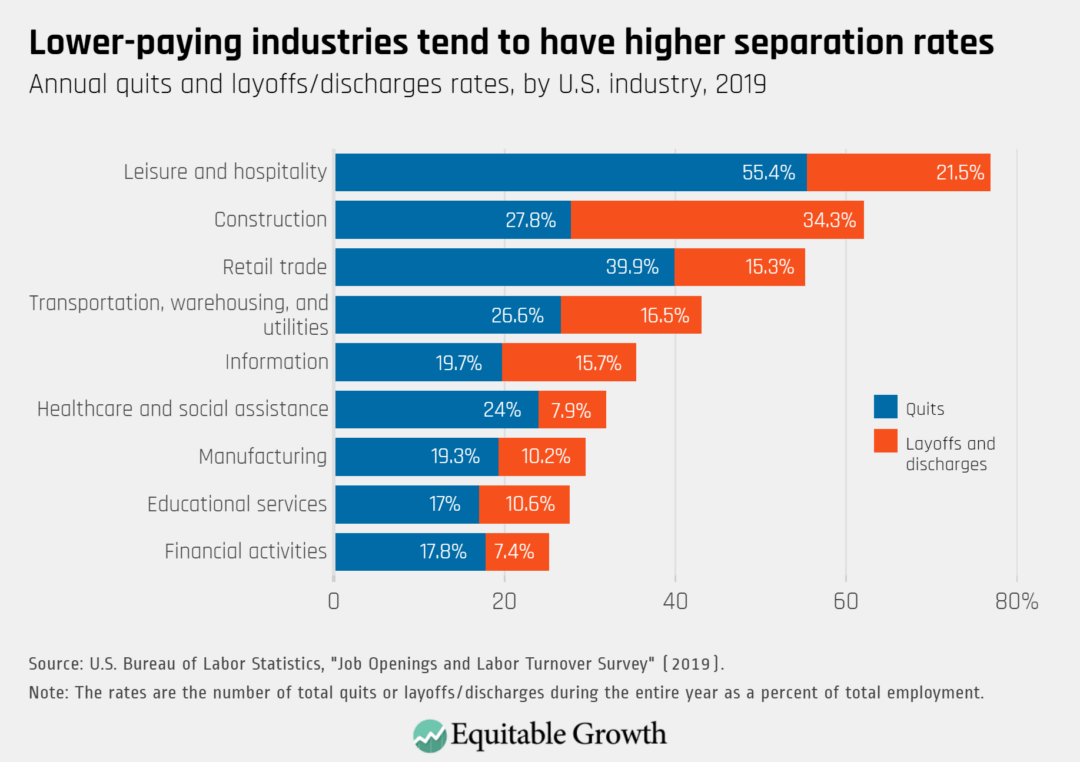
That being said, high turnover is more prevalent in some industries than others. The rates of quits and layoffs—the total number of quits and layoffs in a given period of time as a share of total employment—are highest in leisure and hospitality, construction, and retail. That workers in service industries such as retail and leisure and hospitality are particularly likely to voluntarily leave their jobs is, in no small part, a function of low pay (these two sectors have the lowest average wages among the major U.S. industries), lack of access to employer-provided benefits, and management practices that chip away at workers' sense of well-being and job security, such as unpredictable work schedules. (See Figure 1.)

Figure 1
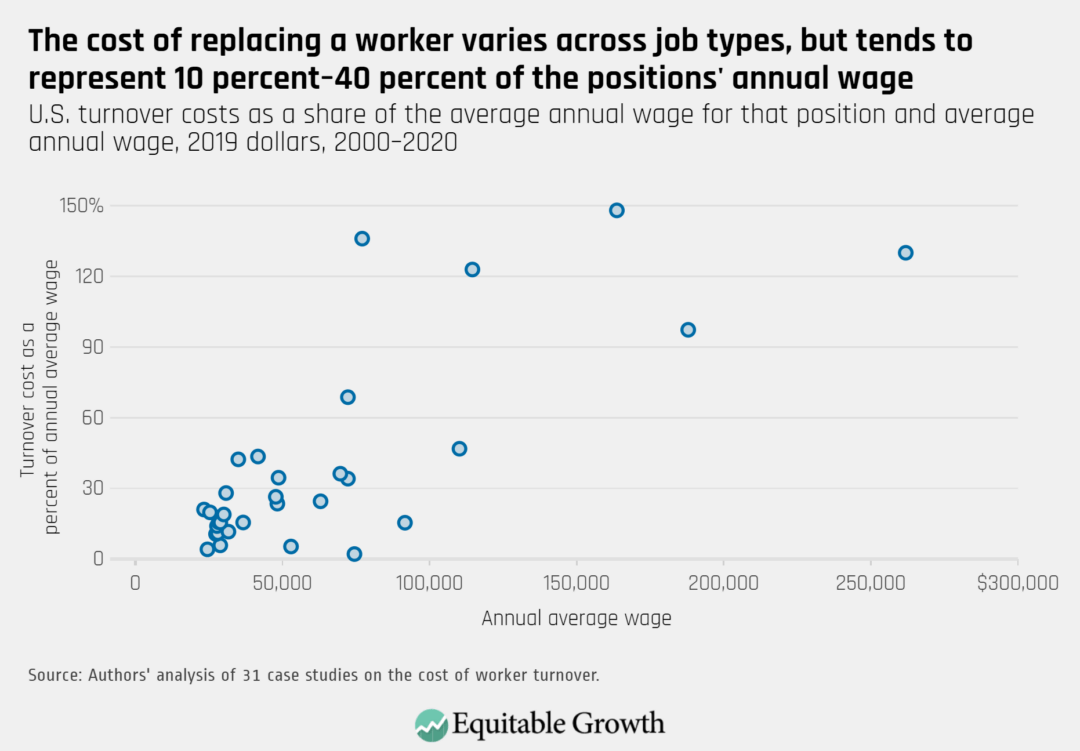
In this issue brief, we analyze 37 case studies in 14 research articles published between 2000 and 2020 (see Table 1 in the Methodological Appendix for a summary of the studies and calculations for each position). The main estimates pool 31 case studies in order to calculate turnover costs as a percent of a given position's average annual wage, and include jobs in the healthcare, education, hospitality, finance, retail, transportation, and manufacturing industries. The results are the following:

  • On average, turnover costs represent 39.6 percent of a position's annual wage. Across the 31 case studies included in our estimates, the median cost of turnover represented 23.5 percent of a worker's annual wage.
  • For workers earning less than the 2019 average annual wage ($53,490), turnover costs made up 19.3 percent of their annual wage.
  • In the two major sectors for which at least five case studies are available, turnover costs as a share of average annual wage are as follows: health services (32.7 percent) and hospitality (19.6 percent).

Emblematic of these findings are the overall costs of replacing a worker across industries up and down the U.S. wage ladder in the 21st century. (See Figure 2.)

Figure 2
Reduce employee turnover by increasing U.S. job quality

One of the most basic ways reduce turnover and increase job tenure is to improve job quality by increasing earnings. In the United States, the minimum wage is the strongest tool to do this. Like other labor policies, opponents of the minimum wage argue that it imposes too high of a cost on businesses, which will respond by reducing employment levels. Yet the breadth of high-quality research on the minimum wage demonstrates that increasing the statutory minimum wage did not reduce employment and increased worker tenure. Across low-wage work and within critical industries such as nursing homes, increasing wages has positive effects for workers and the provision of services, with minimal costs to businesses.

In an Equitable Growth working paper by Kevin Rinz and John Voorheis of the U.S. Census Bureau, the authors use administrative data to follow workers who, over time, were affected by a minimum wage increase in their local labor market. They find that workers in affected jobs experienced wage increases and did not lose employment, which ultimately leads to longer job tenure and increased earnings growth at the lower end of the income distribution. These findings are reinforced by the broad trend of estimating the impact of the minimum wage with administrative data and increasing the accuracy of findings. These estimates show that long-term earnings are increased without reducing employment levels.

The studies reviewed in this issue brief are across a wide variety of occupations, industries, and income levels, many of which would not be directly impacted by a minimum wage increase. But this does not mean statutory wage levels cannot be instituted across earnings levels to improve job quality and increase worker tenure. In Equitable Growth's Vision 2020: Evidence for a stronger economy, an essay by Arindrajit Dube of the University of Massachusetts Amherst develops a proposal for establishing wage standards by industry and occupation so that workers are able to receive earnings aligned with the value they create.

Reduce employee turnover by improving U.S. labor standards

Another metric of job quality is worker voice in their jobs, which, in the United States, is primarily achieved by unionization. In a paper on the impact of unions on job satisfaction and turnover, Trove Hammer and Ariel Avgar of Cornell University School of Industrial and Labor Relations find that unionized workers are more likely to remain in their jobs, yet this may reduce some job satisfaction. A study by Steven Abraham and Barry Friedman of the State University of New York at Oswego and Randall Thomas of Ipsos, formerly of Harris Interactive, surveys workers by union status on job satisfaction and intent to leave a job. They find that job dissatisfaction is more strongly correlated with intent to leave for nonunion members, compared to union members.

Union membership subdues the impact of other variables associated with intent to leave a job, increasing the job tenure of unionized workers. A body of research examines why unions may increase job dissatisfaction while still increasing tenure. One theory is that greater information is available to unionized workers, inducing what Richard Freeman and James Medoff called "voice-induced complaining" in their seminal text, "What Do Unions Do?". A very recent National Bureau of Economic Research working paper by David Blanchflower of Dartmouth College and Alex Bryson of University College London finds that the relationship between union membership and job satisfaction has become positive. Using data from the Gallup U.S. Daily Tracker Poll from 2009 to 2013, they find that unions had a positive effect on job satisfaction in the years following the Great Recession, as the protective effect of unions increased job security among members.

Reducing employee turnover is particularly important to public-sector work, where unions are also more prevalent and where recent attrition in the public-sector workforces is a particular cause for concern. Emma García and Elaine Weiss of the Economic Policy Institute find that there is a shortage of teachers in the Kindergarten through 12th grade education system that has increased in recent years. In a study on unionized teachers in New York state, Yujin Choi of Ewha Womans University and Il Hwan Chung of Soongsil University find a positive relationship between the strength of grievance procedures and a lower likelihood of turnover. And a report by Rich Jones of the Economic Analysis Research Network on Colorado finds that turnover in the public sector has increased in the state over the past 10 years—a phenomenon that could be offset by increasing collective bargaining, which would ultimately improve the provision of public services.

Efforts to increase the coverage of collective bargaining agreements in the United States include proposals in Harvard University's Labor and Worklife Program's "clean slate for worker power" agenda that could pave the way to increase unionization and, by association, reduce worker turnover.

In addition to increasing worker voice at their jobs through unionization, worker involvement in workplace decision-making may broadly reduce turnover. In a study with administrative data from Denmark, Elena Cottini of Università Cattolica del Sacro Cuore, Takao Kato of Colgate University, and Niels Westergård-Nielsen of Copenhagen Business School find that "high-involvement work practices," where human resources policies allow for workers to produce knowledge in a systematic way and have a say in workplace practices, reduce worker turnover.

Worker involvement in establishment decision-making can also be bolstered through policies such as co-determination, where worker representatives have a seat on corporate boards. In a recent study by Equitable Growth grantees Simon Jäger of the Massachusetts Institute of Technology and Benjamin Schoefer of the University of California, Berkeley, along with Jörg Heining of the German Institute for Employment Research, co-determination is not associated with higher wages at firms with workers on boards, but also does not negatively impact firm's bottom line.

Hostile workplaces are also more likely to experience employee turnover, particularly given currently poorly enforced labor laws such as anti-discrimination protections, which give workers little recourse other than to leave their jobs and potentially suffer long-term earnings consequences. Research on sexual harassment in the workplace finds that it increases employee turnover, which, in turn, constitutes the greatest cost of sexual harassment for companies—more than litigation costs.

Likewise, lack of representation across race and ethnicity can result in burnout from the few workers from underrepresented groups in a workplace. This dynamic is detailed in Adia Harvey-Wingfield's recent book Flatlining: Race, Work, and Health Care in the New Economy. Then, there is racial discrimination in healthcare workplaces, which is shown to increase employee turnover. Well-enforced anti-discrimination protections, where workers have recourse without fear of retaliation, and workplace inclusion would both create higher-quality jobs for workers of color and women workers.

Conclusion

Improving U.S. labor standards to protect workers from discrimination in the workplace and to boost earnings and workers' voices on the job would benefit their employers by reducing the costs of employee turnover. This issue brief documents that businesses prioritizing low labor costs over job quality are misguided because they do not take into consideration the significant costs of replacing a worker. The research reviewed in this issue brief finds that the cost of turnover is an average of 40 percent of a worker's salary. To avoid these significant costs, workplaces that provide higher-quality jobs, particularly those with decent pay and a voice at work, have lower turnover and longer employee tenure.

Policies to increase earnings through higher minimum wages and wage boards would take a first step in helping companies avoid losing workers. Expanding unionization would go a long way to increasing worker tenure as well. Workers also need to be protected from discrimination and harassment at work, so that they are not left to choose between job security and their own well-being, which often results in them choosing to leave jobs at a cost to both themselves and the company.

Improving the enforcement of U.S. anti-discrimination protections would give workers recourse within their jobs, potentially reducing turnover and limiting costs to the company at the same time. Improving job quality will increase the well-being of workers, who will then be more likely to stay at a job, thus increasing their firm-specific human capital and productivity in a virtuous cycle where workers are able to share in the gains of economic growth.


 -- via my feedly newsfeed

Tim Taylor: What Should Be Included in Income Inequality? [feedly]

An insightful, class look at diverse dimensions of rising inequality; converging on economic grounds for broad unity for incomes in the bottom 90%

What Should Be Included in Income Inequality?
Tim Taylor
https://conversableeconomist.blogspot.com/2020/12/what-should-be-included-in-income.html

Like many other concepts in economics, "income" is an idea that is only simple if you don't think about it too much. Moreover, one's measure of the inequality of income will depend to some extent on the measure of income that is chosen. 

One well-known example is whether income inequality is measured before taxes or after taxes. Another is whether income inequality is measured after including benefits of government programs, including not just cash payments like Social Security or Temporary Assistance to Needy Families or unemployment insurance, but also the value of noncash programs like Medicare, Medicaid, and food stamps. The Congressional Budget Office publishes regular reports showing income inequality adjusted in these various ways. 

As one either digs into these questions (or is slowly dragged into the swamp of these questions, depending on one's perspective), you are forced to face an overall question: In a very big-picture economic sense, what is produce in an economy in a given year as measured by gross domestic product is equal to the total income received in a year by parties throughout the economy. But when we measure inequality of "income"--even when we use a broad measure that includes taxes and the value of government transfers--it represents only a part of the economy. 

For example, if we start counting noncash government benefits as income, what about noncash benefits received by workers, like the value of employer-provided health insurance, employer-provided contributions to a pension or a retirement account, or an employer-provided life insurance plan. Economists point out that if you live in a house you own, you are--in effect--renting that house to yourself, and one could in principle count the "imputed income" you receive from yourself as part of your personal income, just like any other landlord is required to count rental income. After all, living rent-free because you own a house is a form of the capital income that you receive from home ownership. Or what about business owners who receive a benefit both from the annual salary they receive, but also from reinvesting company profits in a way that leads to a rising value of their business? 

With all of these ideas in mind, economists have been trying to develop "distributional national accounts," which try to figure out what income inequality would look like with everything included. Two leaders in this effort are Emmanuel Saez and Gabriel Zucman, and they lay out the state of play in this effort "The Rise of Income and Wealth Inequality in America: Evidence from Distributional Macroeconomic Accounts" (Journal of Economic Perspectives, Fall 2020, 34:4, pp 3-26). Saez and Zucman have been leaders in using tax data to estimate income inequality (instead of using data from household surveys), but they are now focusing more on forms of income that the tax data leaves out. They write: 

On the labor side, untaxed labor income includes tax-exempt employment benefits (contributions made by employers to pension plans and to private health insurance), employer payroll taxes, the labor income of non-filers, and unreported labor income due to tax evasion. The fraction of labor income which is taxable has declined from 80 to 85 percent in the post-World War II decades to just under 70 percent in 2018, due to the rise of employment fringe benefits—in particular the rise of employer contributions for health insurance, particularly expensive in the United States. Most studies of wage inequality ignore fringe benefits even though they are a large and growing fraction of labor costs. As for capital, only one-third of total capital income is reported on tax returns. Untaxed capital income includes undistributed corporate profits, the imputed rents of homeowners, capital income paid to pension accounts, and dividends and interest retained in trusts, estates, and fiduciaries.

Thinking about how to allocate all of these forms of income to specific individuals, and then to form an income distribution based on the results, is an enormous task. It necessarily involves a lot of judgement calls, which are discussed in some detail in the paper. But here's an example of one of their results. This figure shows the average tax rate paid by different parts of the US income distribution at different times--where "income" here is broadly defined to include everything, not just what people see on a pay stub or report on their taxes, and taxes include all taxes at the federal, state, and local level. 

Several patterns from this figure are especially striking. First, for most of the income distribution in most of these years, the tax burden looks relatively flat--that is, once you combine federal income rates (where those with high incomes pay a higher share of income) with all the other taxes and forms of income, the share of income paid in taxes rises a bit with income, but not a lot. Second, if you look at the far right-hand-side of the figure, focused on the upper 1% and smaller slices of the top 1%, the average tax rate paid looks to have declined sharply. The basic story here is that back in the 1950s,  corporate tax rates, capital gains tax rates, and the top marginal income tax rates were all higher. Now, those with very high income levels have figured out ways for that income to come in the form of capital gains, so that the tax rate is relatively low and taxes can be deferred until the capital gain is realized. 

But as I mentioned a moment ago, it takes a lot of assumptions to develop this data, and others have argued that the Saez-Zucman assumptions are in various ways biased toward showing greater inequality than in fact exists. Wojciech Kopczuk and Eric Zwick present some of the counterarguments in "Business Incomes at the Top"(Journal of Economic Perspectives, Fall 2020, pp 27-51). They focus in part on the distinction between wage inequality and business inequality. 

As a vivid example, think for a moment about some of the employer-paid benefits of being a top corporate executive some decades back in the 1960s and 1970s, like company-paid cars, country club memberships, meals and entertainment, gold-plated health insurance, bring-your-family "work" events and vacations, and personal assistants. At the highest level, there were perks like having a plane available for private use. Business owners can have the firm donate to charities, free of taxes, and then have salaried family members run those charities. And this doesn't include executive benefits which are contractual commitments made in the present but only paid in the future, like lavish retirement plans. All of these used to be counted as business expenses, not as income to the executives involved.  

These kinds of issues suggest a potential problem in comparing levels of income inequality over time, as is done in the figure above. It may be that in the past, top executives faced higher tax rates on the "income" that they reported for tax purposes, but also received much higher levels of "income" in various untaxed forms via employer-paid benefits. Now these patterns have changed. Top executives face lower tax rates than they did some decades ago on the income reported for tax purposes, but they also have fewer options for receiving such a wide array of untaxed employer-paid benefits. 

Kopzcuk and Zwick point out that there have been dramatic shifts in the administrative form in which business income is received in the economy. From the 1960s until into the mid-1980s, more than 80% of business income was typically received by C-corporations--the big companies with lots of stockholders that commonly referred to as "corporations." But since about 2000, it's been common for the C-corporations to receive about 40% of all business income, and even less in some years. Instead, a much larger share of business income is being received by "pass-through" companies, like partnerships, S-corporations and RICS and REITS, where all the profits earned must be passed through to the owners each year. These shifts in corporate ownership affect the ability to keep business income inside the company and thus delay paying income taxes on those earnings, but may also affect the other ways in which the owners of these companies can benefit personally from business expenses.   

Many other issues arise in thinking about what a full measure of income inequality would look like. There seems to be general agreement that the income inequality has risen in recent decades, pretty much however you measure it, but the specific amount will depend heavily on the measure of income used. The idea of multiple kinds of income inequality shouldn't be a shock: indeed, in some cases it's a feature rather than a bug. For example, in some cases you might want to know about the amount of inequality generated by market-paid wages, and the compare that to the inequality that remains after taxes are paid, and then compare that to the inequality that remains after transfer payments are made, and then dig into how all of these estimates are affected by the problems in measuring "income" described here. 

There also seems to be a consensus that these issues are still being worked out, and that it may take some time to work them out. For example, Saez and Zucman write:  

In time, we hope that our prototype distributional national accounts will be taken over by governments and published as part of the official toolkit of government statistics. Inequality statistics are too important to be left to academics, and producing them in a timely fashion requires resources that only government and international agencies possess. A similar evolution happened for the national accounts themselves, which were developed in the first half of the twentieth century by scholars in the United States (such as Simon Kuznets), the United Kingdom (such as James Meade and Richard Stone), France (such as Louis Dugé de Bernonville), and other countries, before being taken over by government agencies. 

It may take decades before we get there. Economic statistics, like aggregate output or concentration of income, are not physical facts like mass or temperature. Instead, they are creations that reflect social, historical, and political contexts. How the data sources are assembled, what conceptual framework is used to combine them, what indicators are given prominence: all of these choices reflect objectives that must be made explicit and broadly discussed. Before robust distributional national accounts are published by government agencies, there are still many methodological choices to be debated and agreed on by the academic and statistical community. As part of that process, our prototype can be used to characterize the rise of inequality in the United States, to confront our methods and findings with those of other studies, and to pinpoint the areas where more research is needed.

I would be remiss in not mentioning  the third paper published in this same symposium in the Fall 2020 issue of JEPFlorian Hoffmann, David S. Lee, and Thomas Lemieux discuss "Growing Income Inequality in the United States and Other Advanced Economies" (pp. 52-78). These authors look at contributions of labor and non-labor income in contributing to rising income inequality. They focus on rising labor income disparities among different income groups, and some ways in which this plays out differently for men and women. They also show rising inequality of incomes in Germany, Italy, and the United Kingdom, although not in France.   

 -- via my feedly newsfeed

Dean Baker: Quick Note on the Federal Reserve Board [feedly]

Quick Note on the Federal Reserve Board
Dean Baker
http://feedproxy.google.com/~r/beat_the_press/~3/rFZkCJLDCk8/

When Pennsylvania Senator Pat Toomey, at the last minute, insisted on adding language to the pandemic rescue package, stripping the Fed of emergency powers, I was among those screaming "No Deal."  I have not always been a huge fan of the Fed, but I felt this plan was a deliberate effort to sabotage an effective response to any financial/economic crises that may arise in a Biden administration.

Just for background, we know that the Republicans are perfectly fine with sabotaging the economy in order to hurt the political prospects of a Democrat in the White House. This is exactly what they did under President Obama, as they demanded recovery killing austerity as they feigned concern about deficits. Republican Senate Leader Mitch McConnell openly said that his job was to make Obama a one-term president.

With this recent history, there can be little doubt that Republicans in Congress will do everything they can to sabotage the economy under President Biden. In this context, it is especially important that the Fed have the ability to take the steps necessary to counteract crises that could arise.

The specific power at issue with Senator Toomey's proposal was whether the Fed could establish special lending facilities to help a market facing a crisis. This could be the situation if, for example, there is a sudden fear of widespread bankruptcies in the municipal bond market, if a major city defaults on its debt.

Without emergency powers, the only thing the Fed could do is to push down Treasury bond rates (they are already very low) and buy some short-term municipal debt. It could not engage in purchases of long-term debt and commit to support the market. Many, perhaps most, Republicans in Congress would then be celebrating as "Democrat" cities lost their ability to borrow and suddenly were unable to pay their bills.

Fed critics (I have often been one myself), have argued that we should not view the Fed as an ally of progressives. It certainly has a very mixed record, so there are plenty of grounds for suspicion. Under Paul Volcker and Alan Greenspan, the Fed repeatedly raised interest rates in an explicit effort to weaken workers' bargaining power and thereby reduce wages. This was done ostensibly to prevent inflation.

More recently, the Fed, beginning under Janet Yellen and continuing under Jerome Powell, the current chair, has acknowledged the role of monetary policy in inequality and especially racial inequality. Chair Powell has committed to keeping interest rates low until we are seeing a full employment economy that is creating serious inflationary pressures

This change in approach stems at least in part from the Fed Up Campaign, organized by the Center for Popular Democracy. (Ady Barkan was lead organizer in getting this campaign going.) This group brought labor and community organizers together to press the Fed for more pro-worker policies. (I was one of the economists who worked with Fed Up.) Chair Yellen and other members of the Fed's leadership took the effort seriously and listened to the arguments. This was a big victory.

As far as the Fed's conduct in the pandemic recession, I would mostly be supportive. They lowered interest rates as much as possible and acted to stabilize markets. This did help businesses and the stock market, but it also led to a housing boom that created hundreds of thousands of jobs. In addition, lower interest rates allowed millions of middle class homeowners refinance, putting thousands of dollars in interest savings in their pocket every year going forward. I have a hard time seeing the world being in a better place if the Fed had sat on its hands.

By contrast, I was one of few economists to criticize the bailouts in the Great Recession. The banks and financial institutions were in a crisis of their own creation, they had made hundreds of billions of dollars of bad loans due to their own greed and stupidity. Being a good capitalist, I thought it was important to let these companies enjoy the fruits of their labor. (We also would have gotten instant financial reform, as the financial sector would have been quickly downsized, eliminating an enormous source of economic waste.) 

The Fed was 100 percent complicit in covering the tracks of the industry, including pushing end of the world stories to force Congress to approve the TARP. By far the best argument for the TARP was that the commercial paper market was shutting down. This meant that even healthy non-financial companies, like Verizon and Boeing, could not get the money they needed to meet their payroll and other regular bills. This really would have been an economic catastrophe.

However, the dirty little secret here was that the Fed always had the power to sustain the commercial paper market on its own, without any assist from Congress. We found this out the weekend after the TARP passed when the Fed announced the creation of a commercial paper lending facility.

The long and short, is yes, we absolutely have to view the Fed with suspicion, but it can play a positive role, and has so far in this crisis. It would be foolish to let Republicans take away its ability to do so in a future crisis.


 -- via my feedly newsfeed

Wednesday, December 23, 2020

The Ghost of Sabotage Future [feedly]

PM: The Ghost of Sabotage Future
https://www.nytimes.com/2020/12/21/opinion/republicans-covid-stimulus.html

The not-a-stimulus deal Congress reached over the weekend — seriously, this is about disaster relief, not boosting the economy — didn't come a moment too soon. Actually, it came much too late: Crucial aid to many unemployed Americans and businesses expired months ago. But now some of that aid is back, for a while.

True, the aid will be less generous than it was in the spring and summer: $300 a week in enhanced unemployment benefits, rather than $600. But because the workers still out of a job as a result of the pandemic tended to have low earnings even before the coronavirus struck, they will, on average, be receiving something like 85 percent of their pre-Covid-19 income.

By the way, although the one-time $600 checks to a much wider group of Americans are getting much of the media coverage, they account for only a small percentage of the overall expense and are far less crucial than the unemployment benefits to keeping families afloat.

So what's not to like about this relief package? There's some dumb stuff, like a tax break for corporate meal expenses — fighting a deadly pandemic with three-martini lunches. But the serious problem with this deal is that economic aid will end far too soon: Enhanced unemployment benefits will last just 11 weeks. And the process by which the deal was reached has ominous implications for the future.


Why isn't 11 weeks of aid enough? Because we won't be able to begin a vigorous economic recovery until a large fraction of the population is vaccinated, which might not happen until the summer or even the early fall. And we're still down around 10 million jobs from pre-Covid levels; even if we can regain jobs as quickly as we did during the false dawn of May and June (when the Trump administration insisted that the pandemic was ending), it will take months more before we're anywhere close to full employment.


So while the new legislation provides a sort of bridge to the post-Covid future, it's a bridge that spans only part of the chasm ahead. And the way the bill was passed offers few reasons to be optimistic about Republican willingness to let the Biden administration finish the project.

Remember, until recently Mitch McConnell showed little interest in passing any kind of relief package. And there's no mystery about what changed his mind: It was all about the Senate runoffs in Georgia. "Kelly [Loeffler] and David [Perdue] are getting hammered" over the failure to provide aid, he told his political allies.

Once those races end on Jan. 5, McConnell's sure to lose interest all over again. And unless Democrats win both elections, he'll still be Senate majority leader, in a position to stand in the way of any further economic relief.


Beyond that, the final hurdles to reaching an agreement were a reminder of something we should have learned during the Obama years: When a Democrat is in the White House, Republicans try to sabotage the economy. And the sabotage doesn't stop with using phony deficit concerns to block necessary spending; it also involves deliberately increasing the risk of financial crisis.

Remember, G.O.P. flimflam when Barack Obama was president went beyond posing as deficit hawks to block needed fiscal stimulus. It also involved constant criticism and harassment of the Fed over its efforts to rescue the economy. And now it's happening again.

Some background: Although the pandemic recession was deep and ugly, it could easily have been even uglier. For a few weeks in March, America teetered on the edge of a financial crisis approaching the meltdown following the fall of Lehman Brothers in 2008. Fortunately, however, this incipient crisis was quickly contained by the Federal Reserve, which stabilized markets both by purchasing trillions of dollars' worth of financial assets and by making it clear that it would do even more if necessary.

That was a job well done. But the risk of financial crisis hasn't gone away, so we want to make sure that the Fed has the tools to meet future challenges.

Yet last month Steven Mnuchin, the blessedly departing Treasury secretary, gratuitously clawed back hundreds of billions of dollars in budget backing for Fed emergency lending programs, making those funds unavailable to his successor. And talks over economic relief almost fell apart over a last-minute demand by Senator Pat Toomey, backed by the Republican leadership, that the legislation bar the Fed from restarting some of these programs or anything like them.

In the end, this poison pill appears to have been rendered mostly harmless, with face-saving language that prevents exact copycat programs but seems to leave room for slightly different programs that would achieve the same results.

But the episode was a preview of things to come. If another crisis develops, expect Republicans to do all they can to prevent an effective response.

So how should we feel about this relief deal? The glass is half full: For millions of American families, the next few months will be less hellish than they would have been otherwise. The glass is half empty: Unless Democrats win those Georgia seats, expect an ugly spring and years of economic sabotage ahead.

The Times is committed to publishing a diversity of letters to the editor. We'd like to hear what you think about this or any of our articles. Here are some tips. And here's our email: letters@nytimes.com.

Follow The New York Times Opinion section on Facebook, Twitter (@NYTopinion) and Instagram.

Paul Krugman has been an Opinion columnist since 2000 and is also a Distinguished Professor at the City University of New York Graduate Center. He won the 2008 Nobel Memorial Prize in Economic Sciences for his work on international trade and economic geography. @PaulKrugman


 -- via my feedly newsfeed

Friday, December 18, 2020

Trumpism and crony capitalism [feedly]

Trumpism and crony capitalism
https://crookedtimber.org/2020/12/11/trumpism-and-crony-capitalism/

 -- via my feedly newsfeed

Some Thoughts on US Wealth Patterns [feedly]

As usual with Tim 'Taylor, the view beneath the lead in US inequality (ratio of wealth/GDP for 1% vs below) -- gets complicated over time.

Some Thoughts on US Wealth Patterns
https://conversableeconomist.blogspot.com/2020/12/some-thoughts-on-us-wealth-patterns.html

 -- via my feedly newsfeed

The Coase Theorem: A Process of Becoming [feedly]


A fascinating dive from Tim Taylor into the ways and means a managed market-mixed economy can handle the COSTS of EXTERNALITIES [not just weather, but costs, like pollution, not included in the transaction price of the commodities produced that are imposed on society at large, or even someone else's property rights.]
Even, indeed especially, socialist and social democratic-led societies must find efficient ways to minimize waste in managing such costs.

$$$$$$$$$$$$$$$$$$$$$$$$$$$$$$$$$

The Coase Theorem: A Process of Becoming
https://conversableeconomist.blogspot.com/2020/12/the-coase-theorem-process-of-becoming.html

Steven Medema know more about the history of the Coase theorem than many of us know about our spouses. So whether you are distantly or intimately familiar with the idea, you are likely to pick up some insights in his article, "The Coase Theorem at Sixty" (Journal of Economic Literature, 2020, 58:4, pp. 1045-1128, subscription required).

In the 1960 article by Ronald Coase, "The Problem of Social Cost," the Coase "theorem" was not actually a theorem, nor does it seem to be the main point of the entirely verbal essay.  Coase was working on various questions of regulatory economics, which might be summarized as the question of the appropriate government reaction in situations where market don't perform well. For example, it had been recognized since the 1920s and the work of A.C. Pigou that some economics activities might involve "externalities," where social costs were imposed on others who were not part of the market transaction. Pollution is an obvious example. The common policy prescription was that the government should estimate the value of this additional social cost, and then impose a "Pigovian tax" so that the firm producing the externality would face the actual social cost of its action--in effect, it would no longer be able to dump its pollution garbage into the environment for free. 

Coase approached the problem of social cost from a different angle. Medema writes: 

The article makes three basic points. First, externalities are reciprocal in nature. Yes, A's actions impose costs on B, but to restrain A in favor of B imposes costs on A. The economic problem, Coase emphasized, is to avoid the more serious harm. ... Second, if the pricing system works costlessly and rights are assigned over the relevant resources, agents will negotiate a solution that maximizes the value of output, and this outcome will be reached irrespective of to which party those rights are assigned—the idea that came to be known as the Coase theorem. ... In the frictionless world of welfare economics circa 1960, the negotiation result shows that Pigouvian remedies are completely unnecessary for an efficient resolution of externality problems. Third, in the real world of positive transaction costs, all coordination mechanisms—markets, firms, and government—are costly and imperfect, meaning that there is no route to the optimum. The best that we can do is to choose among imperfect alternatives ...  Comparative institutional analysis, then, becomes the method of choice, and the goal, from an economic perspective, is to select the coordination mechanism that maximizes the value of output for the problem under consideration.
Here's how I tried to convey the Coase "theorem" insight in an article I wrote last summer about "Are Property Rights a Solution to Pollution? (PERC Reports, Summer 2020). In my words: 
In one famous example, Coase discussed the hypothetical situation of a railroad running beside a farmer's field. Sparks from the train would sometimes start fires in the crops. How should this external cost—a kind of pollution "externality"—be addressed? 
For non-economists, an obvious answer is for the government to pass a law. For example, the government might require that the railroad company install spark arrestors on the smokestacks of its locomotives, use a different blend of fuel or a new engine, leave a buffer zone beside the field, or relocate the rails altogether. Alternatively, the government might declare that the farmer should build a fence to protect the field, install a sprinkler system, change crops, leave a buffer zone, or perhaps even relocate the farm. 

Rather than viewing anti-pollution efforts in terms of how governments should choose which rule to impose, Coase took an altogether different approach. He pointed out that the problem could be rephrased in terms of property rights—in other words, who has what rights? For example, the government could say that the railroad company had a right to emit sparks, in which case the farmer would have to figure out the most cost-effective way of protecting the fields. Alternatively, the government could say that the farmer had a property right not to have sparks land among his crops, in which case the railroad would have to figure out an answer—which might include installing spark arrestors or other technology to prevent fires from occurring, or even just paying the farmer to put up with the annoyance.

In Coase's approach, the question of how to respond to problems of pollution such as unwelcome railroad sparks did not need to be delegated to a government vote or board of experts. Nor did the problem of pollution, in Coase's view, need to be solved by regulators imposing a Pigouvian tax to account for the "externality" imposed. After all, governments or any outside groups will inevitably possess much less detailed and hands-on information about the range of possible options—and how those options might be tweaked or combined—than railroads and farmers. Moreover, any choice of specific government regulations will be affected by politics and lobbying. Instead, Coase argued that once property rights were clearly defined, then one party or the other would have an incentive to seek out the most cost-effective way of reducing this form of "pollution."

Coase's work often pushed back against a common assumption (common both then and now), that direct government actions and mandates are the appropriate answers to problems with markets. He emphasized that governments often lacked both detailed knowledge of how to resolve issues with markets, and also that government acting under political pressure might lack the incentive to resolve such problems appropriately. Instead, the role of government could be to set up a system in which the economic actors themselves would use their detailed private information to reach a better decision.  

In other classic examples, Coase argued in the 1950s that when it came to allocating spectrum rights, it was better for the government to auction those rights rather than to allocate them by an administrative decision-making process. Such auctions would cause private actors to reveal their true preferences, rather than just deploy their lobbyists. In another paper, Coase argued that although economists often invoke lighthouses as an example of where markets can't work well, as a historical fact many lighthouses were built by the private sector once the government gave them the right to collect tolls.   

It's perhaps useful to note that Coase is certainly not claiming that real-world markets are perfect, and that private negotiations will resolve any issues. His prescriptions often involve the active intervention of government: for example, in setting the rules over whether railroads or farmers are responsible for dealing with sparks, or setting up auctions for spectrum rights, or giving lighthouse builders a right to charge tolls. Coase is arguing against "blackboard economics," as he later called it, where market problems and government solutions are sketched out in a classroom like a solved problem. Instead, Coase favored of a comparative institutional economics, where the specific details of situations take on a central role and thus it becomes important to think about details of information and incentives is possessed by the actual parties involved. 

Coase did not refer to his result as a theorem: instead, this label was bestowed by George Stigler a few years later. Medema writes: "[T]he Coase theorem is neither prediction nor testable hypothesis nor descriptor nor policy prescription. It is, and can be nothing more than, a benchmark—a generator of predictive, testable, descriptive, and policy insights."

Medema describes in detail the unfolding of the Coase result over time, as the issues of potential problems, involved parties, information, and incentives have been explored in many contexts--including contexts outside of economics. Here, I'll close with Medema's overall summary of this process. 

The Coase theorem is, by any number of measures, one of the most curious results in the history of economic ideas. Its development has been shrouded in misremembrances, political controversies, and all manner of personal and communal confusions and serves as an exemplar of the messy process by which new ideas become scientific knowledge. There is no unique statement of the Coase theorem; there are literally dozens of different statements of it, many of which are inconsistent with others and appear to mark significant departures from what Coase had argued in 1960. ...

The theorem has never been given a generally accepted formal proof; yet it has been the subject of scores of attempts  to "disprove" it in a stream of analysis and debate that continues to this day. It has been labeled a "tautology" and the "Say's law of welfare economics" (Calabresi 1968, pp. 68, 73), an "illuminating falsehood" (Cooter 1982, p. 28), and even a "religious precept" (Posin 1993, p. 810). Halpin (2007, p. 339) calls the theorem "theoretically degenerate … and ideologically charged." Usher (1998, p. 3) bundles these various charges together, claiming that the theorem is "tautological, incoherent, or wrong," with the specific verdict resting upon to which version of the theorem one subscribes.  ... 

The nature of the theorem's underlying assumptions is often said to make its domain of direct applicability nil; yet, it has been invoked, criticized, and applied to legal-economic policy issues in thousands of journal articles and books in economics and law ... as well as in journals spanning fields from philosophy (Hale 2008) to literature (Minda 2001) to biology (Frech 1973a). Indeed, the Coase theorem may be the only economic concept the use of which is more extensive outside of economics than within it.


 -- via my feedly newsfeed

West Virginia GDP -- a Streamlit Version

  A survey of West Virginia GDP by industrial sectors for 2022, with commentary This is content on the main page.