Wednesday, January 29, 2020

The Coronavirus: State Capacity and Crisis Response in China [feedly]

The Coronavirus: State Capacity and Crisis Response in China
https://www.globalpolicyjournal.com/blog/29/01/2020/coronavirus-state-capacity-and-crisis-response-china

Mega-quarantines, large hospitals built within a week, and sharing information with the global scientific community! The outbreak of the coronavirus (nCov2019) in China that has infected thousands of people and killed over 100, provides an illustrative example of the challenges facing the powerful Chinese state as it strives to contain the epidemic within its borders while limiting the effects of "stagflation" and further damage to its reputation abroad.

Crisis response

Over the past few weeks, China has been widely praised for the unprecedented accomplishment of its scientists in identifying the coronavirus in record-time (one week!) and sharing its DNA sequence with the rest of the world. Indeed, the country has not only developed a diagnostic test but also provided considerable clinical information about the disease, thus allowing it to demonstrate its growing scientific prowess. The strength and power of the Chinese state has been in full display on the world stage. While China has impressed large parts of the world in recent decades with its impressive ability to undertake major infrastructure projects, the current crisis has provided ample evidence of its extraordinary logistical capacity to undertake major projects within its own territory. Social media sites have been inundated with video clips that provide daily updates of round-the-clock activity in constructing a large (1000-bed) makeshift hospital in Wuhan within a week. And a second new hospital is also expected to be ready soon.

Similarly, images of deserted streets, effective roadblocks and the widespread deployment of the police and military personnel illustrate high state capacity to enforce the largest quarantine in history. The city of Wuhan, with its 11 million inhabitants, is in complete lockdown mode while restrictions have been imposed on neighboring cities in the region. State media reports show that food is abundantly available in grocery stores and that social order is being maintained. From a state capacity perspective, this is impressive by all accounts. Which other country in the world could mount such an extraordinary response? There is already a growing amount of concern on the ability of China's neighbors such as India, to respond to a crisis of such magnitude not to mention many countries in Sub-Saharan Africa with poorly funded health systems, inadequate infrastructure and weak state capacity.

China's response to the epidemic is not only a reaction to a mounting health crisis, but also a projection of the strength of its regime and its preferred approaches to development and governance. The censorship of public debate and social media, for instance, can be viewed in some quarters as an effective tool for limiting the spread of rumors and prevent widespread panic.

Crisis declaration

Unlike the SARS epidemic in 2003 – when China was widely criticized for withholding early warning information and thereby delaying efforts to mount an effective response at a crucial early stage – the current crisis, by most available accounts, has been handled much better by the central authorities. There is, however, growing evidence to indicate that the local authorities in Wuhan could have reacted much earlier. By delaying the declaration of a "crisis", and perhaps by withholding information from Beijing on the sheer scale of the growing epidemic, there has been growing criticism of the delay caused by local political and administrative inaction in Wuhan city and Hubei province.

There are already a growing number of news reports and analyses that highlight the siloed and hierarchical political structure in China that appear ill-suited to deal with emerging crises. Local officials may risk jeopardizing their careers if they make higher-ups aware of unpleasant news and complex problems that have not already been dealt with effectively. There is growing evidence to indicate that the strategy adopted by the authorities in Wuhan was to initially tone down the seriousness of the problem, thereby allowing the crisis to escalate beyond control.

But even when such information is available, central authorities may not find it convenient to declare a national emergency. Based on our previous work on famines, we find that by declaring a crisis, leaders risk attracting criticism from domestic and international actors. A crisis is also often understood by leaders to be tantamount to admitting to an administrative failure on their part. All of this negatively impacts the image of the country and may undermine the legitimacy of the government. However, the use of the term "crisis" may also have its benefits. One can give the impression that things happen without a reason, i.e. no one can be blamed and no specific decision can be traced back to have started the numerous components of a "process" that leads up to the crisis "event".

The Chinese response viewed through the global health security prism

China has been a prominent beneficiary and advocate of globalization. The mindboggling ambition of the Belt and Road Initiative (BRI) – launched in 2013 and estimated to cost over $5 trillion – has been variously interpreted by countries and organizations as visionary leadership for global development based on international solidarity, Communist party propaganda, quest for world recognition of China's might, attempt to boost world trade and a platform for win-win global cooperation. The growth of BRI activities has facilitated the increased circulation of goods and people by connecting China with the rest of the world. This in turn has increased the risk of the international spread of the nCov2019 epidemic, particularly in Sub-Saharan Africa which hosts millions of Chinese workers building much-needed infrastructure projects, but where most health systems are ill-equipped to handle a major epidemic.

The global system that fosters cooperation against dangerous epidemics – spearheaded by the World Health Organization (WHO) – aims to rapidly identify and stop the 'bad' circulation of viruses and pathogens. In other words, the system is geared towards reaping the benefits of globalization while making circulation flows safer. The coronavirus epidemic, however, exposes the shortcomings between the ideals of a well-functioning global cooperation mechanism and China's capacity to comply with such a system. Indeed, unlike global mechanisms that emphasizes early detection of, and response to, emerging health threats, the current Chinese model appears better suited to responding to outbreaks that have already turned into a crisis rather than threats that are emerging. Moreover, the WHO's response has been hindered in the absence of independent and non-official sources of information in China – an important bottom-up dimension that the global disease surveillance system relies on. Another factor that is complicating the coronavirus response is China's opposition to Taiwan's membership of the WHO.

Although there are good reasons to be impressed by the Chinese response thus far, there is a risk that the authorities, under colossal domestic and international pressure, may be tempted to politicize their response in order to project strength and safeguard China's reputation – a politicization that may occur at the expense of the efficiency and fairness of the response. While social distancing measures – including the cancellation of festivities and inter-regional transportation measures in connection with the Lunar New Year – have been praised by public health experts, other extraordinary measures such as mega-quarantines are criticized. For example, some argue that not only do quarantines have an uncertain impact for disease containment, they also often tend to negatively impact the most vulnerable social groups in the quarantined zones (e.g. migrants).


Antoine de Bengy Puyvallée is PhD fellow at the University of Oslo's Centre for Development and the Environment, exploring the role of non-state actors during health crises.

Dan Banik, PhD, is Professor of political science at the University of Oslo's Centre for Development and the Environment and is Director of the Oslo SDG initiative.

Image: 葉 正道 Ben(busy via Flickr (CC0 1.0)

FacebookTwitterShare
 -- via my feedly newsfeed

Wisconsin Imposing Nation’s Harshest Medicaid Premiums on People in Poverty [feedly]

Wisconsin Imposing Nation's Harshest Medicaid Premiums on People in Poverty
https://www.cbpp.org/blog/wisconsin-imposing-nations-harshest-medicaid-premiums-on-people-in-poverty

In a move that will likely have deeply harmful effects, Wisconsin next week will become the first state to implement a policy to take Medicaid away from people in poverty who don't pay premiums — and the latest to impose harmful barriers on health coverage for those in or near poverty.

Federal law requires that a state waiver of Medicaid law, like the one Wisconsin obtained, "promote the objectives of the Medicaid program." But evidence shows that Wisconsin's policy will almost certainly do the opposite by taking coverage away from eligible low-income individuals and sowing confusing among beneficiaries and providers. Wisconsin should follow the lead of other states that are reconsidering harmful Medicaid changes and repeal the state law requiring the policy along with other harmful restrictions.

Under the Wisconsin policy, individuals who aren't taking care of children and have incomes above 50 percent of the poverty line (about $500 per month) — and who don't pay $8 monthly premiums — will lose Medicaid and can't re-enroll for six months unless they pay all past-due premiums. Beneficiaries will also owe $8 copayments for non-emergency use of the emergency room, which will likely lead some low-income people to avoid the hospital even in an emergency. We estimate that about half of adult Medicaid enrollees without dependents, or about 80,000 people, will face the new premium and cost-sharing requirements.

Even relatively small dollar requirements can create insurmountable barriers for people with incomes that often don't cover basic needs like food and housing. Moreover, beneficiaries and providers often don't fully understand policies like premiums and cost sharing, and that confusion can cause a loss of coverage or inability to access care.

That's why studies consistently find that premiums and cost sharing significantly reduce Medicaid participation. "Premiums serve as a barrier to obtaining and maintaining Medicaid and [Children's Health Insurance Program] coverage among low-income individuals," concluded a Kaiser Family Foundation review of 65 papers on the effects of premiums and cost sharing. "Even relatively small levels of cost sharing in the range of $1 to $5 are associated with reduced use of care, including necessary services."

Evidence from Wisconsin supports these findings. After the state imposed premiums on adults with family incomes between 150 percent and 200 percent of poverty in 2008, adults with incomes just above 150 percent of poverty were 12 percentage points less likely to stay enrolled for a full year than those with incomes just below 150 percent of poverty, research found. Wisconsin's new premiums apply to adults with far lower incomes, so they'll likely prove even more harmful.

While premiums' damaging effects are well documented, they have no demonstrated benefits. Wisconsin's Medicaid waiver proposal claims that "establishing premiums will encourage [beneficiaries] to place increased value on their health care and utilize it more effectively" but offers no evidence. Indeed, there's no evidence that premiums improve beneficiaries' health behaviors.

Premiums and cost sharing also can be complex to administer, with implementation costs that can exceed the revenue they collect from beneficiaries. For example, in the 18 months after Arkansas began requiring beneficiaries to make monthly contributions to "independence accounts," the state paid over $9 million in contracts to manage the accounts but beneficiaries contributed only about $426,000.

While Wisconsin's affected enrollees must pay premiums beginning this month, the state won't end their Medicaid coverage until the next time they must renew it, so the coverage losses won't begin until 2021. In the meantime, Wisconsin and independent groups should carefully monitor how many beneficiaries don't pay monthly premiums and thus risk losing coverage at renewal. And even those data may understate the impact of the policy, which will likely cause significant confusion that could deter eligible people from signing up for Medicaid in the first place.


 -- via my feedly newsfeed

Monday, January 27, 2020

G.M. Making Detroit Plant a Hub of Electric and A.V. Efforts [feedly]

G.M. Making Detroit Plant a Hub of Electric and A.V. Efforts
https://www.nytimes.com/2020/01/27/business/gm-detroit-electric.html

General Motors said Monday that it was investing $2.2 billion in a Detroit plant where it will produce all-electric trucks and sport utility vehicles, fulfilling a key promise made during last year's union negotiations.

The investment will fund upgrades like new machines and tools at the Detroit-Hamtramck assembly plant's paint shop, body shop and general assembly area. The plant had been scheduled to close this month, but was spared in the October deal that ended the longest G.M. strike in half a century.

As part of that agreement, G.M. vowed to commit $3 billion to the plant's overhaul. The company says that promise is met by the investment in upgrades and an additional $800 million for supplier tooling and related projects.

Once in full operation, the plant will employ more than 2,200 people, the company said. Production is scheduled to begin in late 2021 on an all-electric pickup truck, followed by the Cruise Origin, a six-passenger vehicle that was unveiled last week and is intended for use as a self-driving taxi.

ADVERTISEMENT

Continue reading the main story

Legacy automakers are in a race with one another and a slew of start-ups and technology companies to capture growing demand for electric vehicles while also preparing for the advent of autonomous vehicles. G.M.'s Cruise Origin, for example, faces competition from Uber and Waymo, which is a subsidiary of Google's parent company, Alphabet.

At the same time, that fight over an electric future has helped to reinvigorate the American automotive industry.

In 2018, Ford Motor announced that it had bought Michigan Central Station in Detroit, and would convert the abandoned office tower and train station — a symbol of the city's decline — into an urban campus focused on developing businesses that use self-driving cars.

Last year, Fiat Chrysler said it planned to spend $4.5 billion to update several Detroit plants, an investment that it said would create 6,500 jobs and allow the company to start making electric versions of its Jeep models if customer demand increased.

As part of an existing joint venture, G.M. and South Korea's LG Chem have invested $2.3 billion in a separate plant near Lordstown, Ohio, which will make the battery cells that will power the electric vehicles made at the Detroit-Hamtramck plant, the company said. Executives have said that the venture, in the same area where G.M. shut down a plant last year, would create more than 1,100 jobs, with a groundbreaking expected later this year.

Editors' Picks

The Sex Scene Evolves for the #MeToo Era

How Tiffany Moved 114,000 Gems Without Getting Robbed

Brains Turned to Glass? Suffocated in Boathouses? Vesuvius Victims Get New Look

Continue reading the main story

ADVERTISEMENT

Continue reading the main story

In a statement, a G.M. spokesman said the investments announced on Monday were made possible by a state tax credit from the Michigan Economic Growth Authority.

"Over the past decade, the Michigan MEGA has helped enable G.M. to invest more than $10 billion in its Michigan facilities," the spokesman, Dan Flores, said.

Last week, the Michigan Strategic Fund, an economic development organization, approved changes to that tax credit, which it said had a remaining value of $2.27 billion. The revisions require G.M. to invest at least $3.5 billion in the state over the next decade, including at the Detroit-Hamtramck plant.

G.M. has built more than four million vehicles at Detroit-Hamtramck since it opened in 1985, the company said. The Cadillac CT6 and the Chevrolet Impala are produced at the factory, which will be idled at the end of February for several months for renovations.


 -- via my feedly newsfeed

The Inflation Puzzle: Why Has it Move So Little for 25 Years? [feedly]

Essence of the puzzle, via Sherlock Holmes:

Inspector Gregory asks Holmes, "Is there any point to which you would wish to draw my attention?"
"To the curious incident of the dog in the night-time."
"The dog did nothing in the night-time."
"That was the curious incident," remarked Sherlock Holmes.


The Inflation Puzzle: Why Has it Move So Little for 25 Years?
http://conversableeconomist.blogspot.com/2020/01/the-inflation-puzzle-why-has-it-move-so.html

 -- via my feedly newsfeed

Saturday, January 25, 2020

The Trump administration’s new housing rules will worsen segregation [feedly]

The Trump administration's new housing rules will worsen segregation
https://www.epi.org/blog/the-trump-administrations-new-housing-rules-will-worsen-segregation/

In "The Neighborhoods We Will Not Share," an article published online at The New York Times, I describe how the Trump administration has proposed a rule that will make it virtually impossible to challenge many policies that reinforce residential racial segregation.

This is no small matter. Segregation underlies many of our most serious social problems. Educators can't seem to make significant progress in their efforts to close the racial gap in academic achievement that persists in large part because we enroll the most socially and economically disadvantaged children in poorly resourced schools, located in poorly resourced neighborhoods. Health disparities by race stem, in part, from so many African Americans consigned to areas where they have less access to healthy air and healthy foods, and are more subject to stressful conditions. Black men's high and unjustifiable rates of incarceration depend significantly on their concentration in segregated neighborhoods without good employment opportunities in the formal economy or the transportation to access good jobs. And segregation prevents us from overcoming our very dangerous and frightening political polarization, highly correlated with race. How can we ever develop the common national identity essential to the preservation of our democracy if so many African Americans and whites live so far from each other that we have no ability to understand and empathize with each other's life experiences?

In my book The Color of Law, I described how 20th century federal, state, and local policies—explicitly racial—created, reinforced, and sustained racial boundaries in every metropolitan area in the United States. These unconstitutional government activities still predict today's segregated landscape. For example, the explicit exclusion of black working class families from single-family homes, for which white working class family purchases were subsidized, bears substantial responsibility for the black-white wealth gap—while black family incomes are about about 60% of white family incomes, the median black household wealth is less than 10%of white household wealth, an enormous disparity that was propelled by the equity appreciation of white property while African Americans were consigned to neighborhoods where no similar appreciation occurred. The wealth gap predicts much of our contemporary racial inequality.

The Fair Housing Act of 1968 prohibited ongoing racial discrimination in housing but did little to explicitly prohibit policies that reinforce segregation where the racial intent is either masked, unconscious, or even absent. But federal courts, up to the Supreme Court have found that residential policies with a "disparate impact" on African Americans (and other protected groups) violate the Fair Housing Act if there is a reasonable nondiscriminatory alternative to accomplish a legitimate public purpose.

It is this court-sanctioned policy that the administration is now proposing to undermine. The rule has been through a required public comment period, and when finally released will effectively reduce the Fair Housing Act to legislation that only prohibits racial discrimination where policy proponents openly admit that bigotry is their intent.

The process of creating this rule has largely escaped public notice because it accomplishes its purpose in highly technical ways, not easily explained. For example, it changes the order in which complainants or defendants are required to submit different kinds of evidence in a Fair Housing Act proceeding at the Department of Housing and Urban Development. It will not be obvious to anyone but an experienced lawyer why such a change is fatal to the Fair Housing Act's purpose.

In the article I published on Monday, I attempt to explain why this matters by describing two situations in which it should be obvious to everyone that a Fair Housing Act violation occurred, but where this would be virtually impossible to prove under the new rule. One of these involves homeowners in Syracuse's low-income and predominantly African American neighborhoods who have been paying property taxes at an effectively higher rate than residents of wealthier and predominantly white neighborhoods. The other concerns policies enacted by a predominantly white New Orleans suburb, St. Bernard Parish, to prevent black families from returning to the community after Hurricane Katrina.

Recently, the Trump administration has announced two additional rule revisions that further entrench segregation. One effectively relieves suburban communities of an affirmative obligation to remove policies and practices that create or perpetuate segregation. The other relieves retail banks that take deposits from residents of low-income neighborhoods of an obligation to extend mortgage and other credit to residents of those neighborhoods.

The Trump administration's hostility to justice for racial minorities continues unabated.

Suggested further reading:

Poor black children are much more likely to attend high-poverty schools than poor white children
Toxic stress and children's outcomes
Mass incarceration and children's outcomes
The Color of Law
Historical Income Tables: Households
The racial wealth gap
FR-6111-P-02 HUD's Implementation of the Fair Housing Act's Disparate Impact Standard
DEPARTMENT OF HOUSING AND URBAN DEVELOPMENT, Proposed Rule


 -- via my feedly newsfeed

Everybody's Talkin' 'Bout Taxes--especially Wealth Taxes and Mark-to-Market of Capital Gains [feedly]

Linda Beale takes you on a deep dive into the issues in making Sen. Warren's wealth tax work, as well as how the complexities can drive you back into defense position, given the aggressiveness of Trump assaults.

Everybody's Talkin' 'Bout Taxes--especially Wealth Taxes and Mark-to-Market of Capital Gains
https://ataxingmatter.blogs.com/tax/2020/01/everybodys-talkin-bout-taxes.html

Not surprisingly for those of you who are members of the ABA Tax Section, there is a meeting of that group next week in Florida when a thousand tax lawyers (give or take a few) will be talking about everything from basis to wealth taxes; GILTI, BEAT, Dual BEIT, to EITC.  Yours truly will be on a panel of the Tax Policy and Simplification Committee, meeting Friday morning, to discuss how the tax system should respond to the wealth gap.  Joining me on the dais will be Roger Royse (moderator and panelist), Rich Prisinzano from the Penn Wharton Budget Model, and Dan Shaviro, Wayne Perry Professor of Taxation at NYU and a blogger at Start Making Sense.  We'll talk about the income and wealth gap data, including the different perspectives of  Saez & Zucman, serving as wealth tax advisers to Senator and Democratic presidential candidate hopeful Elizabeth Warren; Penn Wharton Budget Model, applying a more standard budget model to determine harms and benefits of the Warren Wealth Tax; and Cato INstitute.  We'll also discuss Sen. Ron Wyden's proposal for a mark-to-market system of capital gains taxation (including a lookback charge of some kind for hard-to-value assets, Prof. (and former Cleary partner) Edward Kleinbard's Dual Business Enterprise Income Tax proposal, and other means of making the regular tax system more progressive such as rates, removing the capital gains preference, and reinvigorating the estate tax that has been the object of a GOP murder squad for the last 20-30 years at least.

Meanwhile, today in Florida there was a Tax Policy Lecture at  the University of Florida on Taxing Wealth, with Alan Viard, resident scholar at the American Enterprise Institute, David Kamin, Professor at NYU School of Law, Janet Holtzblatt, Senior Fellow at the Tax Policy Center, and William Gale, Arjay and Frances Fearing Miller Chair in Federal Economic Policy7 at the Brookings Institution. 

Last fall, the Tax Policy Center held a program on Taxing Wealth (webcast recording available at this link) with Mark Mazur, Ian Simmons, Janet Holtzblatt, Beth Kaufman, Greg Leiserson, Victoria Perry, and Alan Viard.  Sony Kassam from Bloomberg Tax served as moderator.  The link has a series of power point presentations from that meeting as well, for your edification.

Ian Simmons, for example, includes the letter from billionairesdated June 24, 2019, asking that "[t]he next dollar of new tax revenue should come from the most financially fortunate, not from middle-income and lower-income Americans."  Such a tax "enjoys the support of a majority of Americans--Republicans, Independents, and Democrats."  It's not a new idea, since all those millions of middle-income Americans who own their home "already pay a wealth tax each year in the form of property taxes on their primary form of wealth--their home."   The billionaires are asking "to pay a small wealth tax on the primary source of our wealth as well"--such as Elizabeth Warren's proposal, which would tax "only 75,000 of the wealthiest families in the country" (those with assets over $50 million) and would generate an estimated $3 trillion over ten years to "fund smart investments in our future, like clean energy innovation to mitigate climate change, universal child care, student loan debt relief, infrastructure modernization, tax credits for low-income families, public health solutions, and other vital needs."  All this is necessary because of the wealth gap: "[t]he top 1/10 of 1% of households now have almost as much wealth as all Americans in the bottom 90%." The signatories support a wealth tax because:

  • it's a powerful tool for solving our climate crisis
  • it's an economic winner for America through increased public investments
  • it will make Americans healthier, addressing the difference in longevity (15 years) between the richest and the poorest Americans
  • It's fair -- "[t]axing extraordinary wealth should be a greater priority than taxing hard work."
  • It strengthens American freedom and democracy, since high levels of economic inequality lead to political power and pluotocracy and higher levels of distrust in democratic institutions
  • It is patriotic -- 'The richest 1/10 of the richest 1% should be proud to pay a bit more of our fortune forward to America's future."

Janet Holtzblatt discussed whether wealth should be taxed, with a set of powerful powerpoint charts.  As she notes, there are a number of reasons to think taxing the wealthy is a good idea because it (slide 4) :

  • curbs the accumulation of power that comes with the accumulation of wealth--and, I will add, this is power to get laws and regulations written in your favor, including tax laws, as well as power that allows pollution, rent-seeking, on-demand schedules for workers and other 'evils' that come with plutocracy
  • ensures that the wealth pay their fair share of taxes
  • finances new initiatives (child care, student debt relieve, climate change policies, housing initiatives)
  • provides better data for research on wealth inequality

Those not supportive (or, as JH puts it, "less optimistic") suggest that (slides 5, 7)

  • even with a wealth tax, the rich remain the richest and the most powerful
  • incremental changes to current tax system would be more easily implemented
  • wealth taxes would have a negative impact on savings, investment, entrepreneurship
  • wealth taxes won't raise as much revenue as claimed
  • OECD countries with wealth taxes haven't been all that successful (in 1990 12 had them, in 2018 only 3 still retained wealth taxes: Norway, Switzerland, and Spain)

There are lots of issues with wealth taxes: (slides 8-20)

  • on what assets
  • at what rate (tax burden will depend partly on rate of returns on investments
  • using what exemption threshold (liquidity constraints at lower thresholds; taxing  middle income instead of wealthy)
  • using what means to prevent tax avoidance (dependents' wealth with parents? include assets in family-run foundations? restrictive limits for trusts? exit taxes?)
  • and tax evasion (enhance IRS enforcement, enhance penalties, enhance IRS access to third party data--but the wealthy have resources to battle IRS claims)
  • assuming what actual amounts of tax revenues could be raised ("street fights over revenue estimates...among top public finance economists") (Slide 15)
    • how much wealth is there?  JH notes several 2016 estimates between 86.9 trillion and 101.2 trillion (slides 16-17) {Zucman  says just under $115 trillion]
      • Fed Reserve Survey of Consumer Finance ( 3 year intervals; leaves out Forbes 400 and some pension wealth)
      • estate tax data (adjusted for mortality probabilities and population)
      • income tax data (capitalized using assumed rates of returns)
    • how is that wealth distributed between the top 0.1% and the rest?  Bricker 2016 study estimates range from about 15% to 22%  (Slide 18)
    • how much wealth is hidden by "tax net misreporting rates"?  IRS 2016 misreporting: farms 71%; nonfarm proprietors 64%; CGs 27%; PS/SCorps/Estates/Trusts 16%  (slide 19)
    • how much tax revenues?  between 815 billion and  1.098 trillion between 2021-2030 (slide 22, Urban-Brookings TPC Microsimulation Model [ with lower thresholds and rates than those proposed by Warren]
    • who pays?  40,000 tax units in the top 1% minus the top 0.1%; 127,000 tax units in the top 0.1%,with those in the top 0.1% paying between 97% and 100% on the different options considered

Greg Leiserson discussed the idea of mark-to-market taxation (an idea that Ron Wyden has endorsed), in "Taxing wealth by taxing investment income: An introduction to mark-to-market taxation" (Sept 11, 2019).  The key to MTM taxation is that a tax is assessed annually on investments, whether or not they are sold or otherwise disposed of ('through a transaction that results in "realization" for federal income tax purposes).  The burden of such a tax falls predominantly on the wealthy, since those are the primary owners of bonds, stocks, real estate empires, and pass-through businesses that produce investment income, as well as the appreciation of those assets that is taxed currently as a capital gain on disposition.  Leiserson provides a chart (below) showing the nominal investment income of US households and nonprofits including an offset for inflation.

As he notes, much of this income is taxed at preferential capital gains rates, and much of the income tax is deferred because capital gains and losses are generally taxed only when the asset is sold.  Deferral amounts to a reduction in taxes paid under time-value-of-money principles.  But yet another way in which owners of investment assets escape taxation is the estate tax: appreciation in property in the estate (such as unrealized capital gains from stock that has appreciated in value significantly over decades) is never taxed, since the heirs get a step up in basis to market value, so that if the asset were then immediately sold, there would be no gain remaining.

MTM taxation eliminates the deferral advantage.  MTM taxation combined with elimination of the preferential rate for capital gains would  eliminate the preferential treatment of capital gains that exists in current law.  Leiserson notes the difficulties for a MTM system: which assets are covered, rate of tax applied, and whether there are special rules for volatility. Further, "[i]f a comprehensive system of mark-to-market taxation is enacted, then there would be no unrealized gains at death going forward, because gains will have been taxed on an annual basis, including in the year the person dies" so long as the system applies over some transition period to gains accrued prior to enactment.  Otherwise, the system would have to tax gains at death (repealing step-up in basis rule) or at any other disposition, including gifts, to ensure fair and equal treatment.  He suggests other measures--such as limiting the home sales capital gain exclusion or requiring mandatory distributions of pension account balances above a threshold, that would be reasonable in a MTM context.

One difficulty with MTM taxation is valuation of assets that are not regularly traded.  Ron Wyden's proposal suggests a lookback charge--an additional tax payment for assets not subject to MTM taxation that is collected upon disposition to account for the deferral value while still relying on realization as a trigger for taxation. Wyden and Leiserson suggest different possible methods.  One is to take the gain upon sale and allocate it ratably to each year between purchase and sale, compute the tax on each year's income at the rate applicable in that year, and then calculate interest on those unpaid taxes for the years til payment. Unrealized gains would be deemed realized on death or gift and taxed accordingly.

Three key ideas here:

  • To protect lower and middle income taxpayers from the tax, there could be a lifetime gain  exemption threshold ($0.5 million, say) that has to be reached before the rules apply or an asset value threshold ($2 million; $10 million, etc.).  Under the latter, taxpayers would fall into and out of the MTM regime as assets fluctuate.  (The asset approach is suggested by Wyden.)
  • The revenue raised is significant though it depends on the particular model.  Leiserson suggests MTM combined with elimination of the preferential rate on capital gains "could easily raise $1 trillion over the next decade--and potentially much more."  He notes that just eliminating the preferential CG rate gives a much lower estimate--that's because of "the ease of tax avoidance under current law such as the ready opportunity to defer tax by not selling assets and potentially avoid tax entirely through step up in basis--all while simply borrowing against these same assets to finance any spending."
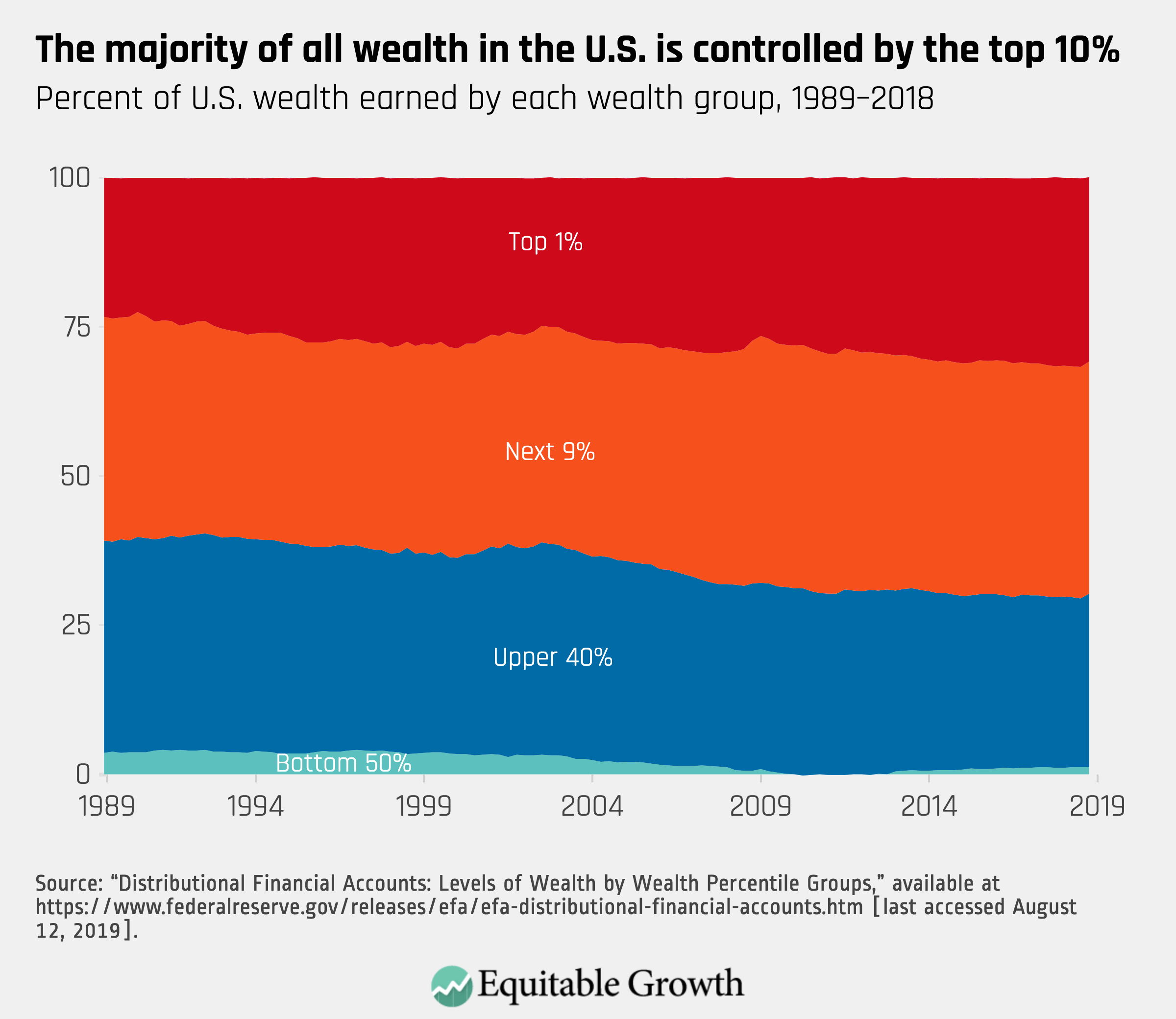
  • "The wealthiest 1 percent of families holds 31 percent of all wealth, and the wealthiest 10 percent holds 70 percent of all wealth."  "The highest-income 1 percent of families receives 75 percent of the benefit of the preferential rates for capital gains and dividends under current law." The wealthiest 10% would bear the burden of MTM reforms.


Of course, while everybody is talking about taxes, some of that talk is the same old endless market fundamentalist myth (Reaganomics) about how tax cuts are what make the economy grow and will actually pay for themselves -- in spite of near 4 decades of evidence to the contrary, where highest growth rates have generally been in times of higher tax rates, with some consideration for stimulus impact of tax cuts after periods of recessions.  See, e.g., NY Times editorial, There's No Such Thing as a Free Tax Cut (Jan 22, 2020).  The op-ed notes that Treasury Secretary Steven Mnuchin "repeated the risible fantasy that the Trump administration's 2017 tax cuts will bolster economic growth sufficiently for the government to recoup the revenue it lost by lowering tax rates" [in the 2017 tax legislation] even though 2 years in, the "budget deficit has topped $1 trillion." This is because, as most of us who haven't drunk the Laffer-curve tax cut kool-aid know and the Times op-ed reiterates, "businesses responded to increased demand more than they did to the lower tax rates."  Nonetheless, we should not be surprised that the Trump Administration is talking about two "big ideas" for taxes if the man gets reelected:  1) cutting Medicare and Social Security: see, e.g., Trump Opens Door to Cuts to Medicare and Other Entitlement Programs, NY Times (Jan 22, 2020) and 2) passing another tax cut bill: see Steven Mnuchin Confirms Trump's New Tax Plan is Imminent, USNews (Jan 23, 2020).  Those two ideas go hand in hand. 

Though Trump doesn't dare state what he is really doing to his base, who he has deceived with typical right-wing rhetoric into thinking that he is trying to rightsize the economy to serve them when he instead engages in class warfare to stuff his own pockets, he is hip to hip with Newt Gingrich's desire to "starve the government" to create a huge deficit (we are up to $1 trillion in our new "gilded age economy") that then provides cover for the wealthy to suck in even more of the country's wealth by downsizing Medicare and Social Security, programs essential for those who are not among the wealthy. 


 -- via my feedly newsfeed

Monday, January 20, 2020

The Politics of Pensions: No Bailout for You [feedly]

The Politics of Pensions: No Bailout for You
https://workingclassstudies.wordpress.com/2020/01/20/the-politics-of-pensions-no-bailout-for-you/

Photo by Andrew Rush, Pittsburgh Post-Gazette

On December 24 last year, the New York Times reported that a multi-billion-dollar bailout of the United Mine Workers Health & Retirement Fund which was slated to go broke in 2023 had been rolled into the $1.4 trillion bi-partisan spending bill passed by Congress and signed by President Trump. The last-minute deal will ensure that thousands of retired miners living in some of the nation's most impoverished communities continue to receive the modest benefits they earned during their years working in Appalachia's coal mines.

The decision to insert the Miner's Pension Protection Act into the must-pass budget bill was clearly good news for the 100,000 retirees who depend on pensions that average $595.00 per month. It was also something of a Christmas miracle.

The legislation had been blocked by Senate Majority Leader Mitch McConnell, Rob Portman of Ohio and other powerful Republicans who opposed the bailout on "principle" even though thousands of retired miners residing in their states would have been devastated if the fund had gone belly-up. Observers speculate that McConnell, who is up for election this year, was scared into a change of heart after Democrat Andy Beshear was elected governor of Kentucky in November. Donald Trump's need to throw miners a bone after failing to deliver on his promise to resurrect the flagging but "beautiful" coal industry also played a role in moving the proposal along.

Frankly, we could care less about what melted McConnell's cold, cold heart—assuming he has one. We're just happy miners and their families will continue to get their checks. But this incident along with the impending collapse of hundreds of other severely underfunded multi-employer (ME) pension funds, provides a frame for comparing the disparate ways leaders of both major political parties deal with Wall Street and Main Street. You won't be surprised to learn who gets the short end of the stick.

It's an easy and disheartening comparison to make. Simply contrast the way the federal government reacted when the financial markets began to meltdown in 2007 to what's been done to address the pension crisis. In the former instance, Bush, Obama, and Congress met behind closed doors and cooked up the Troubled Asset Relief Program, a more than $6 trillion taxpayer bailout of the big banks, speculators, mortgage brokers, and other miscreants whose criminal behavior, greed, and avarice brought the world economy to the brink of disaster and cost 10,000,000 Americans their homes. Of course, no one who engaged in the criminal activity that Fortune'Michael Collins and others have identified ever went to jail. They just went out and bought new Maseratis, Gulfstream Vs, and bespoke suits.

Now let's look at how the feds have dealt with the pension crisis which has been precipitated by the effects of deindustrialization, the sharp decline in union membership, chronic underfunding, poor investment decisions, employer pullouts, lax regulation, and serial bankruptcies. Today,  approximately 1,400 multi-employer plans covering 10.6 million Americans are underfunded by $638 billion. More than 100, including the mammoth Teamsters Central State Pension Fund which has $40.5 billion in unfunded liabilities, could go broke in the next five years. Unless something is done millions of men and women who contributed trillions of dollars in deferred wages to ME plans will, through no fault of their own, receive drastically reduced benefits—if they receive any at all.

Federal officials have floated a number of proposals for dealing with the dilemma.  Most have one thing in common: they punish the innocent victims. For example, Congress and the Obama administration launched a sneak attack against workers and retirees by slipping the Multiemployer Pension Reform Act (MPRA) of 2014 into a must-pass omnibus budget bill at the last possible moment. This "reform" legislation gave ME plan trustees the authority to seek approval from the Treasury Department to reduce benefit levels without seeking prior approval from active workers or retirees.

Shortly after the bill passed, the Central States board asked Treasury for permission to slash benefits by as much as $2,000 per month for current and future retirees. The hundreds of thousands of people who would have been affected were understandably outraged by both the proposed cuts and what they viewed as a betrayal by Congressional Democrats and Obama. That outrage and the resentment it fueled persists to this day, even though Treasury and Special Master Ken Feinberg ultimately rejected the Central States' application in 2016. Since then more than 25 ME plans covering more than 108,000 workers have sought approval to slash benefits.

There is some good news, however. Earlier this year the Democratic majority in the House passed the "Butch Lewis Act," which would provide billions of dollars in loans to the troubled ME plans. Unfortunately, the good news ends there because the Senate Republicans who leapt at the opportunity to throw trillions to their Wall Street buddies are adamantly opposed to a taxpayer funded bail out that will help working-class retirees and ensure that men and women who are on the job today will receive promised benefits tomorrow.

Their alternative? Chuck Grassley's Multiemployer Pension Recapitalization and Reform Plan. Not only will this little beauty result in benefit cuts, it imposes a monthly fee on those greedy retirees who had the temerity to live long enough to collect the pensions they earned. This will teach them.

We have some better ideas. First, a TARP-like relief program for America's pension systems. If we can afford $6,000,000,000 to bailout the robber barons we can afford to ensure that working- and middle-class families get their pension checks every month. And we'll even do one better than TARP, which did little to rein-in the excesses that nearly blew up banking system. In exchange for the money, we'd require pension plans to accept tight new regulations that would protect workers and their deferred wages going forward.

Second, we need to reform the bankruptcy laws so that ME plans would be considered secured creditors in line for payment ahead of banks, hedge funds, and stockholders. This is critical because serial bankruptcies were largely responsible for undermining the UMW fund.  Requiring companies to meet their obligation to retirees and workers would go a long way to strengthening plans that have been weakened by corporate greed.

Finally, the Democratic candidates for office should start talking about the crisis, making clear how it impacts hundreds of thousands of people in swing states like Michigan, Wisconsin, and Pennsylvania – including many working-class voters who abandoned the Democratic Party in 2016. Hillary Clinton ignored David Betras and Leo Jennings, whose "Blue Collar" memo to her campaign, the Democratic National Committee, and the Ohio Democratic Party offered this advice:

Want to move Ohio's 50,000 retired Teamsters and their family members to the HRC camp: use them in ads in which they talk about how much they appreciate the fact she will find a way to keep the Central States Pension Fund solvent that doesn't involve gutting their monthly check and health care benefits…these workers and their family members are scared to death of what may happen and that means they will respond to and vote for the candidate who pledges to fix the problem.

The response from the Clinton campaign: crickets.

The crisis has worsened since then, but so has the opportunity to use it to win working-class votes that could be the difference between victory and defeat in the primary and general elections. We hope it's not ignored again.

Marc Dann and Leo Jennings III

Marc Dann served as Attorney General of the State of Ohio and now leads DannLaw, which specializes in protecting consumers from various forms of predatory financing. Leo Jennings III is a leading Northeast Ohio political consultant and media specialist.


 -- via my feedly newsfeed

West Virginia GDP -- a Streamlit Version

  A survey of West Virginia GDP by industrial sectors for 2022, with commentary This is content on the main page.