Saturday, February 17, 2018

Gun Makers Are Reeling Even as Threat of Regulation Recedes [feedly]

Gun Makers Are Reeling Even as Threat of Regulation Recedes
https://www.nytimes.com/2018/02/16/business/gun-makers-are-reeling-even-as-of-regulation-recedes.html

Gun Makers Are Reeling Even as Threat of Regulation Recedes - The New York Times

As the school shooting in Parkland, Fla., stokes the national debate over firearms, it may be easy to overlook another major development in the gun world this week.

One of the nation's oldest and largest gun makers, Remington, said it was nearing a bankruptcy filing.

Hit with slumping sales and unable to sell itself, Remington has negotiated a deal with its lenders to cut its debt and keep operating.

Other gun makers are also struggling. Colt completed its trip through bankruptcy last year, while sales and profits at Smith & Wesson's parent company have plummeted and its stock price is sagging. All three companies make a version of the AR-15-style semiautomatic rifle, which was used by the killer in Parkland on Wednesday and is the weapon of choice for mass shootings.

The problems demonstrate the paradoxical and tumultuous nature of the gun industry. It has prospered when the prospect of tighter regulations induces people to buy more guns.

And it slumps when that threat of new regulation subsides, as it has done during the Trump administration. President Trump, who has called himself a "true friend and champion" of guns, did not mention gun control in his remarks on Thursday about the Parkland shooting. And many leaders in the Republican-controlled Congress, where gun restrictions have withered over the years, have shown no change of heart in light of this week's school shooting.

"When people feared there would be increased gun regulation, they went out and bought more guns," said Kevin Cassidy, an analyst at Moody's Investors Service, who covers the gun manufacturers.

Declines in the Gun Business

Firearm background checks, often used as a proxy

for firearm sales (for which data is not readily

available), fell farther last year than they had before.

Guns flooded into the American market in the past decade as

manufacturing surged during the Obama administration,

creating an inventory glut that now exceeds slowing demand.

Sales by two of the country's biggest gun

manufacturers declined sharply last year.

American

Outdoor Brands

Firearm background checks

Remington

10

million

+

20

%

+60

%

Year-over-year

change in revenue

Firearms

manufactured

Shotguns

and other

+

15

8

+40

+

10

Rifles

6

+20

+

5

4

0

0

Pistols

and

revolvers

2

5

–20

0

10

Quarterly

Annual

–40

'12

'17

'12

'17

'00

'05

'10

'15

'17

'00

'05

'10

'15

Formerly Smith & Wesson

During the Obama administration, F.B.I. background checks on prospective firearms buyers — a rough proxy for sales — surged nearly 50 percent in the month of the Sandy Hook attack in 2012, compared with the same month a year earlier, as calls rang out for tighter legislation. Similarly, the number of background checks swung up more than 43 percent after the shooting in San Bernardino, Calif., in 2015 and nearly 40 percent after the massacre in Orlando six months later.

But that trend has reversed since Mr. Trump has been in office. In October, when a gunman killed 58 people in Las Vegas and injured hundreds, background checks slumped, falling 13 percent from the same month a year earlier.

Over all, background checks tumbled more than 8 percent last year, the largest fall since the F.B.I. began keeping track in 1998.

"There is no panic buying of guns because there is clearly no threat of federal government action in response to mass shootings that would restrict or regulate firearms," Daniel Webster, the director of the Johns Hopkins Center for Gun Policy and Research, wrote in an email. "The gun lobby can't scare their followers into thinking Donald Trump would sign any piece of gun control legislation as they could under an Obama presidency."

Remington, founded in upstate New York by Eliphalet Remington II in 1816, is the oldest manufacturer of rifles and shotguns in the country.

Advertisement

Continue reading the main story

DuPont, the chemical company, bought a majority share in Remington in 1933, purchased the firearms maker outright in 1980 and then sold it to an investment firm in New York in 1993. The private equity firm Cerberus Capital Management bought the company in 2007 for $118 million and rolled it up with other gun manufacturers into a conglomerate called Freedom Group.

Under Cerberus, the company enjoyed years of expanding gun sales. In 2012, the number of guns made in the United States totaled 8.5 million, more than double the 3.3 million that were produced a decade earlier.

But in December 2012, a gunman walked into Sandy Hook Elementary School in Newtown, Conn., and killed 20 children and six adults. When the authorities reported that the gunman had used an AR-15-style rifle made by Remington, public anger focused on the manufacturer.

Photo
Gun-control initiatives in the wake of mass shootings used to spur gun purchases, but not lately. Credit Doug Mills/The New York Times

Large investors, like the California State Teachers' Retirement System, began taking steps to divest from the gun maker. Cerberus said it would seek to sell the company.

Despite the public outcry, the fallout from Sandy Hook helped the company's bottom line. Spurred by calls that gun controls were imminent, buyers purchased more Remington firearms, and sales surged 36 percent, to $1.3 billion in 2013, Moody's said.

Some investors may have had objections to Remington, but not everyone. After the Sandy Hook shooting, Remington was able to borrow millions more as gun production boomed, particularly heading into the 2016 presidential election because Hillary Clinton was expected to win and push for tighter gun controls.

The company borrowed $12.5 million from the City of Huntsville, Ala., in 2014 to open up a new plant there. The city has agreed to eventually forgive the loan if Remington meets hiring targets over a number of years, said Chip Cherry, chief executive of the Chamber of Commerce of Huntsville and Madison County.

Remington also borrowed $175 million to buy out investors that wanted to divest. (Remington has paid out a total of $48 million, according to a company filing.)

The company does not disclose its lenders, but an analysis by Morningstar shows that some of Remington's debt is held in funds managed by JPMorgan Chase. Oppenheimer, the large mutual fund company, also owned some of the bonds issued by Remington, but said it sold its debt holdings last year.

In 2017, Mr. Trump's first year in office, sales fell 27 percent in the first nine months (the most recent data available) from the same period a year earlier. After production was ramped up in expectation of a Clinton presidency, gun inventories have piled up.

On Monday, Remington announced that its lenders had agreed to cut its $948 million debt load by $700 million in exchange for an ownership stake in the company. Analysts said at the time that even with its lower debt, the company still faced a challenging sales environment.

But this week, things are looking up to some on Wall Street. The price of Remington's bonds have increased more than 16 percent since Wednesday — a sign that some investors believe the company has promise.


 -- via my feedly newsfeed

Could this be the moment the labor movement has been waiting for?

Could this be the moment the labor movement has been waiting for?


Could this be the moment the labor movement has been waiting for?
© Getty Images

It's been a rough couple of decades for the national labor movement. Unions have been subjected to a full blown assault by the GOP, eroded by new work arrangements and all but abandoned by Democrats. Major newspapers no longer employ labor reporters, 28 states have undermined unions with so-called right-to-work laws, the Trump administration has decimated the National Labor Relations Board, and every year brings another grim statistic about how union membership has fallen.

With this set of facts piling up, plenty of people have decided unions are now irrelevant and left the movement for dead. Turns out, though, that West Virginia didn't get the memo.

Teachers, school service personnel and other public employees in the Mountain State are on the verge of a historic statewide walkout over pay that's near the worst in the country. Over the past few weeks, these workers have staged local walkouts, flooded town halls, and descended by the thousands on the state capital in Charleston. Today, teachers will walk out of schools in at least three more counties, and on Saturday they'll rally in a massive protest at the Capitol building in what is expected to be their largest action to date.  


With no sign that the Republican-dominated legislature is going to accede to the teachers' demands for a decent wage, the only avenue left is a coordinated statewide walkout. According to Dale Lee, president of the West Virginia Education Association, the state's largest teachers union: "Unless things change, we're headed toward a work action."

It's hard to overstate just what a dramatic scene this will be. When thousands of teachers walk out of West Virginia schools, they'll be bucking a national trend in a big way. Last year was the second lowest year ever recorded for large-scale strikes. In the entire country for the entire year, there were only 7 strikes involving more than 1,000 workers.

If you're surprised to see a resurgence in progressive radical action coming from West Virginia, then it's time you toss out your old stereotypes of West Virginians as an endlessly trod-upon people who don't understand their own self-interest and reflexively back Republicans. You may also want to revisit your history.

West Virginia was a cradle of militant unionism and the site of some of the most storied, important battles between labor and management. In fact, if you've ever called someone a "redneck" or been called one yourself, you can trace that proud pejorative back to one of the bloodiest battles between labor and management to occur in our nation's history. In the Battle of Blair Mountain, miners literally fought against management and government for their right to organize and to earn cash instead of scrip and to shop outside of company stores. In order to easily identify their brothers in arms, the miners wrapped red bandanas around their necks.

You might also be surprised to learn that those rednecks were composed of whites, black migrants from the South and new European immigrants. They spoke different languages, came from different cultures, but their red bandanas stood as a sign of cross-racial, working-class solidarity.  

In other words, West Virginia may be the perfect place for workers to once again disregard the rules meant to keep them in their place. The perfect place for workers to demand more from a system that has been systematically rigged to deliver for business and the politically connected at the expense of working people in every community. The perfect place to lead a vanguard of progressive activism that just might be the jolt the entire national labor movement needs.

These modern-day rednecks are ready to fight.

Krystal Ball is president of The People's House Project, which recruits Democratic candidates in Republican-held congressional districts of the Midwest and Appalachia. A former candidate for Congress in Virginia and host on MSNBC's "The Cycle," she is a video host for the soon-to-be-launched Hill.TV project. Follow her on Twitter @krystalball.


--
John Case
Harpers Ferry, WV

The Winners and Losers Radio Show
7-9 AM Weekdays, The Enlighten Radio Player Stream, 
Sign UP HERE to get the Weekly Program Notes.

Friday, February 16, 2018

Paul Krugman: Budgets, Bad Faith and ‘Balance’ [feedly]

Paul Krugman: Budgets, Bad Faith and 'Balance'
http://economistsview.typepad.com/economistsview/2018/02/paul-krugman-budgets-bad-faith-and-balance.html

"our job, whether we're policy analysts or journalists, isn't to be "balanced"; it's to tell the truth":

Budgets, Bad Faith and 'Balance', by Paul Krugman, NY Times: Over the past couple of months Republicans have passed or proposed three big budget initiatives. First, they enacted a springtime-for-plutocrats tax cut that will shower huge benefits on the wealthy while offering a few crumbs for ordinary families — crumbs that will be snatched away after a few years, so that it ends up becoming a middle-class tax hike. Then they signed on to a what-me-worry budget deal that will blow up the budget deficit to levels never before seen except during wars or severe recessions. Finally, the Trump administration released a surpassingly vicious budget proposal that would punish not just the vulnerable but also most working families.
Looking at all of this should make you very angry... But my anger isn't mostly directed at Republicans; it's directed at their enablers, the professional centrists, both-sides pundits, and news organizations that spent years refusing to acknowledge that the modern G.O.P. is what it so clearly is.
Which is not to say that Republicans should be let off the hook. ...I can't think of a previous example of a party that so consistently acted in bad faith — pretending to care about things it didn't, pretending to serve goals that were the opposite of its actual intentions. ... The ... party's true agenda, dictated by the interests of a handful of super-wealthy donors, would be very unpopular if the public understood it. So the party must consistently lie...
Meanwhile, many news organizations ... treat recent G.O.P. actions as if they are some kind of ... departure from previous principles. They aren't. Republicans are what they always were: They never cared about deficits; they always wanted to dismantle Medicare, not defend it. They just happen not to be who they pretended to be.
Now, there's no mystery about why many people won't face up to the reality of Republican bad faith. Washington is full of professional centrists, whose public personas are built around a carefully cultivated image of standing above the partisan fray, which means that they can't admit that while there are dishonest politicians everywhere, one party basically lies about everything. News organizations are intimidated by accusations of liberal bias, which means that they try desperately to show "balance" by blaming both parties equally for all problems.
But our job, whether we're policy analysts or journalists, isn't to be "balanced"; it's to tell the truth. And while Democrats are hardly angels, at this point in American history, the truth has a well-known liberal bias.


 -- via my feedly newsfeed

IRS Must Now Be a Top Funding Priority [feedly]

IRS Must Now Be a Top Funding Priority
https://www.cbpp.org/blog/irs-must-now-be-a-top-funding-priority

Now that President Trump and congressional leaders have raised annual spending caps for defense and non-defense discretionary programs for 2018 and 2019, policymakers should make additional Internal Revenue Service (IRS) funding a top priority. The recent tax bill poses a once-in-a-generation, multi-dimensional challenge for the IRS, and the President and Congress must give the IRS the funds to implement it successfully.

Fortunately, congressional leaders who negotiated the agreement to raise the caps recognized the need for additional IRS funding, per their summary of the agreement: "Adequate Funding for Taxpayer and Social Security Administrative Services – Congressional leaders agree to adequate funding for the Internal Revenue Service and the Social Security Administration to satisfy the demand for constituent services and tax administration."

After all, the new tax law will affect virtually every taxpayer and business in America. It's certain to spark questions that individuals and businesses will look to the IRS to answer. Of particular concern, given some of the law's features and the hasty way it was put together, it is likely to fuel an aggressive effort by some businesses and wealthy individuals to push against the law's outer limits — and possibly beyond — to minimize their taxes.

As a result, the IRS will need to provide extensive guidance to taxpayers, update its systems and forms, provide significant public education, expand customer service, and strengthen enforcement in the years to come. The IRS's shrunken budget and depleted workforce magnify the challenge. Policymakers cut its budget by $2.4 billion, or 18 percent, between 2010 and 2017, after adjusting for inflation (see chart). It has lost 18,000 employees (nearly one-fifth of its workforce), with enforcement personnel accounting for more than three-quarters of that reduction.

IRS Funding Has Fallen Sharply


Congress' appropriators, who will write the bills to fund the IRS for 2018 and 2019, must now follow through on the recognized need for more dollars. Specifically, "adequate funding" should mean a robust increase across IRS functions compared to last year. Overall, the agreement raises overall non-defense discretionary (NDD) funding by roughly 12 percent in 2018 compared to last year. While the President has proposed a $581 million increase for the IRS to implement the new tax law and support technology and taxpayer services, he proposes to add that to his original request for 2018 — which was a 2 percent cut — rather than to the 2017 level. As a result, the President's 2018 proposal amounts to just under a 3 percent increase for the IRS, roughly one-quarter of the overall percentage increase for NDD and far short of what the IRS needs.

The President's request for 2019 shows further that he's not taking the IRS' challenge seriously enough. His budget inexplicably proposes to cut taxpayer services and set a target for it to answer less than half of taxpayer calls during fiscal year 2019, when people will file their first returns under the new law. As the Senate Finance Committee's Republican chairman, Orrin Hatch, said, "the Administration, in its budget, has proposed additional cuts to funding for the IRS. I think that is a mistake."

Policymakers should heed the example of how the Reagan Administration and Congress responded to major tax reform legislation in 1986. After enacting it, policymakers provided the IRS with more funds to meet its additional demands. In response, the IRS significantly expanded taxpayer service efforts, hiring 1,300 more staff. At the same time, the agency was in the midst of a major effort to recover unpaid taxes, and so was actively strengthening its enforcement capabilities. Moreover, these staff increases occurred at a time when the IRS had about one-fifth more staff than it does today.

In the face of deep budget cuts and personnel reductions, the IRS has struggled to perform its core functions of helping taxpayers comply with the tax code, enforcing the code fairly and credibly, and collecting nearly all of the revenue that funds federal programs. Policymakers must give the IRS sufficient resources over the coming years — a substantial increase above last year's depleted level, not simply a reversal of a proposed further cut — to meet the additional customer service and enforcement challenges that the new tax law will create.


 -- via my feedly newsfeed

Global Cities on the Bubblicious Scale [feedly]

Global Cities on the Bubblicious Scale
http://ritholtz.com/2018/02/8-global-cities-risk/

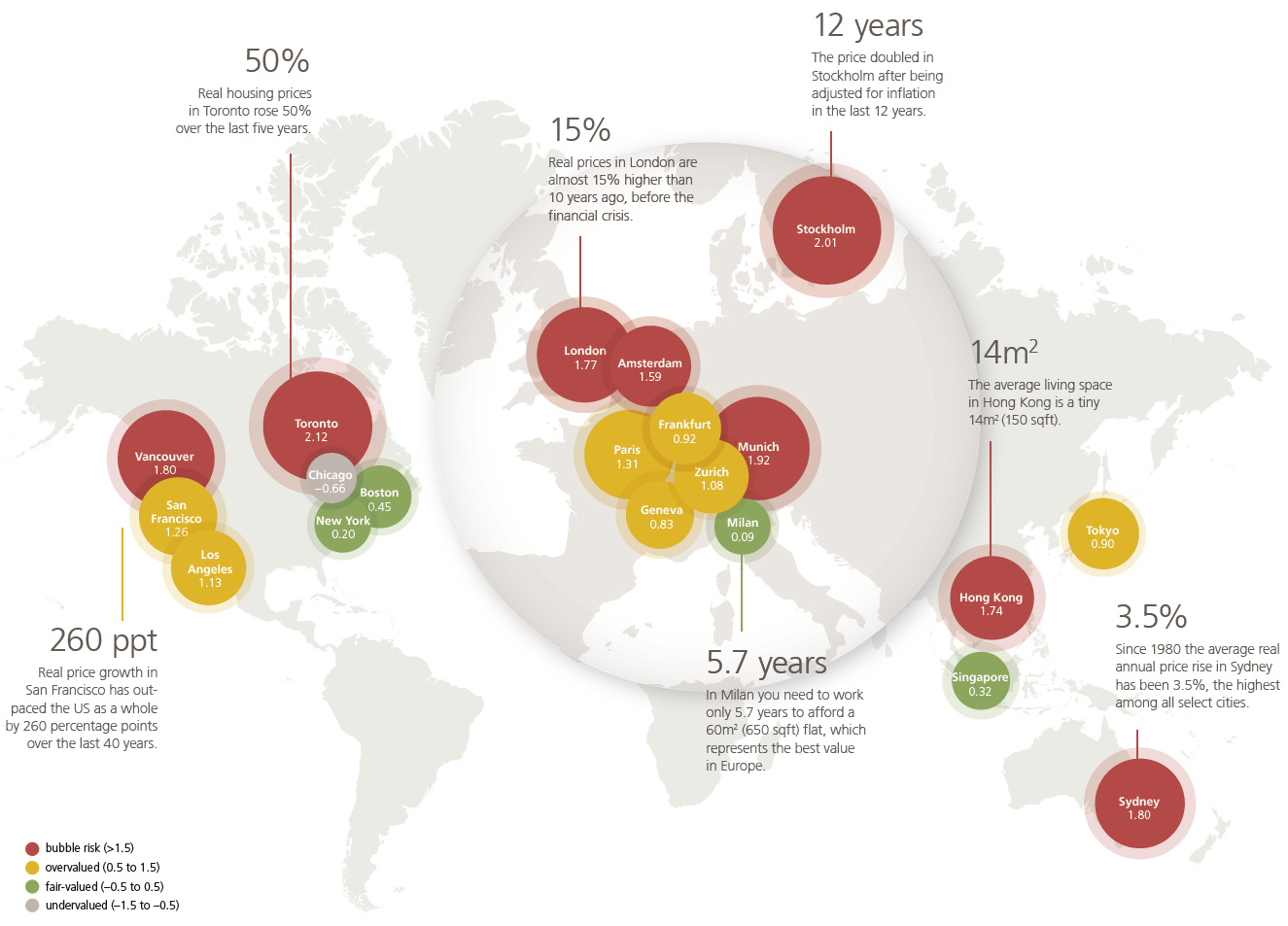
Real Estate Bubbles: The 8 Global Cities at Risk

Courtesy: UBS

Real Estate Bubbles: The 8 Global Cities at Risk

If you had $1 billion to spend on safe real estate assets, where would you look to buy?

For many funds, financial institutions, and wealthy individuals, the perception is that the world's financial centers are the places to be. After all, world-class cities like New York, London, and Hong Kong will never go out of style, and their extremely robust and high-density city centers limit the supply of quality assets to buy.

But what happens when too many people pile into a "safe" asset?

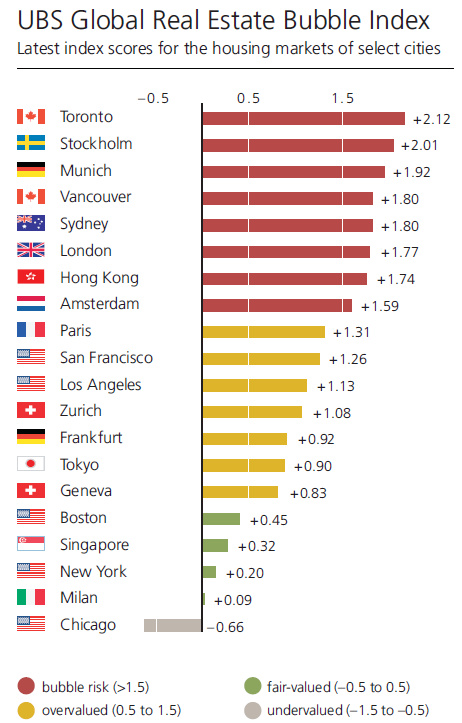
According to UBS, certain cities have seen prices rise at rates that are potentially not sustainable – and eight of these financial centers are at risk of having real estate bubbles that could eventually deflate.

GLOBAL REAL ESTATE BUBBLE INDEX

Every year, UBS publishes the Global Real Estate Bubble Index, and the most recent edition shows several key markets in bubble territory.

Global Real Estate Bubble Index

The bank highlights Toronto as the biggest potential bubble risk, noting that real prices have doubled over 13 years, while real rents and real income have only increased 5% and 10% respectively.

However, the largest city in Canada was certainly not the only global financial center with real estate appreciating at rapid rates in the last year.

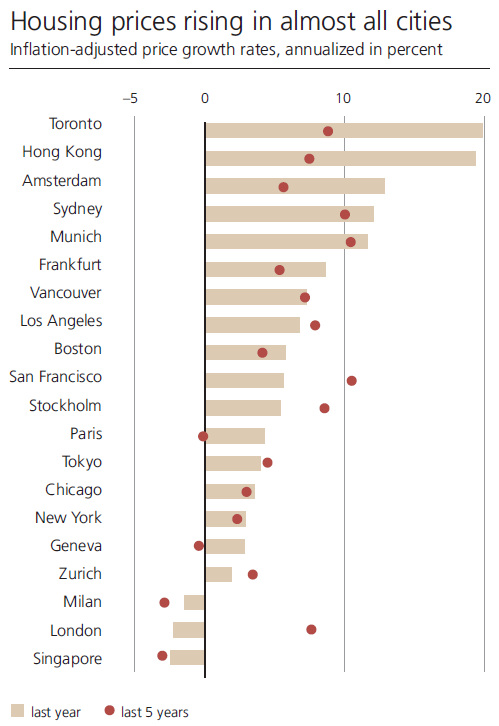
In Munich, Toronto, Amsterdam, Sydney and Hong Kong, prices rose more than 10% in the last year alone.

Annual increases at a 10% clip would lead to the doubling of prices every seven years, something the bank says is unsustainable.

Price Changes in select Real Estate Markets

In the last year, there were three key markets where prices did not rise: London, Milan, and Singapore.

London is particularly notable, since it holds more millionaires than any other city in the world and is rated as the #1 financial center globally.


 -- via my feedly newsfeed

sachs: Ending America’s Disastrous Role in Syria [feedly]

Ending America's Disastrous Role in Syria
https://www.project-syndicate.org/commentary/ending-disastrous-american-role-in-syria-by-jeffrey-d-sachs-2018-02

America's official narrative has sought to conceal the scale and calamitous consequences of US efforts to overthrow Syrian President Bashar al-Assad. That is understandable, because US efforts are in blatant violation of international law, which bars UN member states from supporting military action to overthrow other members' governments.

NEW YORK – Much of the carnage that has ravaged Syria during the past seven years is due to the actions of the United States and its allies in the Middle East. Now, faced with an alarming risk of a renewed escalation of fighting, it's time for the United Nations Security Council to step in to end the bloodshed, based on a new framework agreed by the Council's permanent members.


Here are the basics. In 2011, in the context of the Arab Spring, the US government, in conjunction with the governments of Saudi Arabia, Qatar, Turkey, and Israel, decided to bring down Syrian President Bashar al-Assad's regime, even though overthrowing another country's government amounts to a blatant violation of international law. We know that in 2012, if not earlier, President Barack Obama authorized the CIA to work with America's allies in providing support to rebel forces composed of disaffected Syrians as well as non-Syrian fighters. US policymakers evidently expected Assad to fall quickly, as had occurred with the governments of Tunisia and Egypt in the early months of the Arab Spring.

The Assad regime is led by the minority Alawi Shia sect in a country where Alawites account for just 10% of the population, Sunni Muslims account for 75%, Christians make up 10%, and 5% are others, including Druze. The regional powers behind Assad's regime include Iran and Russia, which has a naval base on Syria's Mediterranean coastline.

Whereas America's goal in seeking to topple Assad was mainly to undercut Iranian and Russian influence, Turkey's motive was to expand its influence in former Ottoman lands and, more recently, to counter Kurdish ambitions for territorial autonomy, if not statehood, in Syria and Iraq. Saudi Arabia wanted to undermine Iran's influence in Syria while expanding its own, while Israel, too, aimed to counter Iran, which threatens Israel through Hezbollah in Lebanon, Syria near the Golan Heights, and Hamas in Gaza. Qatar, meanwhile, wanted to bring a Sunni Islamist regime to power.

The armed groups supported by the US and allies since 2011 were assembled under the banner of the Free Syrian Army. In fact, there was no single army, but rather competing armed groups with distinct backers, ideologies, and goals. The fighters ranged from dissident Syrians and autonomy-seeking Kurds to Sunni jihadists backed by Saudi Arabia and Qatar.

While vast resources were devoted to overthrowing Assad, the effort ultimately failed, but not before causing massive bloodshed and displacing millions of Syrians. Many fled to Europe, fomenting Europe's refugee crisis and a surge in political support for Europe's anti-immigrant extreme right.


There were four main reasons for the failure to overthrow Assad. First, Assad's regime had backing among not only Alawites, but also Syrian Christians and other minorities who feared a repressive Sunni Islamist regime. Second, the US-led coalition was countered by Iran and Russia. Third, when a splinter group of jihadists split away to form the Islamic State (ISIS), the US diverted significant resources to defeating it, rather than to toppling Assad. Finally, the anti-Assad forces have been deeply and chronically divided; for example, Turkey is in open conflict with the Kurdish fighters backed by the US.

All of these reasons for failure remain valid today. The war is at a stalemate. Only the bloodshed continues.

America's official narrative has sought to conceal the scale and calamitous consequences of US efforts – in defiance of international law and the UN Charter – to overthrow Assad. While the US vehemently complains about Russian and Iranian influence in Syria, America and its allies have repeatedly violated Syrian sovereignty. The US government mischaracterizes the war as a civil war among Syrians, rather than a proxy war involving the US, Israel, Russia, Saudi Arabia, Iran, and Qatar.

In July 2017, US President Donald Trump announced the end of CIA support for the Syrian rebels. In practice, though, US engagement continues, though now it is apparently aimed more at weakening Assad than overthrowing him. As part of America's continued war-making, the Pentagon announced in December that US forces would remain indefinitely in Syria, ostensibly to support anti-Assad rebel forces in areas captured from ISIS, and of course without the assent of the Syrian government.

The war is in fact at risk of a new round of escalation. When Assad's regime recently attacked anti-Assad rebels, the US coalition launched airstrikes that killed around 100 Syrian troops and an unknown number of Russian fighters. Following this show of force, US Secretary of Defense Jim Mattis disingenuously stated that, "Obviously, we are not getting engaged in the Syrian civil war." In addition, Israel recently attacked Iranian positions in Syria.

The US and its allies should face reality and accept the persistence of Assad's regime, despicable as it may be. The UN Security Council, backed by the US, Russia, and the other major powers, should step in with peacekeepers to restore Syrian sovereignty and urgent public services, while blocking attempts at vengeance by the Assad regime against former rebels or their civilian supporters.

Yes, the Assad regime would remain in power, and Iran and Russia would maintain their influence in Syria. But the US official delusion that America can call the shots in Syria by choosing who rules, and with which allies, would end. It's long past time for a far more realistic approach, in which the Security Council pushes Saudi Arabia, Turkey, Iran, and Israel into a pragmatic peace that ends the bloodshed and allows the Syrian people to resume their lives and livelihoods.


Should-Read : Martin Wolf : Brexit has replaced the UK’s stiff upper lip with quivering rage : "In part, the UK is vict... [feedly]

Should-Read : Martin Wolf : Brexit has replaced the UK's stiff upper lip with quivering rage : "In part, the UK is vict...
http://www.bradford-delong.com/2018/02/should-read-martin-wolf-brexit-has-replaced-the-uks-stiff-upper-lip-with-quivering-ragehttpswwwftcomcon.html

Should-Read: Martin Wolf: Brexit has replaced the UK's stiff upper lip with quivering rage: "In part, the UK is victim of its past successes...

...A small offshore island became, temporarily, a superpower... defined... against Europe and... any power wishing to dominate Europe.... Now, Europe is uniting while the UK is very much not a superpower. So what does it choose? Is it to be an irrelevant offshore island or a part of a united Europe? The choice has to be divisive. When divisions are so deep, nobody is considered neutral....

How will this end? The answer is that anything is possible. Could there still be a "no-deal Brexit"? Yes. Could there be another referendum? Yes. But the likelihood is that the UK will exit on terms laid down, in detail, by the EU. When a country is this divided and its political processes are in such disarray, someone else has to sort things out. The EU will do so, because that is in its interests. The EU will not let the UK have its cake and eat it. It is led by people who also have a historical goal: not to return to the past. Their history was not British history and their aims are not British aims. They will determine the terms of the separation. We will then see whether the UK's civil war is resolved, or renewed in other, yet more bitter, ways.

VISIT WEBSITE

 -- via my feedly newsfeed

West Virginia GDP -- a Streamlit Version

  A survey of West Virginia GDP by industrial sectors for 2022, with commentary This is content on the main page.