Tuesday, February 13, 2018

Kuttner: The Democrats' False Choice [feedly]

The Democrats' False Choice
https://www.huffingtonpost.com/entry/opinion-kuttner-democrats-choice_us_5a7870f4e4b0905433b6c40d

The Democrats' False Choice

ALEX WONG VIA GETTY IMAGES
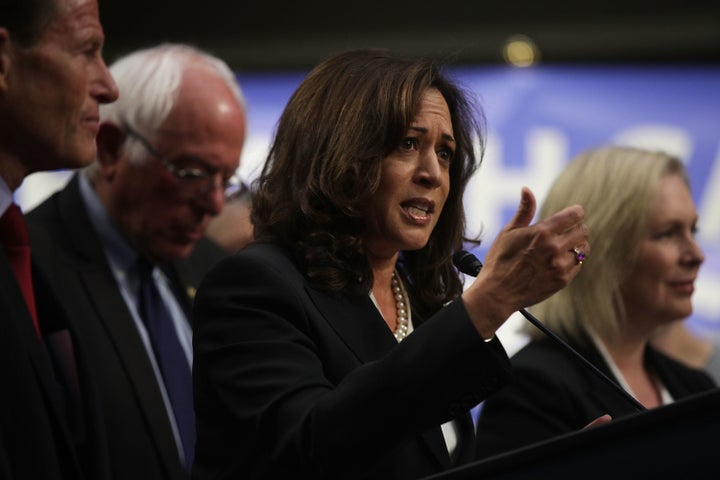
Senators Kamala Harris, Bernie Sanders and Kerstin Gillibrand onstage at an event introducing the Medicare for All Act of 2017 on Sept. 13, 2017.

Should Democrats go all out to energize a "rising electorate" of women, blacks, Latinos, Asians, immigrants, LGBTQ people and on-the-march young voters? Or should the Democrats go all out to rebuild their shattered reputation as the Party of Roosevelt that cares about the white working class?

A great deal has been written by advocates of both views, and many of these articles and speeches have talked right past each other.

For instance, advocates of the new rainbow, majority-minority coalition argue that white working-class voters are privileged relative to people of color, and that progressives can win without them, without compromising on race, gender, immigration and inclusion to pander to a coddled white working class.

Conversely, champions of the white-working-class emphasis point out that the white working class may be a declining share of the electorate but that it is distributed geographically, alas, with great efficiency.

These voters, defined as those without a college degree, are down to 34 percent of the electorate nationally, but over 50 percent in every state of the Midwest, over 60 percent statewide in Indiana, Iowa, Ohio, Missouri and Wisconsin, and over 80 percent in key counties of western Pennsylvania, Michigan, Ohio and Wisconsin.

Do those states ring a bell? They are, of course, where Democratic support has been collapsing, and where Hillary Clinton lost the election.

Partisans of the Don't Forget the White Working Class view also observe that although the group has been "privileged" relative to minorities historically, for about two generations they also have been losing ground. The only truly privileged group today is the one percent — who just gained even more economic and political privilege via the tax bill.

"Rising electorate" advocates respond that if Democrats would only maximize the turnout of the new electorate, they could forget about those white working-class voters, many of whom are hopelessly racist, sexist, homophobic, anti-immigrant, violent, and worse — let Trump have them.

SPOILER ALERT: The punchline of this column, if you haven't guessed it, is that this argument inside the family is our old nemesis, the False Dichotomy. Democrats need to do more for downtrodden people of all races, including whites, and they need to be the party of justice for groups oppressed based on their race, gender, sexuality, national origin or immigrant status.

If Democrats don't pull this off ― if they don't stop fighting among themselves ― the Republican corporate elite will keep laughing all the way to the bank and the polling place. But this truism turns out to be very challenging to execute in practice, and there is far too much self-righteousness on both sides of the argument.

I could quote any number of recent pieces, but here are some samples.

Steve Phillips, a respected African-American strategist from Democracy of Color, writing in The New York Times, observed that 56 percent of the Alabama voters who sent Doug Jones to the senate were black, a higher turnout than the black share of the Alabama electorate, and that: "If Democrats want to win, they will elevate and give broad budgetary authority to strategists and organizers with long histories and deep ties in the country's communities of color."

Subscribe to The Morning Email.
Wake up to the day's most important news.

Ruy Teixeira, a pollster, social scientist, and strategist whom I much admire, counters persuasively in a piece for Vox titled "The Math is Clear: Democrats Need to Win More White Working Class Votes":

Jones's triumph was not attributable to his strong showing among black voters alone, or even a combination of black voters and white college graduates. My analysis indicates that Jones benefited from a margin swing of more than 30 points among white non-college voters, relative to the 2016 presidential race in the state.

But Bill Spriggs, senior professor of economics at Howard University and chief economist of the AFL-CIO, points out what should be obvious. Writing in The American Prospect, Spriggs observed that the challenge is both race and class:

Democrats need to spend more time developing a frame to combat inequality. They need to do a better job of explaining that income inequality is a threat to economic growth. They need to be spending time helping Americans take the blinders off and see that workers, of all races, are being given the shaft by a system where corporate greed has become an elite "entitlement." They need to pull the Band-Aid off a false sense there is some white privilege that can spare some workers the wrath of America's war on working people. They must fess up to their quiet, and sometimes vocal, support of an agenda that attacked America's workers. They need to stop believing the problem confronting American workers is that they are uneducated or unskilled. They need to stop defining the white working class as the less-educated. Those are the perennial excuses meted out to black workers. Young black workers reacted angrily in 2016 to a perception that their pain was being ignored. They didn't vote for Trump, but Clinton lost as much because they didn't vote for her either as Trump won because white voters voted for him.

Keep the emphasis on the economic screwing that the one percent and Republicans are giving to working people of all races and genders, and you stand a better chance of bridging these divides. This is all the more important as centrist Democrats close to Wall Street discover the magic of doubling down on identity politics to disguise their opposition to needed radical economic reforms.

This is tough stuff. It is even tougher in a presidential year, when aspiring Democratic candidates will be tempted to demonize their rivals as too inclined to sell the party's soul to attract racist Trump voters, or too inclined to stress the group identities that divide rather than unite Democrats.

Given the immense stakes in 2020 and beyond, the last thing the Democrats need is another circular firing squad.

Robert Kuttner is co-editor of The American Prospect and professor at Brandeis University's Heller School. His forthcoming book is Can Democracy Survive Global Capitalism?


 -- via my feedly newsfeed

The new asymmetric risk [feedly]

The new asymmetric risk
http://jaredbernsteinblog.com/the-new-asymmetric-risk/

For years, economists, including no less than former Fed chair Janet Yellen, talked about the concept of "asymmetric risk," or AR. In this earlier context, which related to monetary policy, AR maintained that the risk of weak demand was greater than that of faster inflation. Therefore, the full-employment side of the Fed's mandate should get more weight in interest rate decisions than the stable-prices part.

With some important caveats I'll get to below, there's a new AR in town, this time as regards fiscal policy. As I've written in many places, thanks to the deficit-financed tax cuts and new spending bill, the deficit as a share of GDP is going to be unusually large, given that we're likely closing in on full employment.

As John Cassidy points out, some analysts, quite reasonably, worry that stimulating an economy so close to full employment is a basic economic mistake. It's being more Keynesian than Keynes. Such stimulus won't deliver more real economic activity, like jobs or real wage growth. It will just deliver more inflation and higher interest rates, which we slow growth. Added fiscal impulse at this point, they fear, will add more heat than light.

I share their concerns, but I think AR is in play, which points towards supporting this fiscal experiment. Once again, the risk of insufficient aggregate demand is greater than that of overheating. Let me explain.

You may be thinking: "insufficient demand!? But the economy is clearly at full utilization!"

Here's the thing about that: neither you nor I know that to be the case. The first figure below shows that it is beyond our ability to identify the lowest unemployment rate commensurate with stable inflation. The next figure is trickier but it's explained in this important new paper from our Full Employment Project that recalculates potential GDP, or GDP at full utilization. The thick, bottom line is actual GDP relative to its 2007 level and the middle clump of lines are the relevant re-estimates, using an arguably better technique. They show that there's maybe 5 percent of GDP more untapped capacity than the conventional wisdom suggests.

Forthcoming, Bernstein, 2018.

Source: Coibion et al.

Meanwhile, inflation, which is the main risk of overheating, has been too low for too long. The Fed has missed its 2 percent inflation target to the downside for years running.

Ergo, given that we cannot confidently assert that we are at full employment or full capacity, that there are still people left behind, that wage trends and employment rates for some groups of workers are still on the mend, that inflation remains low and below target, and that if it did speed up, the Fed has ample room to hit the brakes, this hyper-Keynesian experiment is worth undertaking.

OK, caveat time, and there are good ones which I take seriously.

–It's not just faster inflation we should worry about. It's also higher interest rates, which could slow down growth and hurt the real variables we care about. As debt investors sniff wage and price pressures, they've insisted on higher inflation premiums. As I write, the yield on the 10-year Treasury is up about 40 basis points this year, at about a 4-year high. For years, the evidence for bigger deficits nudging up interest rates was nowhere to be seen. But that could be changing, and if so, the AR becomes less A and more balanced.

–This particular fiscal stimulus has lousy multipliers. Some of the spending in the budget deal may end up supporting useful infrastructure projects and providing much needed disaster relief—worthy expenditures that could help tighten the job market in places where it's still slack. But the regressive tax cut is terribly targeted, and any fiscal stimulus is less potent when the Fed is pushing in the other direction, albeit slowly. So even if the AR scenario is correct, the bang-for-the-buck here is sure to be weak.

–Even if this AR scenario is in play this year, it may not be next year. The fiscal impulse from all this spending is, by some estimates, about the same both this year and next (Alec Phillips at Goldman Sachs finds that the growth impact should be about an extra 0.7 percentage points in 2018 and 0.6 points in 2019; no link). So, if added fiscal impulse doesn't trigger overheating in 2018, it could do so in 2019.

In sum, asymmetric risk doesn't mean no risk. And given the unusual, pro-cyclical timing of all this spending and tax cuts, the risks engendered by these fiscal dynamics are unquestionably worth watching out for. But if this extra spending can knock the unemployment rate down to the mid-3's by the end of this year without triggering more than the expected and manageable amount of price and rate pressures, then, from the perspective of those who've yet to benefit from full employment, it will be worth it.


 -- via my feedly newsfeed

The President’s new budget. Sorry, but attention must be paid. [feedly]

The President's new budget. Sorry, but attention must be paid.
http://jaredbernsteinblog.com/the-presidents-new-budget-sorry-but-attention-must-be-paid/

Every year around this time, we ask the Talmudic question: is there any reason to pay attention to the president's budget?

This year, given that the Congress just passed, and President Trump just signed, a spending deal covering the next couple of years, the question is particularly germane, as "dead on arrival" would be an upgrade for this year's budget.

And yet, I once again conclude that attention must be paid. People should know an administration's priorities, but in the case of team Trump, as the gulf between their rhetoric and their budget preferences is uniquely wide, tracking their priorities is particularly important. They make a huge deal over infrastructure but cut transportation funds; they talk about helping the left-behind but propose cuts to health care, nutritional assistance, and housing. They preach fiscal rectitude but practice fiscal recklessness.

In this regard, the basic structure of Trump's second budget is closely related to those Republicans have been writing for years, reflecting their shared priorities of tax cuts for the wealthy and spending cuts for the economically vulnerable.

For example, according to CBPP analysis, the budget takes us back to the big health care debate of last year, calling for repealing the Affordable Care Act, cutting Medicaid, and eliminating protections for people with pre-existing conditions. It proposes cuts in nutrition, housing, and other basic assistance for millions of vulnerable Americans. For example, SNAP (formerly food stamps) would face a $213 billion, or a nearly 30 percent cut over ten years; at least 4 million low-income people would lose their SNAP benefits altogether.

Regarding infrastructure, do not—I repeat, do not—take seriously the claim that there's a plan here to invest $1.5 trillion in our public goods. Far, far from it. The budget proposes $200 billion over 10 years, but as budget analyst Bobby Kogan tweeted: "The budget cuts $178 billion in…transportation [not including cuts to] water, broadband…and energy. This means [Trump is] giving $200 billion with his left hand but taking away that much with his right."

In fact, the "plan" depends on shifting the costs of infrastructure investment to private investors, states, and cities. Regarding the states' ability to fund infrastructure, there's a critical interaction with the Trump tax cut to consider. Recall that the plan significant lowers the amount of federal taxes that state and local taxpayers can deduct from their tax bill. This change will make it much harder for states and cities to raise the revenue to support this sort of infrastructure plan. As I recently wrote on this topic, "Trump and the Republicans are shifting infrastructure costs to the states at the same time they're cutting the states' revenue-raising capacity off at the knees."

One thing to watch is the extent to which the budget violates the terms of the bipartisan spending plan Trump just signed. Remember, at this point, a lot of that spending is just topline amounts, yet to be allocated to specific spending lines. Nudged on by this budget, which sets funding for Democratic priorities from the deal $57 billion below the agreed-upon levels, conservatives will try to chip away at non-defense allocations to education and worker training, medical research, transportation, low-income housing, environmental protection, the national parks, child care, and more.

For example, CBPP points out that "the bipartisan agreement calls for adding $2.9 billion per year over the next two years to the discretionary Child Care and Development Block Grant, boosting this key federal program to help make child care affordable for low- and modest-income parents. But the budget reneges on that and proposes essentially flat funding for the program."

Again, I don't think Congress will violate the new agreement, but there's no question the president's budget dials up the pressure to re-open the deal at the expense of programs in those areas.

Here's one area where the budget reveals serious damage that's already been done to government under Trump's watch. As the Wall St. Journal's Richard Rubin put it, "A big result of President Donald Trump's tax cuts is a predictable one: Less revenue for the federal government." Even using the administration's own rosy economic scenario, projected revenue is down 6 percent from their last budget."

In 2019, they predict revenues as a share of GDP to be 16.3 percent. What's alarming about that number is that it's projected to occur in a period when the economy is at, or at least near, full employment. In such periods, the percolating economy should be spinning off increasing revenues as a share of GDP, as more people make more money and pass into higher tax brackets. Using data back to the 1960s, when the unemployment rate has been around where it is now—in the 4 percent range—revenues have come to about 18 percent of GDP. In today's economy, that difference of two percentage points (16 vs. 18) of GDP amounts to $400 billion per year in revenues lost to the tax cuts.

Of course, that's a feature, not a bug, for those in the starve-the-beast camp. But as I argued the other day, with the recent spending bill as exhibit A, it doesn't work that way. Once they whack the tax base and take new revenues off the table, the beast doesn't starve. It gets fed in deficit dollars.

The media is probably one or two crazy tweets away from never mentioning this budget again, and I certainly understand that in terms of news value. But it is incumbent on those of us who recognize what Trump and the Congressional Republicans are up to, to call them out.

And what is it that they're up to? Channeling revenue from the Treasury to the wealthy, while trying to convince the public that America's problem is not inequality, dysfunctional government, disinvestment in physical and human capital, and an increasingly non-representative democracy. Instead, their budget implies that what's holding America back are poor people getting $1.40 a meal in nutritional assistance, or a family whose housing assistance and Medicaid allows them to get by on a minimum wage job.

Immediate political salience aside, anytime that demonstrably false argument is made, it must be highly elevated and thoroughly rejected.


 -- via my feedly newsfeed

The Chinese banking system: Much more than a domestic giant

The Chinese banking system: Much more than a domestic giant

Eugenio Cerutti, Haonan Zhou 09 February 2018


China's banking system has been growing steadily over the past eight years. Measured in total assets, its size surpassed that of the US banking system in 2010, and even all euro area banking systems put together in the last quarter of 2016 (see Figure 1). It is now clearly the largest banking system in the world, with $35 trillion in total assets (about 300% of China's GDP).1

Figure 1 Total bank assets for selected countries

Source: Bank of Japan, CEIC, European Central Bank, FRED.

Domestic versus foreign operations

Domestic assets constitute most of Chinese banks' balance sheets, representing about 97% in 2016 based on aggregate official data. Behind the very fast growth in domestic assets, as highlighted in IMF (2017), there is a lending boom that resulted from (among other things) a focus on hitting GDP growth targets and protecting employment while China is transitioning from a high-growth economic model based on exports and investment to one based on services and consumption.

Although relatively small vis-à-vis domestic assets, the size of Chinese foreign claims has been growing at an even faster rate than domestic exposures. For example, as shown in Figure 2, foreign assets have grown more than 200% from their 2011 level, substantially increasing their upward pace with respect to domestic growth in the past three years. Given this context, the rest of the column will focus on Chinese banks' foreign assets.

Figure 2 Total assets of banks in China, by portfolio type

Source: CEIC, Authors' calculation.

High financial dependence on Chinese banks

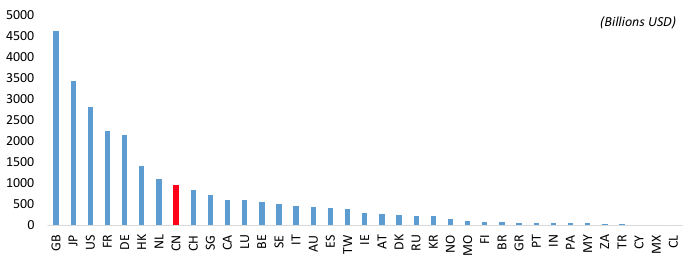
One of the recent upgrades to the Bank for International Settlements' (BIS) banking statistics is an enlargement in the set of reporting countries. With China recently joining the BIS Locational Banking Statistics, it is now possible to have a relatively consistent look at China's cross-border bank lending. As shown in Figure 3, mainland Chinese banks' cross-border claims amounted to $970 billion as of the second quarter of 2017, ranking eighth overall globally and exceeding those of traditional financial centres such as Switzerland and Luxembourg, or countries hosting large international banking groups such as Spain and Italy.

Figure 3 Cross-border claims of BIS reporting countries, 2017Q2

Source: BIS.

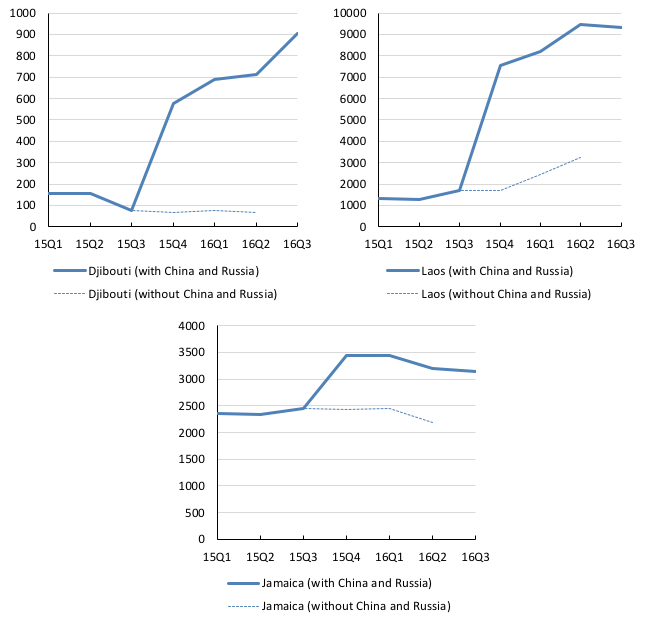
While the BIS does not publicly release China's bilateral exposures to individual counterparties, we approximate the bilateral linkages by comparing two vintages of aggregate total banks' claims from the BIS Locational Banking Statistics dataset.2 One vintage was retrieved on 17 October 2016, weeks before it was replaced with a new vintage of the same publicly available data, but now including Chinese and Russian bank data (we retrieved it on 19 January 2017). As shown in Figure 4, the inclusion of China and Russia triggered sharp increases in banks' claims. For example, BIS reporting of banks' claims on Djibouti jumped by $650 million (an almost tenfold increase) in 2016Q2. To deal with the issue that Russia and China were included simultaneously in the dataset, we exclude in the rest of the analysis former Soviet Union countries, Cyprus, and Malta (the last two being offshore financial centers), which together account for around half of the total claims by Russian banks. The remaining Russian banks' claims are distributed across the other countries, but likely concentrated in the US, the UK, and other developed countries (Koon Goh and Pradhan 2016). Thus, our estimates are probably a good proxy for China's cross-border claims to emerging and developing counterparties.

Figure 4 BIS reporting countries' claims on selected countries, US$ millions

Source: BIS.

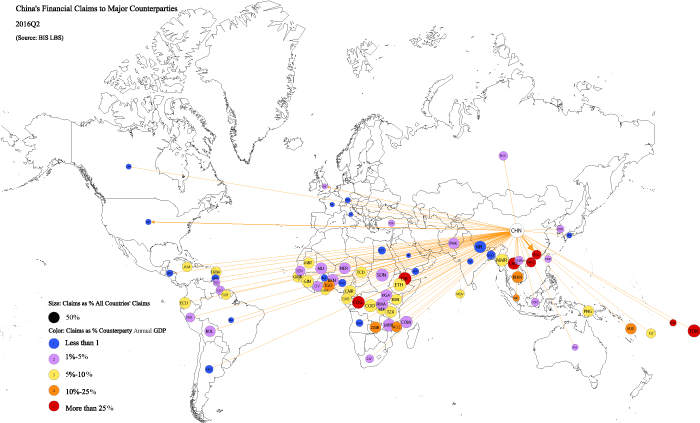
These estimates are plotted in Figure 5, which illustrates the map of Chinese banks' major financial linkages, by displaying counterparties in the map if either they are G20 countries, or if China's claims on the node exceed 5% of BIS reporting countries' total claims on the same node. Not only is China connected to many countries, Chinese banks also serve as major foreign creditors for many countries in sub-Saharan Africa, the Caribbean, and Southeast Asia (illustrated by node ball sizes above 50% in Figure 5). China's overseas presence in the global banking network not only throws light on the expansion of China's banking system, it also highlights the potential spillovers from China to the borrowing countries. In some cases, the claims of banks located in mainland China exceed 25% of counterparty GDP (e.g. Hong Kong, Laos, Congo, and Djibouti).

What can explain the banking relationships? The roles of FDI and trade linkages

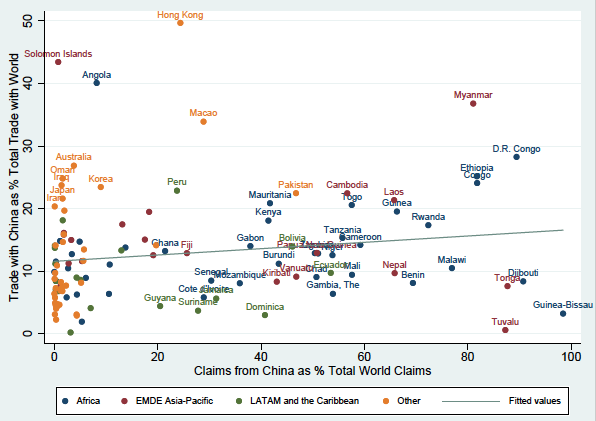
While trade finance motives may explain China's banking linkages, the financial connections go far beyond what trade can explain. Figure 6 compares the cross-sectional relationship between countries' gross trade with China in 2016 (as a share of trade with the world) and China's share of banking claims on them in the second quarter of 2016. Gross trade is defined as gross exports plus gross imports. Overall, no relationship between trade and banking linkages with China is apparent. China's trade and international banking, although related, are not necessarily different sides of the same coin. For a significant number of African and emerging and developing Asian countries, Chinese banks seem to be the major lenders, even though China has not yet established itself as a major trade partner with these countries.

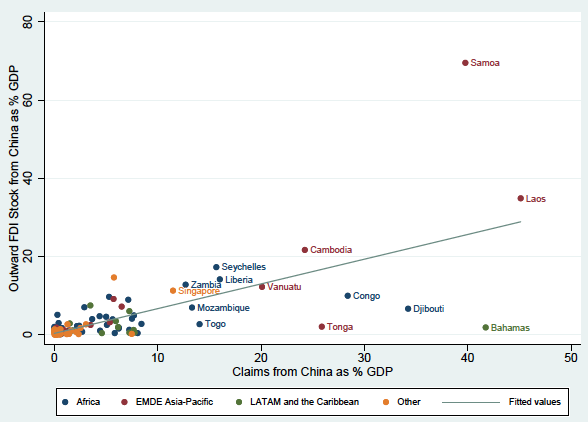
Instead, China's cross-border lending seems to be more synchronised with its outward FDI. Overseas lending from Chinese banks has been used to fund the construction of large-scale infrastructure projects, such as the hydropower station in Laos, supported by the $1.3 billion loan from China Construction Bank (Yap 2017). Using BIS Locational Banking Statistics and CEIC data, Figure 7 presents the cross-sectional relationship between China's bilateral FDI stocks and bank claims, both expressed as percentages of recipient GDP. Indeed, the amount of cumulative FDI tends to be large when China has a large bilateral exposure on cross-border lending.3

Figure 5 Importance of China as a counterparty, 2016Q2

Source: BIS, authors' calculations

Figure 6 Banking and trade linkages with China, 2016

Source: BIS, Direction of Trade Statistics, authors' calculation.

Figure 7 Banking and outward FDI linkages with China, 2016

Notes: Outliers are excluded to facilitate visualisation.
Source: BIS, CEIC, authors' calculations.

Policy conclusions

China's overseas presence in the global banking system is a key feature of the country's banking system, but it also highlights the potential for financial spillovers from China. From the borrowers' side, the large relative estimated size of Chinese banks' claims on several emerging and developing borrower countries highlights that potential spillovers from China depend on direct banking channels together with other traditional channels – such as trade linkages and China's monopsony power over global commodity prices (IMF 2016).

A better understanding of Chinese banking claims might also help to explain other phenomena – for example, the current low incidence of emerging market and developing country sovereign defaults despite heavy recent external borrowing could be partly associated with mismeasurement (e.g. as information on defaults and/or arrears on Chinese loans is not available). Carmen Reinhart raised this issue recently (Reinhart 2017). We cannot directly address this, but estimating Chinese banks' bilateral exposures is a first step to a better understanding of global banking linkages and the increasing importance of China.

Authors' note: The views expressed herein are those of the authors and should not be attributed to the IMF, its Executive Board, or its management.

References

BIS (2016), Quarterly Review, December.

IMF (2016), "Spillovers from China's transition and from migration", October 2016 WEO, Chapter 4.

IMF (2017), "People's Republic of China: Financial System Stability Assessment", Country report No 17/358

Koon Goh, S and S-K Pradhan (2016), "China and Russia join the BIS locational banking statistics", BIS Quarterly Review, December.

Reinhart, C (2017), "The curious case of the missing defaults", Project Syndicate.

Yap, C-W (2017), "Chinese banks ramp up overseas loans", Wall Street Journal, 9 April.

Endnotes

[1] Following the traditional locational definition, throughout this column the reference to the Chinese banking system corresponds to banks operating from mainland China, independently of the nationality of their owners. Having said this, a large majority of the Chinese banking system is domestically owned. The mainland affiliates of foreign-controlled banks owned only about 1.25% of the banking system's total assets. In this context, and given that China is not an offshore centre, the identified claims from Chinese banks do not represent important indirect claims from other banking systems, especially in the case of emerging and developing countries.

[2] China and Russia both joined BIS Locational Banking Statistics as reporting countries in November 2016, and reported aggregate claims starting from 2015Q4 (BIS 2016).

[3] This correlation is probably consistent with the 'going global' strategy promoted by the Chinese government. The relationship may be even stronger as the 'One Belt One Road' initiative unfolds.


--
John Case
Harpers Ferry, WV

The Winners and Losers Radio Show
7-9 AM Weekdays, The Enlighten Radio Player Stream, 
Sign UP HERE to get the Weekly Program Notes.

Angus Deaton on the Under-Discussed Driver of Inequality in America: “It’s Easier for Rent-Seekers to Affect Policy Here Than In Much of Europe” [feedly]

Angus Deaton on the Under-Discussed Driver of Inequality in America: "It's Easier for Rent-Seekers to Affect Policy Here Than In Much of Europe"
http://economistsview.typepad.com/economistsview/2018/02/angus-deaton-on-the-under-discussed-driver-of-inequality-in-america-its-easier-for-rent-seekers-to-a.html

"In an interview with ProMarket, Nobel Prize-winning economist Angus Deaton talks about the connection of rent-seeking and monopolization to rising inequality":

Angus Deaton on the Under-Discussed Driver of Inequality in America: "It's Easier for Rent-Seekers to Affect Policy Here Than In Much of Europe": In December, the United Nations' special rapporteur on extreme poverty and human rights, Philip Alston, embarked on a coast-to-coast tour of the United States. Alston's fact-finding mission, conducted at the invitation of the federal government, resulted in a grim report that declared the US "the world champion of extreme inequality" and highlighted the vast inequities that plague American society: The US is one of the world's wealthiest countries, yet 40 million of its inhabitants live in poverty, its infant mortality rates are the highest among developed nations, and Americans lead "shorter and sicker lives, compared to people living in any other rich democracy." The US also has the lowest rate of social mobility of any rich country, rapidly turning the American Dream—its national ethos—to "an American illusion."
Rising inequality has been the focus of countless articles, books and debates in recent years, as more and more empirical studies show that in the decades since 1980, income gains have gone overwhelmingly to the top 1 percent and 0.1 percent. Much of the debate, however, is concerned with the implications of inequality: Does rising inequality negatively affect economic growth? Does it undermine democracy? Did it contribute to the rise of populist politics in America and around the developed world?
Those, says Nobel Prize-winning economist Angus Deaton, are the wrong questions to ask if we wish to understand inequality. In fact, he suggested in a recent piece for Project Syndicate, it's possible that the term "inequality" itself might be ill-fitting. A better term might be "unfairness": Inequality, he argued, is the consequence of economic, political, and social processes—some good, some bad, and some very bad. The key to addressing its rapid increase is to address the processes that can be deemed "unfair."
Examples are plenty. In his piece, Deaton focuses on several processes and policies that have allowed the rich to get richer while holding down middle- and working-class wages. Among them: rising health care costsmarket consolidation, diminishing labor power, and corporations' political power. These processes do not stem from "unstoppable processes" like technology or globalization, argues Deaton, but are the result of rent-seeking. 
Deaton, the recipient of the 2015 Nobel Prize in Economics, is one of the world's foremost experts on inequality. The groundbreaking research on US mortality rates he conducted together with Anne Case revealed an increase in midlife mortality rates among white non-Hispanic Americans, led by death related to drugs, alcohol and suicide—what they called "deaths of despair."
To better understand the connection between inequality and rent-seeking in America, we spoke with Deaton, a Senior Scholar and the Dwight D. Eisenhower Professor of Economics and International Affairs Emeritus at the Woodrow Wilson School of Public and International Affairs and the Economics Department at Princeton University. In his interview with ProMarket, Deaton discussed the connection of rent-seeking and monopolization to rising inequality, and explained why he believes it's easier for rent-seekers to influence policy in the US than in Europe. ...[continue]...


 -- via my feedly newsfeed

West Virginia GDP -- a Streamlit Version

  A survey of West Virginia GDP by industrial sectors for 2022, with commentary This is content on the main page.