Sunday, April 12, 2020

The Green New Deal and the State: Lessons from World War II—Part II [feedly]

The Green New Deal and the State: Lessons from World War II—Part II
https://economicfront.wordpress.com/2020/04/10/the-green-new-deal-and-the-state-lessons-from-world-war-ii-part-ii/

There is growing interest in a Green New Deal, but far too little discussion among supporters about the challenging nature of the required economic transformation, the necessary role of public planning and ownership in shaping it, or the strategies necessary to institutionalize a strong worker-community voice in the process and final outcome. In this two-part series I draw on the experience of World War II, when the state was forced to direct a rapid transformation from civilian to military production, to help encourage and concretize that discussion.

In Part I, I first discussed the need for a rapid Green New Deal-inspired transformation and the value of studying the U.S. experience during World War II to help us achieve it. Then, I examined the evolution, challenges, and central role of state planning in the wartime conversion to alert us to the kind of state agencies and capacities we will need to develop. Finally, I highlighted two problematic aspects of the wartime conversion and postwar reconversion which we must guard against: the ability of corporations to strengthen their dominance and the marginalization of working people from any decision-making role in conversion planning.

Here in Part II, I discuss the efforts of labor activists to democratize the process of transformation during the war period in order to sharpen our thinking about how best to organize a labor-community movement for a Green New Deal.  During this period, many labor activists struggled against powerful political forces to open up space for new forms of economic planning with institutionalized worker-community involvement.  The organizing and movement building efforts of District 8 leaders of the United Electrical, Radio & Machine Workers of America (UE), as described by Rosemary Feuer in her book Radical Unionism in the Midwest, 1900-1950, stand out in this regard.  Although their success was limited, there is much that we can learn from their efforts.

Organizing for a worker-community planned conversion process

District 8 covered Missouri, Iowa, Kansas, Arkansas, southern Indiana and southern and western Illinois, and UE contracts in that area were heavily weighted towards small and medium sized firms producing mechanical and electrical products.  As the government began its war time economic conversion in 1941, its policy of suppressing civilian goods and rewarding big corporations with defense contracts hit the firms that employed UE members hard.

The UE response was to build a labor and community-based effort to gain control over the conversion process. In Evansville, Indiana, the UE organized a community campaign titled "Prevent Evansville from Becoming a Ghost Town."  As Feurer explains,

District 8's tentative proposal called upon union and civic and business leaders to request the establishment of a federal program that would "be administered through joint and bona fide union-management-government cooperation" at the local level. It would ensure that before reductions in the production of consumer goods were instituted, government must give enough primary war contracts and subcontracts to "take up the slack" of unemployment caused in cities such as Evansville. It also proposed that laid-off workers would get "first claim on jobs with other companies in the community," while excessive overtime would be eliminated until unemployment was reduced.

District 8 organizers pressed Evansville's mayor to gather community, labor, and business representatives from all over the Midwest to discuss how to manage the conversion to save jobs.  They organized mass petition drives and won endorsements for their campaign from many community groups and small businesses.  Persuaded, Evansville's mayor contacted some 500 mayors from cities with populations under 250,000 in eleven midwestern states, requesting that they send delegations of "city officials, labor leaders, managers of industry and other civic leaders" to a gathering in Chicago.  Some 1500 delegates attended the September meeting.

The conference endorsed the UE's call for a significant role for labor in conversion planning, specifically "equal participation of management and labor in determining a proper and adequate retraining program and allocation of primary and sub-contracts. . . [And that] all possible steps be taken to avoid serious dislocations in non-defense industries."  A committee of seven, with two labor representatives, was chosen to draw up a more concrete program of action.

One result was that Evansville and Newton, Iowa (another city with a strong UE presence) were named "Priority Unemployment Plan" areas, and allowed to conduct "an experiment for community-based solving of unemployment and dislocations caused by war priorities."  The plan restricted new plant construction if existing production capacity was considered sufficient, encouraged industry-wide and geographical-based pooling of production facilities to boost efficiency and stabilize employment, required companies to provide training to help workers upgrade their skills, and supported industry-wide studies to determine how to best adapt existing facilities for military production.

William Sentner, the head of District 8, called for labor to take a leading role in organizing community gatherings in other regions and creating regional planning councils. Unfortunately, CIO leaders did little to support the idea. Moreover, once the war started, unemployment stopped being a serious problem and the federal government took direct control over the conversion process.

Organizing for a worker-community planned reconversion process

As the war began to wind down, District 8 leaders once again took up the issue of conversion, this time conversion back to a peacetime economy.  In 1943, they got the mayor of St. Louis to create a community planning committee, with strong labor participation, to discuss future economic possibilities for the city.  In 1944, they organized a series of union conferences with elected worker representatives from each factory department in plants under UE contract throughout the district, along with selected guests, to discuss reconversion and postwar employment issues.

At these conferences District 8 leaders emphasized the importance of continued government planning to guarantee full employment, but also stressed that the new jobs should be interesting and fulfilling and the workweek should be reduced to 30 hours to allow more time for study, recreation, and family life.  They also discussed the importance of other goals: an expansion of workers' rights in production; labor-management collaboration to develop and produce new products responsive to new needs; support for women who wanted to continue working, in part by the provision of nurseries; and the need to end employment discrimination against African Americans.

While these conferences were taking place, the Missouri River flooded, covering many thousands of acres of farmland with dirt and sand, and leaving thousands of people homeless.  The US Army Corps of Engineers rushed to take advantage of the situation, proposing a major dredging operation to deepen the lower Missouri River channel, an effort strongly supported by big shipping interests.  It became known as the Pick Plan. Not long after, the Bureau of Reclamation proposed a competing plan that involved building a series of dams and reservoirs in the upper river valley, a plan strongly supported by big agricultural interests. It became known as the Sloan Plan.

While lower river and upper river business interests battled, a grassroots movement grew across the region opposing both plans, seeing them, each in their own way, as highly destructive.  For example, building the dams and reservoirs would destroy the environment and require the flooding of hundreds of thousands of acres, much of it owned by small farmers, and leave tens of thousands of families without homes.

Influenced by the growing public anger, newspapers in St. Louis began calling for the creation of a new public authority, a Missouri Valley Authority (MVA), to implement a unified plan for flood control and development that was responsive to popular needs.  Their interest in an MVA reflected the popularity of the Tennessee Valley Authority (TVA), an agency created in 1933 and tasked with providing cheap electricity to homes and businesses and addressing many of the region's other development challenges, such as flooding, land erosion, and population out-migration.  In fact, during the 1930s, several bills were submitted to Congress to establish other river-based regional authorities.  Roosevelt endorsed seven of them, but they all died in committee as the Congress grew more conservative and war planning took center stage in Washington DC.

District 8, building on its desire to promote postwar regional public planning, eagerly took up the idea of an MVA.  It issued a pamphlet titled "One River, One Plan" that laid out its vision for the agency.  As a public agency, it was to be responsive to a broad community steering committee; have the authority to engage in economic and environmental planning for the region; and, like the TVA, directly employ unionized workers to carry out much of its work.  Its primary tasks would be the electrification of rural areas and flood control through soil and water conservation projects and reforestation.  The pamphlet estimated that five hundred thousand jobs could be created within five years as a result of these activities and the greater demand for goods and services flowing from electrification and the revitalization of small farms and their communities.

District 8 used its pamphlet to launch a community-based grassroots campaign for its MVA, which received strong support from many unions, environmentalists, and farm groups.  And, in August 1944, Senator James Murray from Montana submitted legislation to establish an MVA, written largely with the help of District 8 representatives.  A similar bill was submitted in the House.  Both versions called for a two-year planning period with the final plan to be voted on by Congress.

District 8 began planning for a bigger campaign to win Congressional approval.  However, their efforts were dealt a major blow when rival supporters of the Pick and Sloan plans settled their differences and coalesced around a compromise plan.  Congress quickly approved the Pick-Sloan Flood Control Act late December 1944 but, giving MVA supporters some hope that they could still prevail, Senator Murray succeeded in removing the act's anti-MVA provisions.

District 8 leaders persuaded their national union to assign staff to help them establish a St. Louis committee, a nine-state committee, and a national committee to support the MVA. The St. Louis committee was formed in January 1945 with a diverse community-based steering committee.  Its strong outreach effort was remarkably successful, even winning support from the St. Louis Chamber of Commerce.  Feurer provides a good picture of the breadth and success of the effort:

By early 1945, other city-based committees were organizing in the nine-state region. A new national CIO committee for an MVA laid plans for "reaching every CIO member in the nine-state region on the importance of regionally administered MVA.  In addition, other state CIO federations pledged to organize for an MVA and to disseminate material on the MVA through local unions to individual members.  Further the seeds planted in 1944 among AFL unions were beginning to develop into a real coalition.  In Kansas City, the AFL was "circulating all the building trades unions in the nine states for support" to establish a nine-state buildings trades MVA committee. Both the AFL and CIO held valley wide conferences on the MVA to promote and organize for it.

Murray submitted a new bill in February 1945, which included new measures on soil conversation and the protection of wild game, water conservation, and forest renewal. It also gave the MVA responsibility for the "disposal of war and defense factories to encourage industrial and business expansion."

But the political tide had turned.  The economy was in expansion, the Democratic Party was moving rightward, and powerful forces were promoting a growing fear of communism.  Murray's new bill was shunted to a hostile committee and big business mounted an unrelenting and successful campaign to kill it, arguing that the MVA would establish an undemocratic "super-government," was a step toward "state socialism," and was now unnecessary given passage of the Pick-Sloan Flood Control Act.

Drawing lessons

A careful study of District 8's efforts, especially its campaign for an MVA, can help us think more creatively and effectively about how to build a labor-community coalition in support of a Green New Deal.  In terms of policy, there are many reasons to consider following District 8 in advocating for regionally based public entities empowered to plan and direct economic activity as a way to begin the national process of transformation.  For example, many of the consequences of climate change are experienced differently depending on region, which makes it far more effective to plan regional responses.  And many of the energy and natural resources that need to be managed during a period of transformation are shared by neighboring states.  Moreover, state governments, unions, and community groups are more likely to have established relations with their regional counterparts, making conversation and coordination easier to achieve.  Also, regionally organized action would make it much harder for corporations to use inter-state competition to weaken initiatives.

Jonathan Kissam, UE's Communication Director and editor of the UE News, advocates just such an approach:

UE District 8's Missouri Valley Authority proposal could easily be revived and modernized, and combined with elements of the British proposal for a National Climate Service. A network of regional Just Transition Authorities, publicly owned and accountable to communities and workers, could be set up to address the specific carbon-reduction and employment needs of different regions of the country.

The political lessons are perhaps the most important.  District 8's success in building significant labor-community alliances around innovative plans for war conversion and then peacetime reconversion highlights the pivotal role unions can, or perhaps must, play in a progressive transformation process.  Underpinning this success was District 8's commitment to sustained internal organizing and engagement with community partners.  Union members embraced the campaigns because they could see how a planned transformation of regional economic activity was the only way to secure meaningful improvements in workplace conditions, and such a transformation could only be won in alliance with the broader community.  And community allies, and eventually even political leaders, were drawn to the campaigns because they recognized that joining with organized labor gave them the best chance to win structural changes that also benefited them.

We face enormous challenges in attempting to build a similar kind of working class-anchored movement for a Green New Deal-inspired economic transformation.  Among them: weakened unions; popular distrust of the effectiveness of public planning and production; and weak ties between labor, environmental, and other community groups.  Overcoming these challenges will require our own sustained conversations and organizing to strengthen the capacities of, and connections between, our organizations and to develop a shared and grounded vision of a Green New Deal, one that can unite and empower the broader movement for change we so desperately need.


 -- via my feedly newsfeed

Saturday, April 11, 2020

American Democracy May Be Dying [feedly]

The state of US bourgeois democracy, its brittleness, sclerosis, paralysis and inequities, is being exposed. From the right, and the fascists like Trump, the weaknesses are exploited to benefit the class  interests of billionaires in suppressing the voting power, and other democratic institutions through which working people can exercise their rights.

However, I got to say, that getting to a more natural and sustainable democracy, may require a more Lincolnesque methods of suppressing, prosecuting and repressing the slavery-like fascist forces. They do not understand, nor respond to, anything but force. There should be no illusions about that. if there are still illusions on that -- the coming year will persuade you otherwise.

PK: American Democracy May Be Dying
https://www.nytimes.com/2020/04/09/opinion/wisconsin-primary-democracy.html

text only

Authoritarian rule may be just around the corner.

By Paul Krugman

Opinion Columnist

April 9, 2020

3257

Wisconsin Republican leaders gave citizens a choice on Tuesday: give up their vote or go to the polls and risk their and their neighbors' health. Credit...Tannen Maury/EPA, via Shutterstock

If you aren't terrified both by Covid-19 and by its economic consequences, you haven't been paying attention.

Even though social distancing may be slowing the disease's spread, tens of thousands more Americans will surely die in the months ahead (and official accounts surely understate the true death toll). And the economic lockdown necessary to achieve social distancing — as I've been saying, the economy is in the equivalent of a medically induced coma — has led to almost 17 million new claims for unemployment insurance over the past three weeks, again almost surely an understatement of true job losses.

Yet the scariest news of the past week didn't involve either epidemiology or economics; it was the travesty of an election in Wisconsin, where the Supreme Court required that in-person voting proceed despite the health risks and the fact that many who requested absentee ballots never got them.

Why was this so scary? Because it shows that America as we know it may not survive much longer. The pandemic will eventually end; the economy will eventually recover. But democracy, once lost, may never come back. And we're much closer to losing our democracy than many people realize.

ADVERTISEMENT

Continue reading the main story

To see how a modern democracy can die, look at events in Europe, especially Hungary, over the past decade.

What happened in Hungary, beginning in 2011, was that Fidesz, the nation's white nationalist ruling party, took advantage of its position to rig the electoral system, effectively making its rule permanent. Then it further consolidated its control, using political power to reward friendly businesses while punishing critics, and moved to suppress independent news media.

Until recently, it seemed as if Viktor Orban, Hungary's de facto dictator, might stop with soft authoritarianism, presiding over a regime that preserved some of the outward forms of democracy, neutralizing and punishing opposition without actually making criticism illegal. But now his government has used the coronavirus as an excuse to abandon even the pretense of constitutional government, giving Orban the power to rule by decree.

If you say that something similar can't happen here, you're hopelessly naïve. In fact, it's already happening here, especially at the state level. Wisconsin, in particular, is well on its way toward becoming Hungary on Lake Michigan, as Republicans seek a permanent lock on power.

Editors' Picks

The Virus Changed the Way We Internet

Here's How Those Hot Jigsaw Puzzles Are Made

These Young Renters Wanted a Starter Apartment in Manhattan for a Reasonable Price. Here's What They Found.

Continue reading the main story

ADVERTISEMENT

Continue reading the main story

The story so far: Back in 2018, Wisconsin's electorate voted strongly for Democratic control. Voters chose a Democratic governor, and gave 53 percent of their support to Democratic candidates for the State Assembly. But the state is so heavily gerrymandered that despite this popular-vote majority, Democrats got only 36 percent of the Assembly's seats.

And far from trying to reach some accommodation with the governor-elect, Republicans moved to effectively emasculate him, drastically reducing the powers of his office.

Then came Tuesday's election. In normal times most attention would have been focused on the Democratic primary — although that became a moot point when Bernie Sanders suspended his campaign. But a seat on the State Supreme Court was also at stake.

Yet Wisconsin, like most of the country, is under a stay-at-home order. So why did Republican legislators, eventually backed by the Republican appointees to the U.S. Supreme Court, insist on holding an election as if the situation were normal?

The answer is that the state shutdown had a much more severe impact on voting in Democratic-leaning urban areas, where a great majority of polling places were closed, than in rural or suburban areas. So the state G.O.P. was nakedly exploiting a pandemic to disenfranchise those likely to vote against it.

What we saw in Wisconsin, in short, was a state party doing whatever it takes to cling to power even if a majority of voters want it out — and a partisan bloc on the Supreme Court backing its efforts. Donald Trump, as usual, said the quiet part out loud: If we expand early voting and voting by mail, "you'd never have a Republican elected in this country again."

Does anyone seriously doubt that something similar could happen, very soon, at a national level?

This November, it's all too possible that Trump will eke out an Electoral College win thanks to widespread voter suppression. If he does — or even if he wins cleanly — everything we've seen suggests that he will use a second term to punish everyone he sees as a domestic enemy, and that his party will back him all the way. That is, America will do a full Hungary.

ADVERTISEMENT

Continue reading the main story

What if Trump loses? You know what he'll do: He'll claim that Joe Biden's victory was based on voter fraud, that millions of illegal immigrants cast ballots or something like that. Would the Republican Party, and perhaps more important, Fox News, support his refusal to accept reality? What do you think?

So that's why what just happened in Wisconsin scares me more than either disease or depression. For it shows that one of our two major parties simply doesn't believe in democracy. Authoritarian rule may be just around the corner.


 -- via my feedly newsfeed

C.D.C. Releases Early Demographic Snapshot of Worst Coronavirus Cases [feedly]

C.D.C. Releases Early Demographic Snapshot of Worst Coronavirus Cases
https://www.nytimes.com/2020/04/08/health/coronavirus-cdc-demographic-study-hospitalizations.html

 -- via my feedly newsfeed

text only:

On March 1, there were 88 confirmed cases of the coronavirus in the United States. By month's end, there were more than 170,000. The Centers for Disease Control and Prevention has compiled data on people who were hospitalized from the virus during that month to get a clearer demographic picture of infected patients who have required the most serious medical care.

The study, released Wednesday, found that older people infected with the virus were more likely to be hospitalized; men were more likely to endure severe cases than women; and black people were hospitalized at a higher rate than whites. The study also found that hospitalization rates for Covid-19 have been significantly higher than for recent outbreaks of influenza.

The data, based on hospitalizations from March 1 to 30, was taken from a network of hospitals in parts of 14 states, including New York, Connecticut, California and Ohio. The area studied includes only about 10 percent of the overall population of the United States, but is seen as a representative snapshot of the virus's spread and the demographic breakdown of patients.

"There have been a lot of questions swirling about testing and what is the actual burden of the disease in the population," said Charles Branas, a professor of epidemiology at Columbia University, who did not participate in the study. "By the time it gets to hospitals, that is a really nice way to gauge the burden of the disease."

ADVERTISEMENT

Continue reading the main story

The C.D.C. uses information on hospitalizations to help public health officials better understand the evolving epidemiology of a disease, and to help in the planning and prioritization of health care resources.

Latest Updates: Coronavirus Outbreak in the U.S.

The United States is on track to surpass Italy with the number of confirmed deaths from the coronavirus.
New York City schools closed through end of academic year
Prohibit Easter church services? Some governors offer guidance, not orders.

See more updates
Updated 27m ago
More live coverage: Global Markets New York

On Wednesday, the C.D.C. also announced new guidelines outlining how employees who are considered essential by their employers but who have been exposed to people infected by the virus can go back to work. The guidelines apply to workers who do not feel sick and are able to follow certain precautions.

Refer your friends to The Times.

Such workers can return to work if they take their temperature before heading to their workplace, wear a face mask at all times and practice social distancing while on the job, Dr. Robert Redfield, the C.D.C. director, said at the White House coronavirus briefing. While at work, they should not share headsets or other objects that touch their face, and they should not congregate in break rooms or crowded places, he added.

Dr. Redfield said that employers should send workers home immediately if they developed any symptoms. He also said they should increase air exchange in their buildings, and should clean common surfaces more often. The goal, he said, is to "get these workers back into the critical work force so that we don't have worker shortages." In its report on hospitalization data, the agency cautioned that the findings about Covid-19 were preliminary, with the number of cases expected to increase considerably as the virus continues to spread and as testing becomes more available. Also, the data does not reflect the surge of cases during the first week of April, straining hospitals in places like New York, New Jersey, Louisiana and Michigan.

But the numbers reflected trends that were reported from other countries at earlier stages of the outbreak. The C.D.C. received information about possible underlying medical conditions in a subset of 180 patients. Approximately 90 percent of those patients had one or more underlying conditions. The most common of those was hypertension, in 49.7 percent of patients, followed by obesity, chronic metabolic disease (like diabetes), chronic lung disease (like asthma) and cardiovascular disease.

ADVERTISEMENT

Continue reading the main story

In terms of age and gender, 74.5 percent of patients were 50 or older, and 54.4 percent were male.

18

Covid-19 hospitalization rates

per 100,000 population

16

14

12

10

8

6

4

2

Age 0–4

5–17

18–49

50–64

65–74

75–84

85+

By The New York Times | Source: C.D.C. data from 14 states

The report also shows that, while the highest overall percentage of hospitalized patients were white (45 percent), the percentage of black patients (33 percent) was much higher than the percentage of African-Americans in the population as a whole. In the geographical areas covered by the study, 59 percent of the population is white, the report said, and 18 percent is black, "suggesting that black populations might be disproportionately affected by Covid-19."

In the included region, men generally represent 49 percent of the population and women 51 percent, which effectively further widens the disproportionate percentage of men requiring hospitalization.

The report emphasized that its findings would need to be confirmed by more data.

Over all, 4.6 people per 100,000 have been hospitalized in the area studied. But the rate jumped to 13.8 per 100,000 for people 65 and older, which the C.D.C. found was higher than the rates for recent influenza patients. The study compared data from the first four weeks of the past five seasons of influenza, and found those hospitalization rates ranged from 0.1 per 100,000 people between the ages of 5 to 17, up to between 2.2 and 5.4 for people 85 and older. For Covid-19, the hospitalization rate for patients 85 or older is 17.2 per 100,000.

These Charts Show Global Economy's Dive Into Deep Recession [feedly]

These Charts Show Global Economy's Dive Into Deep Recession
https://www.bloomberg.com/news/articles/2020-04-10/these-charts-show-global-economy-s-dive-into-deep-recession

The bad economic news has been coming thick and fast, from record drops in activity to record surges in jobless claims, and unsurprisingly it's set to continue next week.

The International Monetary Fund updates its global forecasts to coincide with its spring meeting, which will now take place via video conference for the first time because of the coronavirus.

ADVERTISING

Huge downgrades are expected, echoing the multiple dire predictions from economists, institutions and central banks already. In a gloomy preview, Managing Director Kristalina Georgieva said Thursday the world is looking at the worst economic fallout since the Great Depression.

Here are some of the charts that appeared on Bloomberg this week, offering a snapshot of the immense damage being done to activity, jobs and government finances because of the measures needed to contain the virus.

Serious Losses

JPMorgan says virus could cost world at least $5.5 trillion in lost output

Source: JPMorgan Chase

Note: Forecasts show deviation from Jan. 24 baseline

The coronavirus outbreak is set to rob the global economy of more than $5 trillion of growth over the next two years, according to JPMorgan Chase economists. That's almost 8% of gross domestic product, or greater than the annual output of Japan.

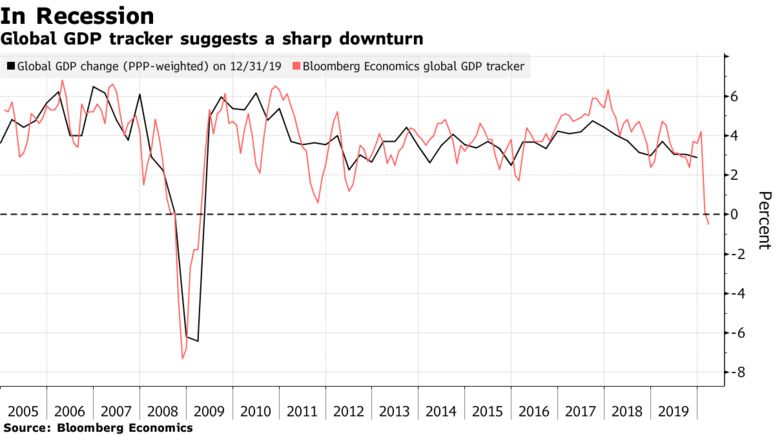
Global GDP tracker suggests a sharp downturn

The global economy is already shrinking, and losing steam faster than in the early days of the financial crisis: That's the main takeaway from Bloomberg Economics' new global GDP tracker. The reading for March shows a 0.5% contraction on an annualized basis, compared 0.1% in February. With lockdowns deepening over the past month and set to stay in place in April, the March reading is unlikely to be the worst of the downturn.

Risky Business

The ILO fears 38% of the world's workers are at risk of layoffs, pay cuts

Source: International Labor Organization

The pandemic is having a "deep, far-reaching and unprecedented" impact on employment, with more than 1 billion workers at high risk of a pay cut or losing their job, according to the International Labor Organization. With factories, schools and shops shuttered around the world, the ILO says lockdowns are affecting almost 2.7 billion workers. Within that, almost half -- representing about 38% of the global workforce -- are extremely vulnerable, mainly in the hotel, food service, manufacturing and retail industries.

Ugly Numbers

The World Trade Organization says 2020 trade could fall as much as 32%

Source: World Trade Organization 

The World Trade Organization says there may be a deeper collapse of international trade flows than at any point in the postwar era. The WTO presented two possible scenarios for global trade in the years to come in a report published Wednesday, noting that the unprecedented nature of the health crisis could result in a wide range of outcomes. In an optimistic scenario, the WTO forecasts merchandise trade may fall 13% in 2020 and rebound 21% in 2021, while in a pessimistic case volumes could drop by as much as 32% before increasing 24% next year.

Quantitative Easing

Net asset purchases for G-7 central banks approached $1.4 trillion in March

Source: Bloomberg Economics

Major central banks have been forced to take extreme steps to support growth and underpin financial stability. Across the Group of Seven, that's included the return, or launch, of large-scale asset purchases. Net asset purchases for G-7 central banks were close to $1.4 trillion in March. That's an extraordinary total, close to five times higher than the previous peak of $270 billion in April 2009, according to Bloomberg Economics.

Fiscal Stimulus

Spending packages vary vastly globally

Source: ING Bank report from April 2, calculations exclude liquidity and guarantees

Leaders around the global are unveiling ever-bigger spending packages to help companies and workers. In the European Union, finance ministers managed to paper over differences this week to agree a 540 billion-euro package. Russia was proving an outlier, with the Kremlin hoarding hundreds of billions of dollars in reserves. ING Bank estimates President Vladimir Putin's support measures so far amount to only about 2% of GDP. That is set to change: The government will roll out about 1 trillion rubles ($13.5 billion) of new spending, according to people familiar with the plans.

Movement Denied

Europe imposed tough clampdowns on movement in response to virus

Source: UBS Global Mobility Restrictions Tracker

Note: *Restriction rating on 10-point scale

Countries have implemented social distancing measures and shutdowns at varying speeds and intensity. While some governments have spoken about gradually easing tough restrictions, any return to what might be recognized as "business as usual" is unlikely to happen very soon.

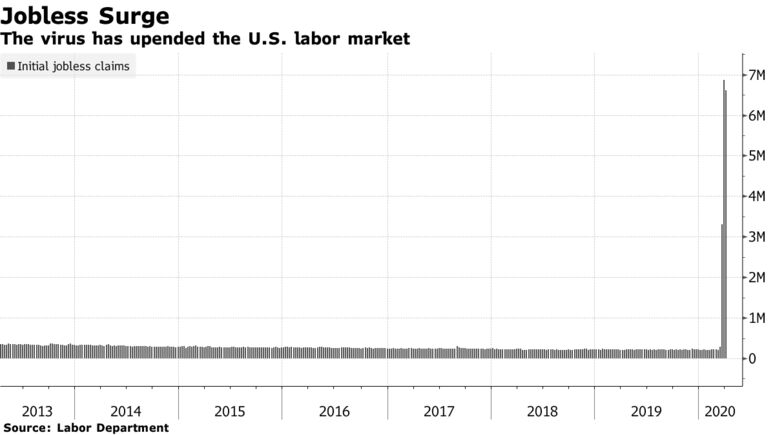
The virus has upended the U.S. labor market

With huge swathes of economies shut down, workers have been laid off, lost hours or been furloughed. In the U.S., the impact on the labor market can be clearly, and depressingly, seen in initial jobless claims, with the weekly total hitting more than 6.6 million. The average over the past five years -- before the virus-related surge -- is less than 250,000.

— With assistance by Anna Andrianova, Bryce Baschuk, Catherine Bosley, David Goodman, Dan Hanson, William Horobin, Jeannette Neumann, Tom Orlik, and Reade Pickert


 -- via my feedly newsfeed

States continue to see record-high levels of initial unemployment insurance claims, including in the South [feedly]

States continue to see record-high levels of initial unemployment insurance claims, including in the South
https://www.epi.org/blog/states-continue-to-see-record-high-levels-of-initial-unemployment-insurance-claims-including-in-the-south/

Key takeaways:
  • 28 states had record numbers of unemployment insurance (UI) filings last week. The rest of them had their record high one of the previous two weeks.
  • California, Georgia, Michigan, New York, and Texas filed the most claims last week.
  • Southern states didn't initially lose jobs as quickly as other states, because they were slow to implement social distancing measures. Now, however, they are experiencing this unprecedented job loss particularly acutely.
  • The federal government should take on the costs of keeping workers on the payroll and provide substantially more funding to state and local governments.

Another 6.6 million people filed initial unemployment insurance (UI) claims last week, continuing the upending of the labor market we have seen in response to the coronavirus pandemic. According to seasonally adjusted data released yesterday morning by the Department of Labor, over the last three weeks, 16.8 million—over one in 10—workers have filed for UI. As the labor market is disrupted, so are the lives of millions of workers across the country.

Last week, 28 states saw a record number of initial UI filings, with the rest of the states experiencing their high point during one of the prior two weeks. While many states saw a slight decline in UI claims compared to the prior week, the number of claims filed this week is still staggeringly high. In the four weeks between March 7 and April 4, over two million Californians and one million Pennsylvanians filed UI claims. 

Figure A

In addition to the one-week change in UI claims (which is slower or even negative relative to the record-setting week before), Figure A shows the change in claims relative to the pre-virus period, or the average of initial UI claims for the four weeks ending March 7.

After Californians, Georgians filed the most initial UI claims last week, followed by Michigan, New York, and Texas. In fact, last week Georgia saw the largest percent increase in claims of any state compared to the week prior and relative to the pre-virus period. As we predicted, initial UI claims continued to increase across much of the South. Many other southern states were among the 10 states with the highest over-the-week percent change in UI claims (Arkansas, Mississippi, Virginia, Alabama, and South Carolina) or the ten states with the highest percent change relative to the pre-virus period (Louisiana, Tennessee, Virginia, Mississippi, and North Carolina).

Although Southern states generally weren't among the hardest hit initially, likely because they were slow to take up social distancing measures, it is now clear that they are also experiencing job loss on an unprecedented scale. This underscores the importance of the need for policymakers in Southern states to bolster and expand access to their strained UI systems.

Table 1 shows the data displayed in the map as well as the change in UI claims over the last four weeks relative to the same four-week period a year ago. These extreme increases in UI claims over the past few weeks represent not only a devastating loss of income for these individuals and their families, but a massive strain on under-resourced state unemployment insurance agencies. To get these workers the unemployment they deserve and desperately need, federal funding is needed to support these agencies and states must leverage existing laws to get aid to workers quickly.

We expect nearly 20 million workers to be laid off or furloughed by the summer, although it could end up being even higher. While it may seem like job losses are an inevitable outcome of the social distancing measures necessary to slow the spread of disease, this is simply not the case. In other countries, like Denmark, the Netherlands, and the United Kingdom, the government has stepped in to cover most payroll costs for employers affected by coronavirus-related shutdowns. The United States could follow suit by doing the same and undertaking other transformative measures. At the very least, policymakers must address gaps, including insufficient aid to state and local governments, in the existing relief and recovery measures in a fourth package.

Table 1

 -- via my feedly newsfeed

Friday, April 10, 2020

World Federalism, Global Democracy and Coronavirus [feedly]

I completely agree. But the slip between the cup of reason and the lip of thirst is awesome. One trembles at the the blood loss and treasure costs of nationalism expended,  before the unavoidable necessity of global governance is confronted. And, it won't happen all at once. But failure to move  forward, in this crisis, toward internationalism -- will exact a very steep price. History's harsh guidance on social memory tends to argue that we don't really pay attention, collectively, until the pain of false posturing is unendurable.

World Federalism, Global Democracy and Coronavirus

https://www.globalpolicyjournal.com/blog/10/04/2020/world-federalism-global-democracy-and-coronavirus
 Fernando Adolfo Iglesias  

The coronavirus crisis shows the consequences of the enormous contradiction under which seven billion human beings live now: a world globalized by technology and economy but politically divided into almost 200 national states all taking separate and uncoordinated measures. Does anyone still believe this can work?

Financial instability. Climate change. Coronavirus crisis. Indifferent to the warning signals, we continue to keep our political systems bounded to the national/international model based on the paradigm of national sovereignty. Each govern to according to whatever best suits their national interest. "Sovereignism" they call it, and we all pay the consequences.


Has there been Chinese negligence during the start of the coronavirus pandemic? Was it a Trump's, or a Putin's, or a terrorist sect's plot? Did all the involved countries react appropriately? Are they doing it well? We do not really know, as there are no transparent global mechanisms for early detection and control of pandemics. We do not know, but our lives are at stake over this.


Of course, despite the sabotage of national populists, the United Nations and the World Health Organization still exist. But the coronavirus pandemic has made it clear that the capacities of the UN and its agencies are far below the requirements of a global society, which needs binding action at the global level: early warning systems, information sharing, delivery and enforcement of general norms, management of transmission across borders and vaccine-treatment research.

Basic regulations and mandatory standards are crucial to preserve world public goods such as human health, environment, financial stability and international peace.


Yet, although the UN and its agencies do exist, national states are free to refuse to take action and to follow the wrong measures, causing disastrous consequences for the rest. Exaggeration? It is exactly what is happening with coronavirus and global warming right now.


A new world will emerge from the coronavirus pandemic, everybody says so; but nobody knows if it will be a better or a worse one. If each country decides to play its own cards - as at the beginning of the 20th century - the consequences will be the same: disconnection, a rise in nationalism, an inability to face common challenges, extended crises; and then, authoritarianism, growing conflicts, tragedies, death and despair.


Fortunately, it is fated. Since the creation of the United States and the European Union, we human beings have developed two paradigms to avoid these nightmares, federalism and democracy, which have been extraordinarily successful at the national and regional levels. The time to apply them to the global scale has come.


Unfortunately, despite being amazing innovators in technology and pragmatic geniuses in economics, we human remain conservative in politics. Applying federalism and democracy to the global field still sounds like a utopian dream for most. At the same time, a network based on electrical impulses and encoded by ones and zeros almost covers the whole world regardless of how divisive it is for our economies, cultures and social relationships. Indeed, it now seems the most natural thing on Earth to everybody.


A federal-democratic global structure or a new nightmare, that is the question we face? A global democracy in which a world parliament delivers mandatory early-warning standards and binding health protocols in response to pandemics is needed. And it should be complemented by a world federalism that preserves national sovereignty on national issues but delegates decisions on global ones.


It's not a plot against national states but a desperate attempt to save democracy. It does not mean a world state, or a world government, based on a centralized executive power. On the contrary, world federalism and global democracy would reinforce the capacities of the global judiciary and parliamentary powers that embryonically exist at the global scale.


Specifically, I am calling for a UN Parliamentary Assembly whose directives should be binding but limited to critic global issues such as pandemics and climate change. They could be reinforced by an International Criminal Court able to sanction genocides and war crimes but also those governors who do not comply with coronavirus control protocols.


A world totalitarianism? Hardly. Totalitarianism has always been based on nationalism and wars against external enemies that do not exist at the global level other than in the unlikely case of a Martian invasion. Moreover, contrary to Orwell's 1984, world federalism does not mean the building of a central Big Brother but rather the decentralization of global and local attributions that the national state has misappropriated.


This will support a more balanced and decentralized local, provincial, regional and global decision-making system in which each level has its own capacities and limits and is able to limit and control one another. A network! millennials would say. A network as horizontal and decentralized as the digital world, and as interactive, participatory and fast as its platforms.


A 21st Century global political system for a 21st Century global society. As simple as that.


Maybe the coronavirus crisis has taught us how small the Earth is, how close we are to each other and that humanity is already a community of fate. Maybe we only learn from tragedies. If this is the case, the panic generated by insufficient responses to global crises, discontent and anger will continue to grow; and with it, nationalism and populism, with their simple responses to complex global issues and their threats to democracy and human life.


Science fiction? Science fiction is already our reality. It remains to be seen whether it will be like Star Trek or Star Wars.


 -- via my feedly newsfeed

Enlighten Radio:Talking Socialism: The China Wet Market Podcast

The Red Caboose has sent you a link to a blog:


Blog: Enlighten Radio
Post: Talking Socialism: The China Wet Market Podcast
Link: https://www.enlightenradio.org/2020/04/talking-socialism-china-wet-market.html

--
Powered by Blogger
https://www.blogger.com/

West Virginia GDP -- a Streamlit Version

  A survey of West Virginia GDP by industrial sectors for 2022, with commentary This is content on the main page.