Wednesday, April 11, 2018

Pikety: Rising Inequality and the Changing Structure of Political Conflict


An IMPORTANT PAPER by Piketty.

John
--
John Case
Harpers Ferry, WV

The Winners and Losers Radio Show
7-9 AM Weekdays, The Enlighten Radio Player Stream, 
Sign UP HERE to get the Weekly Program Notes.

Dani Rodrik: Whats Been Stopping the Left?

What's Been Stopping the Left?

Apr 10, 2018 DANI RODRIK


If progressive political parties had pursued a bolder agenda in the face of widening inequality and deepening economic anxiety, perhaps the rise of right-wing, nativist political movements might have been averted. So why didn't they?

CAMBRIDGE – Why were democratic political systems not responsive early enough to the grievances that autocratic populists have successfully exploited – inequality and economic anxiety, decline of perceived social status, the chasm between elites and ordinary citizens? Had political parties, particularly of the center left, pursued a bolder agenda, perhaps the rise of right-wing, nativist political movements might have been averted.


In principle, greater inequality produces a demand for more redistribution. Democratic politicians should respond by imposing higher taxes on the wealthy and spending the proceeds on the less well off. This intuition is formalized in a well-known paper in political economy by Allan Meltzer and Scott Richard: the wider the income gap between the median and average voter, the higher the taxes and the greater the redistribution.

Yet in practice, democracies have moved in the opposite direction. The progressivity of income taxes has decreased, reliance on regressive consumption taxes has increased, and the taxation of capital has followed a global race to the bottom. Instead of boosting infrastructure investment, governments have pursued austerity policies that are particularly harmful to low-skill workers. Big banks and corporations have been bailed out, but households have not. In the United States, the minimum wage has not been adjusted sufficiently, allowing it to erode in real terms.

Part of the reason for this, at least in the US, is that the Democratic Party's embrace of identity politics (highlighting inclusiveness along lines of gender, race, and sexual orientation) and other socially liberal causes came at the expense of the bread-and-butter issues of incomes and jobs. As Robert Kuttner writes in a new book, the only thing missing from Hillary Clinton's platform during the 2016 presidential election was social class.

One explanation is that the Democrats (and center-left parties in Western Europe) became too cozy with big finance and large corporations. Kuttner describes how Democratic Party leaders made an explicit decision to reach out to the financial sector following President Ronald Reagan's electoral victories in the 1980s. Big banks became particularly influential not just through their financial clout, but also through their control of key policymaking positions in Democratic administrations. The economic policies of the 1990s might have taken a different path if Bill Clinton had listened more to his labor secretary, Robert Reich, an academic and progressive policy advocate, and less to his Treasury secretary, Robert Rubin, a former Goldman Sachs executive.

But vested interests go only so far in explaining the failure of the left. Ideas have played at least as important a role. After the supply-side shocks of the 1970s dissolved the Keynesian consensus of the postwar era, and progressive taxation and the European welfare state had gone out of fashion, the vacuum was filled by market fundamentalism (also called neoliberalism) of the type championed by Reagan and Margaret Thatcher. The new wave also appeared to have caught the electorate's imagination.


14Add to Bookmarks
PreviousNext

Instead of developing a credible alternative, politicians of the center left bought wholesale into the new disposition. Clinton's New Democrats and Tony Blair's New Labour acted as cheerleaders for globalization. The French socialists inexplicably became advocates of freeing up controls on international capital movements. Their only difference from the right was the sweeteners they promised in the form of more spending on social programs and education – which rarely became a reality.

The French economist Thomas Piketty has recently documented an interesting transformation in the social base of left-wing parties. Until the late 1960s, the poor generally voted for parties of the left, while the wealthy voted for the right. Since then, left-wing parties have been increasingly captured by the well-educated elite, whom Piketty calls the "Brahmin Left," to distinguish them from the "Merchant" class whose members still vote for right-wing parties. Piketty argues that this bifurcation of the elite has insulated the political system from redistributive demands. The Brahmin Left is not friendly to redistribution, because it believes in meritocracy – a world in which effort gets rewarded and low incomes are more likely to be the result of insufficient effort than poor luck.

Ideas about how the world works have played a role among the non-elite as well, by dampening the demand for redistribution. Contrary to the implications of the Meltzer-Richard framework, ordinary American voters do not seem to be very interested in raising top marginal tax rates or in greater social transfers. This seems to be true even when they are aware of – and concerned by – the sharp rise in inequality.

What explains this apparent paradox is these voters' very low levels of trust in government's ability to address inequality. One team of economists has foundthat respondents "primed" by references to lobbyists or the Wall Street bailout display significantly lower levels of support for anti-poverty policies.

Trust in government has generally been declining in the US since the 1960s, with some ups and downs. There are similar trends in many European countries as well, especially in southern Europe. This suggests that progressive politicians who envisage an active government role in reshaping economic opportunities face an uphill battle in winning over the electorate. The fear of losing that battle may explain the timidity of the left's response.

Yet the lesson of recent studies is that beliefs about what the government can and should do are not immutable. They are susceptible to persuasion, experience, and changing circumstances. This is as true for elites as it is for non-elites. But a progressive left that is able to stand up to nativist politics will have to deliver a good story, in addition to good policies.


DANI RODRIK


Dani Rodrik is Professor of International Political Economy at Harvard University's John F. Kennedy School of Government. He is the author of The Globalization Paradox: Democracy and the Future of the World Economy, Economics Rules: The Rights and Wrongs of the Dismal Science, and, most recently, Straight Talk on Trade: Ideas for a Sane World Economy.

--
John Case
Harpers Ferry, WV

The Winners and Losers Radio Show
7-9 AM Weekdays, The Enlighten Radio Player Stream, 
Sign UP HERE to get the Weekly Program Notes.

Thomas Piketty: Capital in Russia

Capital in Russia

http://piketty.blog.lemonde.fr/2018/04/10/capital-in-russia/#xtor=RSS-32280322

Thomas Piketty

Next month Karl Marx will be 200 years old. What would he have thought of the sad state Russia is in today? This is a country which never ceased to claim to be 'Marxist Leninist' throughout the Soviet period. Doubtless he would have denied any responsibility for a regime which appeared long after his death. Marx grew up in a world of censitory oppression and private property sacralization, where even the owners of slaves could be handsomely compensated if their property was violated (for 'liberals' like Toqueville this was a matter of course). It would have been difficult for him to anticipate the success of social democracy and the welfare state in the 20th century. Marx was 30 years old at the time of the 1848 revolutions and he died in 1883, the year of Keynes' birth. Both were acute commentators on their times; we were doubtless wrong to take them for consummate theoreticians of the future.

The fact remains that when the Bolsheviks took power in 1917, their action plan were far from being as 'scientific' as they claimed. Private property was to be abolished, that was agreed. But how would the relations of production be organised and who would be the new masters? What would be the mechanisms for decision-taking and distribution of wealth in the huge State planning apparatus? For lack of a solution, resort was made to the hyper-personalisation of power and for lack of results, scapegoats were quickly found and imprisoned, with purges being the order of the day. When Stalin died, 4% of the Soviet populations was in prison, more than half for 'theft of socialist property' and other petty crimes which helped to improve one's lot. This is the 'society of thieves' described by Juliette Cadiot, and it signs the dramatic failure of a regime which wished to emancipate. To exceed this level of incarceration we have to take the situation of Black American men today (5% of Black adult men are in prison).

Soviet investments in infrastructures, education and health do indeed enable a certain amount of catching up; per capita national income stagnated before the Revolution at about 30-40% of the level in Western Europe; it rose to over 60% in the 1950s. But the lag increased in the 160s-1970s, life expectancy even began to fall (a unique phenomenon in time of peace), the regime was on the brink of implosion. The dismantling of the USSR and its productive apparatus led to a fall in standard of living in 1992-1995. Income per capita rose as from 2000 and in 2018 stands at approximately 70% of the West European level in terms of purchasing power parity (but is twice as low if one uses the prevailing rate of exchange, given the weakness of the rouble). Unfortunately inequalities have risen much more rapidly than the official statistics claim, as is demonstrated in a recent study carried out with Filip Novokmet and Gabriel Zucman (available on WID.world).

More generally, the Soviet disaster led to the abandon of any ambition of redistribution. Since 2001, income tax is 13%, whether your income be 1,000 roubles or 100 billion roubles. Even Reagan and Trump have not gone as far in the destruction of progressive taxation. There is no tax on inheritance in Russia, nor in the People's Republic of China. If you want to pass on your fortune in peace in Asia, it is better to die in the ex-Communist countries and definitely not in the capitalist countries such as Taiwan, South Korea or Japan where the tax rate on inheritance on the highest estates has just risen from 50% to 55%.

But while China has succeeded in conserving a degree of control on capital outflows and private accumulation, the characteristic of  Putin's Russia is an unbounded drift into kleptocracy. Between 1993 and 2018, Russia had massive trade surpluses: approximately 10% of GDP per annum on average for 25 years, or a total in the rage of 250% of GDP (two and a half years of national production). In principle that should have enabled the accumulation of the equivalent in financial reserves. This is almost the size of the sovereign public fund accumulated by Norway under the watchful gaze of the voters. The official Russian reserves are ten times lower – barely 25% of GDP.

Where has the money gone? According to our estimates, the offshore assets alone held by wealthy Russians exceed one year of GDP, or the equivalent of the entirety of the official financial assets held by Russian households. In other words, the natural wealth of the country, (which, let it be said in passing, would have done better to remain in the ground to limit global warming) has been massively exported abroad to sustain opaque structures enabling a minority to hold huge Russian and international financial assets. These rich Russians live between London, Monaco and Moscow: some have never left Russia and control their country via offshore entities. Numerous intermediaries and Western firms have also recouped large crumbs on the way and continue to do so today in sport and the media (sometimes this is referred to as philanthropy). The extent of the misappropriation of funds has no equal in history.

Rather than apply commercial sanctions, Europe would do better to finally go for these assets and to address Russian public opinion. Today post-Communism has become the worst ally of hyper-capitalism: Marx would have appreciated the irony but this is not a reason for putting up with it.


--
John Case
Harpers Ferry, WV

The Winners and Losers Radio Show
7-9 AM Weekdays, The Enlighten Radio Player Stream, 
Sign UP HERE to get the Weekly Program Notes.

How Medicaid Work Requirements Will Harm Low-Wage Workers [feedly]

How Medicaid Work Requirements Will Harm Low-Wage Workers
https://www.cbpp.org/research/health/how-medicaid-work-requirements-will-harm-low-wage-workers

Medicaid is a critical source of health coverage for working people in low-wage jobs, which often don't offer health benefits. Sixty percent of adult Medicaid enrollees not receiving federal disability benefits through the Supplemental Security Income (SSI) program work. Of those who don't work, half live in working families, and more than 80 percent report that they are in school or unable to work due to illness, disability, or caregiving responsibilities.

Now, the Trump Administration is allowing states to take away Medicaid coverage from people who don't work a specified number of hours each month. Contrary to a common misconception, this won't just hurt non-working enrollees; it also will likely cause many working people to lose coverage.
For people with low-wage jobs, such as food services, construction, or retail, work hours often fluctuate from month to month, leaving them short of the required minimum in some months even as they exceed it in others. Low-wage jobs are also unstable, with frequent job losses that leave people unable to find work in some months. Also, some enrollees who meet work requirements may still lose coverage because they get tripped up by red tape and paperwork.The Administration's guidance allows states to impose work requirements on adult Medicaid enrollees other than those who are 65 or older, pregnant, or qualify for Medicaid because they receive disability benefits through SSI. The first work requirement approved was Kentucky's, which requires enrollees to document that they work or engage in other work activities (e.g., job training or volunteer work) for at least 80 hours per month unless they prove that they qualify for limited exemptions. The Administration has also approved work requirement policies in Indiana and Arkansas, and other state proposals are pending.

Working People with Unstable Jobs Will Lose Coverage

Approved and pending state work requirement policies reflect an assumption that people who want to work can find steady employment with regular work hours — an assumption out of step with the realities of today's low-wage labor market.

 
Even Many Workers Who Work Substantial Hours Could Lose Coverage Under Medicaid Work Requirements


Many Medicaid enrollees work in industries in which both employment and hours are volatile. The two industries that employ the most Medicaid enrollees potentially subject to work requirements are restaurants/food services and construction; many enrollees also work at grocery stores, department stores, and discount stores or provide home health or child care services. These industries generally have above-average rates of involuntary part-time work, where employees want full-time work but can't get it. In the food service and retail industries, large shares of workers report fluctuating weekly hours; these industries also have above-average rates of irregular scheduling, in which employees are expected to be on call and available for much of the week but may receive well under 20 hours of work per week. The low-wage labor market is also characterized by frequent job loss. In the retail and construction industries, for example, job separation rates are well above private-sector averages. While many factors contribute to this high turnover, one is a lack of flexibility: workers may lose their job if an illness, family emergency, or breakdown in child care arrangements forces them to take even a short amount of time off from work.

Overall, a large share of low-wage workers will fail to meet a work requirement like Kentucky's at least some of the time, analysis of 2012-2013 Survey of Income and Program Participation data shows. Among adults age 19 to 64 not receiving federal disability assistance and with incomes that would qualify them for Medicaid, most worked at least some of the year. But among those who were working, 46 percent worked fewer than 80 hours in at least one month, putting them at risk of losing their health coverage under Kentucky's approved (and other states' pending) work requirements. Even among those who worked at least 1,000 hours over the course of the year — or about 80 hours per month, on average — 25 percent would have failed to meet Kentucky's work requirement in at least one month. (See chart.) This means that if all states adopted work requirements similar to Kentucky's, millions of working people could lose coverage or face interruptions in coverage due to unstable employment or volatile work hours.

Other Workers Will Lose Coverage Due to Red Tape

On top of these challenges, some workers who comply with work requirements also will likely lose coverage due to paperwork requirements and other reporting burdens. To prove that they are in compliance, Medicaid enrollees will often have to submit paystubs, timesheets, or other documents, potentially from multiple employers. This will be challenging for enrollees and create many chances for people to lose coverage due to inadvertent paperwork mistakes — theirs, their employer's, or the state's. Meeting reporting requirements may also involve taking time off from work to visit an eligibility office, waiting to get through to a caseworker, or using online portals that aren't readily available to people who lack computers or Internet access.

Moreover, some states plan to impose even more onerous reporting requirements. Arkansas, for example, will require enrollees to report their hours for the previous month by the fifth of each month; workers who miss that deadline will be automatically treated as out of compliance for the month. Such an approach will almost certainly cause some eligible workers to lose coverage.

Loss of Coverage Will Worsen People's Health

Losing coverage worsens health for all groups, which is why physician organizations like the American Medical Association, American Academy of Family Physicians, American Academy of Pediatrics, and others oppose Medicaid work requirements. But coverage losses and interruptions in coverage are especially harmful for people with serious health needs, for whom loss of access to medications and other treatment can lead to serious deterioration in health, increased emergency room visits and hospitalizations, and higher health care costs, research has shown.

Low-income people have above-average rates of chronic conditions and other health challenges.  Even working Medicaid enrollees — who are generally healthier than other enrollees — have high rates of serious health needs. For example, a study of working adults enrolled in Michigan's Medicaid expansion found that more than half had a serious physical health condition such as heart disease, asthma, or diabetes, and 25 percent had a mental health condition, often depression.

Work Requirements Will Make It Harder for People to Keep Working

Among working people who gained coverage through Medicaid expansion in Ohio and Michigan, majorities reported that gaining coverage made them better at their jobs or made it easier for them to keep working. That probably reflects the fact that, for the many Medicaid enrollees with serious health conditions, Medicaid provides access to needed treatments that allow them to control these conditions and maintain employment.

In contrast, Medicaid work requirements are likely to set off a vicious cycle for some working enrollees. One common cause of job loss among low-wage workers is health problems, in part because, as noted, low-wage jobs offer little flexibility (most don't provide sick leave, for example). In states with work requirements, health setbacks resulting in job loss may then lead to loss of coverage and access to treatment, making it far harder for people to regain health and employment. Similarly, loss of coverage due to failure to document enough hours of work may result in deteriorating health, causing job loss.

Thus, while the Administration argues that Medicaid work requirements will improve economic mobility, they are likelier to do the opposite — in addition to reducing coverage, access to care, and financial security and worsening health.
April 11, 2018

 -- via my feedly newsfeed

Tuesday, April 10, 2018

Everyone loses in an all-out trade war, but some of the poorest countries lose the most [feedly]

Everyone loses in an all-out trade war, but some of the poorest countries lose the most
https://www.washingtonpost.com/news/wonk/wp/2018/04/10/everyone-loses-an-all-out-trade-war-but-some-of-the-poorest-countries-lose-the-most/


Residents of Cap-Haïtien wait for Hurricane Irma in September. The storm was one in a series of natural disasters that left Haiti vulnerable to an upheaval in the system of global trade. (Hector Retamal/AFP/Getty Images)

Everyone loses if Donald Trump shifts the focus of his trade war to the World Trade Organization. But a new analysis of global trade in more than 5,000 commodities shows some of the world's poorest countries would suffer most.

In recent days, the president has broadened his anti-China trade tirades to the "unfair" WTO, which he has called "great for China and terrible for the United States." It's unlikely Trump's rhetoric will bring the WTO crashing down, but we can see how a doomsday scenario could unfold.

As international trade referee, the WTO is the main obstacle between the global economy and what international trade economist Peri da Silva and his collaborators estimate would be a crushing 32-percentage-point average jump in global tariff levels.

A rogue actor can undermine the whole system

Last month, Trump used a national-security provision of the U.S. Trade Expansion Act of 1962 to restrict steel and aluminum imports. This month, he used an investigation based on the U.S. Trade Act of 1974 to propose tariffs on $50 billion in goods from China. Days later, he threatened tariffs on an additional $100 billion of Chinese products.

China promised to retaliate in kind, but has typically paid lip service to the WTO dispute-resolution system.

By acting outside the WTO, Trump increases the risk that other economies will do the same, undermining the organization's authority and effectiveness.

A tendency toward tariffs puts the weakest at risk

Without the WTO, da Silva says, countries would use their market power to raise tariffs as high as markets would bear — not unlike corporations setting prices in a competitive market.

This would disrupt intricate global supply chains and force companies to pay more for imported raw materials and other goods. At the same time, international markets would shrink as trade partners throw up retaliatory tariffs. Meanwhile, consumers get less bang for their buck as prices rise in accordance with the tariffs.

The protectionist plague won't hit all countries and industries equally. We know that because da Silva, a professor at Kansas State University, and fellow trade economists Alessandro Nicita of the United Nations Conference on Trade and Development and Marcelo Olarreaga of the University of Geneva created a detailed model of each country's relative market power, based on the characteristics and quantities of the 5,000-plus goods they trade with more than 120 partners.

For a coming paper in the Journal of Political Economy, they calculated the leverage each country had over each commodity, given their partners, circumstances and share of the market. The United States happens to have unusual market power over ceramic building bricks, chicory and certain specialized steel products, while China could flex its muscles over certain tungsten products, silk ties or preserved pineapple.

Haiti, still rebuilding from the 2010 earthquake and 2016's Hurricane Matthew, lacks almost any market power and depends heavily on trade with powerful partners such as the United States. It needs the American market and has little access to alternatives. In a cruel, rational world, it might face tariffs as high as 97 percent. The same goes for other Central American and Caribbean nations, as well as America's NAFTA partners.

The United States is well built for a trade war. It can cause a lot of damage to trade partners should it pursue an aggressive America-first policy. It has the size and economic independence to withstand significant retaliation. But that doesn't mean that trade wars are easy to win  despite what the president says.

"In principle, you could win," da Silva said, "but from our measures you clearly don't have anybody powerful enough."

The European Union ranks above the United States as the most powerful entity in the academics' model, and China combines its market clout with an authoritarian government that gives it the resources to subsidize threatened domestic industries while freeing it from the need to answer to voters.

When each country exploits its full advantage, the United States would face about 30 percent tariffs, the E.U. would face 36 percent and China would face 39.5 percent. That's about a tenfold increase from the current relatively negligible tariffs of around 3 to 4 percent.

Poor and trade-dependent countries such as Sri Lanka, Zimbabwe and Ethiopia would be hit even worse.

These countries have been the beneficiary of the WTO — arguably even more than China — and would suffer most from its failure, facing tariffs of above 50 percent.


 -- via my feedly newsfeed

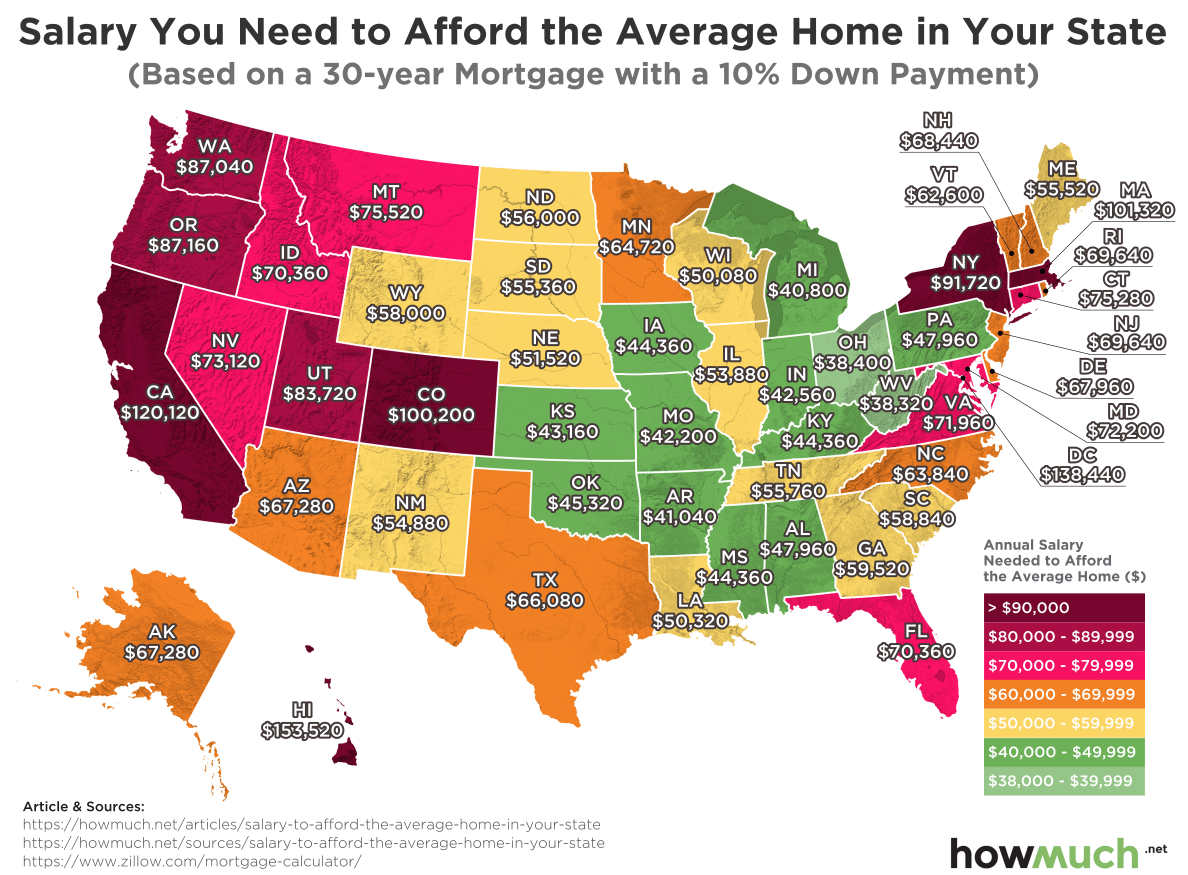
Income Required to Purchase a House [feedly]

Income Required to Purchase a House
http://ritholtz.com/2018/04/income-required-purchase-house/

How Much Income You Need to Afford the Average Home in Every State in 2018 Source: How Much     Yesterday, I discussed how much retail has changed. In particular, I noted how decades of wage stagnation made middle income consumers (and below) especially price sensitive. The results of this: "To me, price sensitivity is…

Read More

The post Income Required to Purchase a House appeared first on The Big Picture.


 -- via my feedly newsfeed

Donald Trump trade threats lack credibility [feedly]

Donald Trump trade threats lack credibility
http://larrysummers.com/2018/04/09/donald-trump-trade-threats-lack-credibility/

April 8, 2018

US bluster has caused most of the world to rally to China's side

As the possibility of a trade war between the US and China looms, threats and counter-threats are hurled back and forth and markets gyrate, economic logic and truth appear to be an early casualty. There are certain points of fact on which there should be no disagreement.

First, globalization and trade have caused significant disruption to the US economy but this has had little to do with trade agreements of the last generation. It is now clear that increased imports especially from China have inflicted substantial burdens on manufacturing workers, particularly in the the north central part of the country. Where too much conventional analysis goes wrong is in attributing this to trade agreements and in failing to recognize offsetting job gains from exports.

The reality is that the US economy was largely open by the 1980s and that every major trade agreement has reduced other nations' trade barriers by far more than it altered any American trade barriers. This is most true of China's 2001 accession to the WTO, in which the US only committed to continuing to keep its markets open on the most favorable nation terms that had already been ratified each year for more than a decade but won major changes in Chinese economic policy.

The real reason for economic disruption was not trade agreements but the emergence of emerging markets as major participants in the global economy. This is not something the US could stop or, given its export interests and broader interests in global co-operation, could plausibly aspire to contain.

Second, much of President Trump's rhetoric notwithstanding, it is wrong to say nothing has been achieved through negotiation with China. Only a few years ago, China's current account surplus was the largest relative to GDP among significant countries, it was holding its currency down to maintain demand for its exports, and most software used on its personal computers and videos on sale in its major cities were pirated.

Today China's global surpluses are far below past US negotiating targets of a few years ago, China has spent about $1tn propping up its currency, and IP protections are far better enforced than a few years ago for major US software and video producers. Of course major issues remain but the view that multilateral pressure without bluster is ineffective is belied by experience.

Third, extraction of IP through joint venture requirements is largely a problem for companies outsourcing production from the US and not for American workers. Corporations headquartered in the US often complain bitterly that if they wish to enter the Chinese market they must enter into joint ventures with Chinese counterparts who demand transfer of intellectual property and then operate on their own.

These complaints are often accurate. Notice, however, that they typically involve cases where the company in question produces for China in China and so have little impact on US employment. In many cases a substantial number of the company's shareholders are foreign and it pays taxes to many governments. It is more than a little ironic that an administration that condemns outsourcing should make standing up for those who move production to China so central a priority.

Fourth, bilateral trade bluster is not an effective strategy for the US. While most countries feel somewhat threatened by Chinese trade and business practices, it has been the unfortunate accomplishment of US trade policy in recent months to cause most of the world to rally to China's side because of our disregard for the WTO and the global system.

Not only does having many others on its side make it easier for China to resist the US, it also undercuts the effectiveness of our sanctions. China can still export to other markets and US producers who use Chinese inputs lose competitiveness when only they are forced to pay tariffs. History is clear that moments of high trade truculence like that pursued against Japan in the early 1990s accomplished very little while imposing substantial costs.

Fifth, threats have to be credible to be effective. In recent weeks, every time the US has pushed its strategy markets have had mini-collapses, and every time it has appeared to pull back markets have rallied. How in such a world can it seem credible that the US will actually carry through on its threats? And without credibility why should one expect strong responses from China? I return from a recent meeting with senior Chinese officials with the clear sense that they are more bemused than alarmed by what they see as a boomeranging US approach.

The US can do much better for itself and for the global economy but this is the subject for a subsequent column.


 -- via my feedly newsfeed

West Virginia GDP -- a Streamlit Version

  A survey of West Virginia GDP by industrial sectors for 2022, with commentary This is content on the main page.