Tuesday, April 10, 2018

New Tax Law Invites Rampant Tax Sheltering and Gaming [feedly]

New Tax Law Invites Rampant Tax Sheltering and Gaming
https://www.cbpp.org/research/federal-tax/new-tax-law-invites-rampant-tax-sheltering-and-gaming

The major tax legislation enacted last December not only ignores the need for more revenue and is heavily tilted in favor of wealthy people and corporations, but also suffers from a third fundamental flaw: its design invites rampant tax sheltering and gaming.[1]

True tax reform simplifies the tax code and narrows the gaps between how different types of income are taxed.  The new law does the opposite, adding complexity to the tax code and introducing new, arbitrary distinctions between different kinds of income, thereby creating new gaming opportunities. In particular, its new deduction for "pass-through" income and deep cut in the corporate tax rate risk making the 37 percent top individual tax rate merely theoretical for some very wealthy people.  The new law also confers enormous tax benefits on some industries but not others, makes it easier for wealthy households to shelter their assets and thereby accumulate multi-million-dollar fortunes, and favors business production and investment overseas rather than at home.

Widespread abuse of the bill's loopholes and preferences could cause it to lose even more revenue — and increase inequality even more — than current projections indicate.  Moreover, Congress has depleted the enforcement division of the IRS, cutting its workforce by more than a quarter since 2010, and provided no additional funding for enforcement following enactment of the new law.[2]

New Law Is Opposite of True Tax Reform

Well-designed tax reform eliminates loopholes and reduces opportunities for gaming the tax system so that individuals and businesses with the same income are treated as similarly as possible. This brings several benefits:

  • It increases the degree to which individuals and businesses base their decisions on economics instead of taxes.  This is good for the economy: it encourages resources such as capital and labor to flow to where they are most productive instead of where the tax breaks and gaming opportunities are most plentiful.
  • Closing loopholes and eliminating opportunities for gaming raises revenue and may also reduce inequality, since wealthy individuals and corporations are best equipped to exploit these weaknesses in the tax code.
  • It reduces the amount of economic resources that are diverted to developing sophisticated tax avoidance schemes that provide little overall economic benefit, allowing those resources to go to more productive uses.

The new tax law moves in the opposite direction.  It creates new loopholes that will result in similar economic activities being taxed, often arbitrarily, at different rates.  Hence, it "has turned us into a nation of tax shelter hunters," as the Tax Policy Center's Howard Gleckman has observed, as various parts of the law have "set off a frenzy of loop-hole seeking."

Changes Risk Undermining Integrity of Tax Code

Provisions of the new law that create new gaming opportunities include the following:

  • Deduction for "pass-through" income invites abuse.  The law introduces a 20 percent deduction for "pass-through" income, or income from businesses such as partnerships, S corporations, and sole proprietorships that business owners claim on their individual tax returns.  This provision never enjoyed a solid policy rationale:  although proponents argued that it was necessary to maintain "parity" between the taxation of corporate and pass-through business income, pass-throughs already enjoyed a tax advantage over regular corporations (known in the tax code as C corporations).  While pass-through income faces only one layer of taxation — at the individual level — C corporation income faces two levels of tax: one when the firm pays the corporate income tax, and another when shareholders pay individual income tax on their dividends or capital gains.  Because of the new deduction, many high-income individuals may now be able to secure very large tax savings by converting their wage and salary income into pass-through income.

    The law includes a series of complex "guardrails" aimed at limiting the scope of the provision and preventing gaming, but these measures are unlikely to be effective.  They consist of a series of questions for taxpayers to determine whether particular income qualifies for the pass-through deduction, with each question drawing a line between qualification and disqualification for the deduction.  (Among other things, the law draws lines between compensation and profits, between different types of services, and between real estate investment trusts and other assets.) This will entice many taxpayers, aided by their accountants or lawyers, to try to place themselves on the tax-saving side of each line.  Such tax avoidance activities produce no gain for the economy and lose revenue for the Treasury.

  • Deep cut in corporate rate risks encouraging tax sheltering. The new law creates a powerful incentive for wealthy Americans to shelter large amounts of income in corporations by slashing the corporate rate to 21 percent, far below the top individual tax rate of 40.8 percent (the new 37 percent top individual income tax rate plus the 3.8 percent Medicare payroll tax rate).  This will entice wealthy people to shield their labor or interest income from the top individual rate by setting up a corporation and reclassifying their income as corporate profits in order to pay the lower corporate rate.  They also can defer the second level of tax on their corporate income by electing not to receive dividends immediately or by delaying selling shares and realizing a capital gain.

    The new law also encourages income sheltering by retaining the "stepped-up basis" loophole, which allows the heirs of an estate not to pay any taxes on any appreciation of an asset that occurred during the previous owner's lifetime. The combination of the new low corporate rate and this retained tax loophole risks opening a gaping tax sheltering opportunity for wealthy people, with no gain for the economy.

    For example, an investor with a multi-million-dollar bond portfolio now has an incentive to place it in a corporation and pay roughly half the tax rate on the interest income it produces than she'd pay if that income faced the individual tax rates.  She might eventually have to pay taxes on the dividends or capital gains on the wealth that has accrued in the corporation, but she could defer that second layer of tax for decades and even avoid it altogether by passing the corporation housing her bond portfolio on to her heirs and relying on the stepped-up basis loophole to wipe out her tax liability.

  • New international tax regime encourages offshoring and profit shifting. The new law also moves U.S. international tax rules to a "territorial' system that largely exempts multinationals' foreign profits from U.S. tax and thereby encourages them to shift profits and operations overseas.  The drafters of the law put in place a minimum tax to limit this incentive, but it is seriously flawed and could in fact add to incentives to shift both paper profits and real investments and operations overseas since multinationals owe less minimum tax when they invest more abroad. This threatens to reduce investment in the United States and could wind up reducing U.S. workers' wages.


 -- via my feedly newsfeed

New Tax Law Is Fundamentally Flawed and Will Require Basic Restructuring [feedly]

New Tax Law Is Fundamentally Flawed and Will Require Basic Restructuring
https://www.cbpp.org/research/federal-tax/new-tax-law-is-fundamentally-flawed-and-will-require-basic-restructuring

The law will cost approximately $1.5 trillion over the next decade and deliver windfall gains to wealthy households and profitable corporations, further widening the gap between those at the top of the income ladder and the rest of the nation.


 -- via my feedly newsfeed

Sunday, April 8, 2018

50 years after Martin Luther King’s death, structural racism still drives the racial wealth gap [feedly]

50 years after Martin Luther King's death, structural racism still drives the racial wealth gap
https://www.urban.org/urban-wire/50-years-after-martin-luther-kings-death-structural-racism-still-drives-racial-wealth-gap

The difference between the average wealth of white families and that of African American families has expanded.


 -- via my feedly newsfeed

China’s Belt & Road Global Infrastructure Plan [feedly]

China's Belt & Road Global Infrastructure Plan
http://ritholtz.com/2018/04/chinas-belt-road-global-infrastructure-plan/

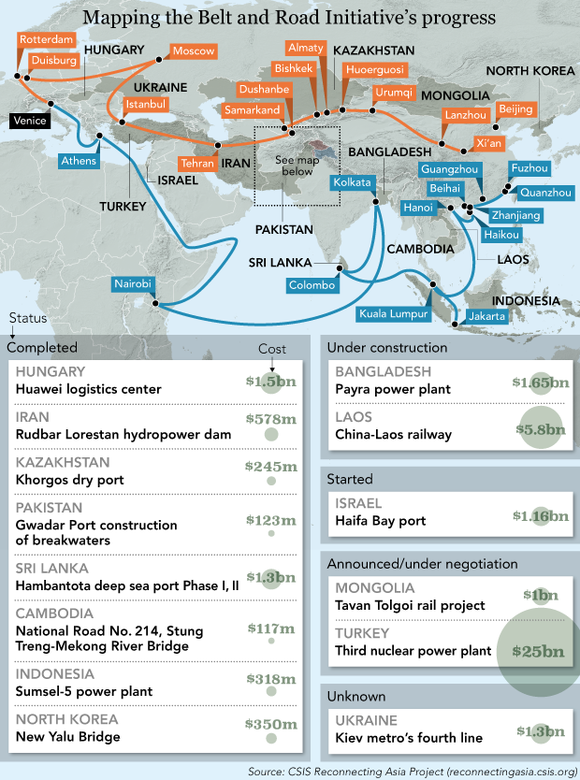
Source: Nikkei Asian Review     While we are creating a potential trade war, China is expanding a global infrastructure to sell its goods everywhere . . .

The post China's Belt & Road Global Infrastructure Plan appeared first on The Big Picture.


 -- via my feedly newsfeed

Daniel Gros: Trade Wars in a Winner-Take-All World [feedly]

Trade Wars in a Winner-Take-All World
https://www.project-syndicate.org/commentary/trade-wars-monopoly-rents-by-daniel-gros-2018-04

In the old competitive economy, trade wars might be easy to win for a country with a large trade deficit. But, in the emerging winner-take-all economy, a war designed to force the rest of the world to open up, thereby allowing the aggressor's own winning firms to earn higher rents, is an altogether different proposition.

BRUSSELS – With President Donald Trump's new trade tariffs, the United States has been transformed from the global multilateral trading system's leading champion and defender to its nemesis. But it would be very difficult for an erratic politician suddenly to overturn long-established structures and mechanisms, were it not for a more fundamental economic shift.


The first formal manifestation of today's trade tensions occurred in the steel sector – an "old economy" industry par excellence, one that is plagued, especially in China, by enormous excess capacity.

Excess capacity is a recurrent phenomenon in the steel sector, and has always produced friction. Back in 2002, President George W. Bush's administration imposed steep tariffs on steel imports, but relented when a World Trade Organization dispute-resolution panel ruled against the US. Although Trump administration trade hawks remember this ruling as a loss, most economists agree that it was ultimately good for the US economy, which does not gain from taxing a major input for many other industries.

In any case, today's tariffs differ from Bush's in a crucial way: they specifically target China. Under section 301 of the US Trade Act of 1974 – which empowers the president to act if US industry has been damaged by a foreign government's unjustified actions – Trump has imposed steep tariffs on some $50 billion worth of Chinese imports. And China has already hit back, introducing steep tariffs on imports of 128 US-made products.

So why is Trump risking a trade war? His administration's main complaint is that China requires foreign companies to reveal their intellectual property (IP) as a condition of access to the domestic market. And it is true that this requirement can do serious damage to US tech companies – as long as those companies are dominant in their industries.

For a major player in social networks or search engines, for example, the cost of entering a new market is essentially zero. Since the existing software can easily serve many more millions of users, they just need to translate their interface into the local language, meaning that entering a new market mostly means more profits. But if such companies are forced to reveal their IP, their business models are destroyed, as local players can then compete effectively in that market – and potentially in others.


This is not the case for companies operating in competitive industries. For them, producing and selling more abroad costs much more, limiting the marginal profits that can be reaped. In other words, in the more competitive "old" economy, the gains of opening new markets are much smaller. That is why lobbying by potential exporters for better access to markets with high tariffs has usually been muted – hence the lack of resistance to India's protectionism.

This is changing in the new "winner-take-all" tech economy: with IP-owning winners missing out on massive profits when a big market like China is protected or closed, trade conflicts become more acute. Meanwhile, trade policy becomes focused primarily on re-distributing rents, with employment and consumer interests viewed as secondary. (Under competitive conditions, policymakers place a higher priority on maximizing trade's potential to boost productivity and create high-quality employment.)

Monopoly rents translate into high market valuations. And, indeed, the new economy giants have a much higher stock-market value than their "old economy" equivalents. The three largest US tech companies are worth over 50 times more than the three largest US steel producers.

The looming trade war promises to be asymmetric. The US – home to all the dominant tech firms – will struggle to find allies against China. After all, in Europe and Japan, IP-owning companies operate mostly in more competitive industries, meaning that China's demand for that IP will have less of an impact.

Making European support even harder to come by, some European governments are eager to secure their share of rents from US firms. This is the ultimate aim of European efforts to raise taxes on the profits of digital multinationals, though such a tax is unlikely to do the job.

Proponents of that tax argue that profits should be taxed where they are earned, with the implicit argument being that they are earned where the consumers are. But this is an arbitrary criterion. US firms can legitimately claim that their "European" profits are just a return on their IP, which can formally be localized anywhere, preferably in a low-tax jurisdiction. A European tax on these companies is thus unlikely to yield substantial revenues.

In the old competitive economy, trade wars might be easy to win for a country with a large trade deficit. But in the emerging winner-take-all economy, a trade war launched with the goal of forcing the rest of the world to open up, thereby allowing the aggressor's own winning firms to earn higher rents, is an altogether different proposition.

So the US government is essentially arranging its diplomatic guns behind its Internet giants, while Europe and China are baying for their monopoly profits. This is more destructive than a zero-sum game: it will do serious damage to the global trading system, leaving everyone worse off.DANIEL GROS

**********************************

Daniel Gros is Director of the Brussels-based Center for European Policy Studies. He has worked for the International Monetary Fund, and served as an economic adviser to the European Commission, the European Parliament, and the French prime minister and finance minister. He is the editor of Economie Internationale and International Finance.
 -- via my feedly newsfeed

March jobs: Topline miss but solid trend, plus a deeper dive into the current wage story [feedly]

March jobs: Topline miss but solid trend, plus a deeper dive into the current wage story
http://jaredbernsteinblog.com/march-jobs-topline-miss-but-solid-trends-plus-a-deeper-dive-into-the-current-wage-story/

Payrolls were up 103,000 last month, well below expectations for about 180,000, but this miss should not be taken to mean that the job market is in trouble. To the contrary, the trend of job growth remains strong and unemployment is at a 17-year low. Remember, these monthly data are noisy and you must average over numerous months to extract a meaningful trend—see "smoother" figure below. Consider, for an example of the monthly swings in these data, February's gain, revised up now to 326,000 (the larger downward revision to January led to a decline of 50,000 from the combined previous reports of job gains in those months).

Wages, before inflation–a closely watched gauge of the extent to which the tightening job market is boosting workers' bargaining clout–rose 0.3% in March, and 2.7% year-over-year, a slight bump over last month's 2.6% rise. However, this is far from an inflationary number, and the production/non-supervisor wage was up only 2.4%, and that's 80% of the workforce. (Yes, that implies outsized gains to higher-paid workers, but again, some of that is monthly noise.) I dive more deeply into the wage story below

Our smoother wrings out some of that noise by looking at average monthly job gains over 3, 6, and 12-month periods. As you see, the underlying trend is around 200,000 a month. This is a very solid trend of job growth, especially considering a job market closing in on full capacity.

But the key words there are "closing in." The employment rate of prime-age workers (25-54) still implies room-to-run (as does the lack of pressure from price measures, including inflation and wages). The peak in the prime-age rate was 80.3% in January 2007; its trough in 2011 was 74.8%, an historically sharp decline as these workers got seriously slammed by the Great Recession. But the persistently tight job market is enabling them to claw back their losses, against many predictions that they were lost forever (a reminder to economists that it's tough in this space to know what's cyclical and what's structural).

Their employment rate in March was 79.2%. Thus, prime-agers have recovered 4.4 out of 5.5 percentage points, or 80%, of their decline over the course of the recession. Prime-age men, whose employment rates have suffered a longer-term decline, have made back 76% of their loss; women have done better, clawing back 90%.

Deeper wage dive

This month, we (Lexin Cai and I) dig a bit deeper into the wage story. Much wonkiness follows, but the punchline is that slow productivity growth poses a clear constraint on wage growth. However, there's a lot more room for wage growth through labor clawing back some of its lost share of national income. Importantly, from the Fed's perspective, that's source of wage growth is non-inflationary.

As noted, nominal hourly wages rose 2.7% over the past year. For the 80% of the workforce in blue-collar, non-managerial jobs, wage growth was up 2.4%. The figures below show yearly wage growth since the downturn along with a smooth trend (a 6-month rolling average) for both series. After falling in the recession, nominal wages settled at about 2%, year-over-year, and, as unemployment fell further, which typically creates more pressure on wage growth, climbed to about 2.5%.

But, as the scatterplot below shows, they've essentially plateaued at that level, which the figure reveals to be somewhat unusual.

The figure plots yearly, nominal wage growth for blue-collar, non-supervisory workers (this data series goes back to 1964, far enough to enable this analysis) in every month that the unemployment rate was between 3.5-4.5 percent. The average wage growth in these months was about 4%, but as you see in the cluster we've circled, all the recent observations have been significantly lower than that, at around 2-2.5%.

What gives? Why is that cluster such an outlier?

First, there's a bit of apples-to-oranges in this comparison. The demographics of the workforce, inflation, and most importantly, productivity growth–all of which influence wage growth–have all changed a lot over these years, such that even conditional on low unemployment, we'd expect different outcomes. I don't think changing demographics is much of a determinant of this outcome. To some extent, pulling less skilled people into the job market may be putting some downward pressure on wage growth, but I'm sure low inflation and especially our current slow productivity growth are more consequential.

What you see in the figure are essential three different wage growth regimes at low unemployment. The top one—the dots clustered around 6%–occurred mostly in periods of very high inflation, like back in the 1970s, when big Paul Volcker shut down wage and price inflation with massive, recession-inducing interest rate increases.

The middle cluster partially reflects the strong wage growth of the full-employment latter 1990s, when much strong productivity growth (2.5% versus today's 1%) helped pay for non-inflationary wage growth while enabling firms to maintain high profit margins.

The bottom cluster—the one we're currently living through—reflects both low inflation and low productivity.

Does that mean workers, especially these middle-wage folks, must be resigned to being stuck in that bottom group of dots? No! Prices should, and to some extent are, rise some as the economy continues to tighten, and that could help push up nominal wage growth (though not real, since higher wages would be met with higher prices). The problem is slow productivity growth.

We don't know much about how to get faster productivity growth, but there's another path toward wage gains for these workers: redistribution from the inflated profit share of national income to the labor share. Under that scenario, very tight labor markets—I'm talking about the left side of this scatterplot—create the pressure for faster wage gains that shift income from profits to wages.

Yes, that crimps corporate profit margins and the stock market will hate it. But it is precisely the rebalancing that should occur in a truly full employment labor market. In fact, the absence of such a rebalancing is one signal that we're not yet at full employment.


 -- via my feedly newsfeed

New UN data on international migrants highlights special responsibility for destination countries in the Global Compact for Migration [feedly]

New UN data on international migrants highlights special responsibility for destination countries in the Global Compact for Migration
https://www.epi.org/blog/new-un-data-on-international-migrants-highlights-special-responsibility-for-destination-countries-in-the-global-compact-for-migration/

INSIGHTS

Add note

Large movements of refugees and migrants around the world since 2015, many in response to humanitarian crises, have led to a global negotiation at the United Nations (UN) to create a new Global Compact for Migration (GCM). The GCM will be a non-binding international agreement to establish a new regime for cooperation on international migration that can maximize the benefits of migration and better protect migrants in vulnerable situations. While governments—minus the United States—continue to negotiate the GCM, it's important to step back and reflect on the lives at stake. The latest UN report and data on migration from the UN Population Division helps by providing a snapshot of migrants around the world. These data can assist policymakers who are currently negotiating the GCM's substantive provisions, who should remember to take into account their special responsibilities to protect the human rights of all migrants who live and work within their borders.

The UN Population Division reported that there were 258 million international migrants worldwide in 2017, meaning that 3.4 percent of people had been living outside of their country-of-birth for at least one year. The number of international migrants rose by 10 million from 248 million in 2015, but was unchanged as a share of the global population. The number of migrants in 2017 is an increase of 50 percent from 173 million in 2000, rising 0.6 percent from 2.8 percent of the global share of the population in 2000. Almost 75 percent of international migrants are of prime working age, meaning between the ages of 20-64. Men were 52 percent of international migrants in 2017 and women 48 percent.

By continent, Asia hosted 80 million international migrants, Europe 78 million, North America 58 million, Africa 25 million, Latin America 9.5 million, and Oceania 8.4 million. Europe's population would have declined between 2000 and 2015 had it not been for the arrival of international migrants.

Most international migrants, some 146 million or 57 percent, are in the more developed countries (as defined by the UN) in Europe, Canada, the United States, Australia, New Zealand, and Japan. The share of international migrants among residents of more developed countries rose from less than 10 percent in 2000 to 14 percent in 2017.

A separate category devised by the UN distinguishes migrants in high-, middle-, and low-income countries. There were 165 million migrants in high-income countries, 64 percent of the total, including some in countries that are considered high income but are also considered less developed, like Korea, Hong Kong, Singapore, and many Gulf oil-exporting countries.

Middle-income countries such as Mexico, Morocco, and Turkey had 32 percent of the world's migrants, and low-income countries from Bangladesh to Zimbabwe had four percent.

Half of all international migrants were in 10 countries and two-thirds were in 20 countries. The United States hosts the most international migrants, 50 million, accounting for nearly 20 percent of all international migrants around the world (including five million Puerto Ricans the UN counts as international migrants who moved to the U.S. mainland). The United States is followed Saudi Arabia and Germany, each hosting 12.2 million, 11.6 million in Russia, 8.6 million in the United Kingdom, and 8.3 million in the United Arab Emirates (UAE). The 11 countries that each had at least six million international migrants hosted 53 percent of all international migrants, including France, Canada, Australia, Spain, and Italy.

Table 1

Three-fourths of the nearly 50 percent increase in the total number of international migrants since 2000 was in high-income countries, and half was in more-developed countries, highlighting the importance of distinguishing between high-income and more developed countries. The United States accounted for 18 percent of the increase in the migrant stock between 2000 and 2017, while Saudi Arabia accounted for eight percent of the increase.

The highest shares of migrants among the national population were in Gulf oil-exporting countries such as the UAE, with 88 percent, Kuwait with 76 percent, and Qatar with 65 percent. 30 percent of Switzerland's population are migrants, Australia 29 percent, Canada 22 percent, and the United States 15 percent. Countries with fewer than one percent of migrants in the population include Mexico, Brazil, the Philippines, Vietnam, and China.

The latest UN data reveal that a small group of countries are hosting most of the international migrants around the world. The major countries of destination should commit in the GCM to cooperating with countries of origin to ensure that migrants can travel safely—especially when fleeing dangerous situations—and to providing migrants with equal rights and protection under the law wherever they reside.


 -- via my feedly newsfeed

West Virginia GDP -- a Streamlit Version

  A survey of West Virginia GDP by industrial sectors for 2022, with commentary This is content on the main page.