China's government aims to raise as much as 200 billion yuan ($31.5 billion) to invest in homegrown chip companies and accelerate its ambition of building a world-class semiconductor industry, people familiar with the matter said.
The state-backedChina Integrated Circuit Industry Investment Fund Co. is in talks with government agencies and corporations to raise at least 150 billion yuan for its second fund vehicle but is angling for up to 200 billion yuan, the people said, asking not to be identified talking about a plan that hasn't been publicized. It intends to begin deploying capital in the second half of the year, they added.
The firm will again invest in a wide range of sectors from processor design and manufacturing to chip testing and packaging, potentially benefiting industry leaders from telecoms gear makersHuawei Technologies Co.andZTE Corp.to major players such as the Tsinghua Group. The first fund -- about 140 billion yuan -- had gone toward more than 20 listed companies, including ZTE and contract chipmakerSemiconductor Manufacturing International Corp., the people said.
China's trying to reduce a reliance on some $200 billion of annual semiconductor imports, which it fears undermines national security and hampers the development of a thriving technology sector. The country envisions spending about $150 billion over 10 years to achieve a leading position in design and manufacturing, an ambitious plan that U.S. executives and officials havewarnedcould harm American interests.
While officials have suggested their initial vision of attaining pole position in chips may have been unrealistic, the government remains intent on finding ways to reduce imports as the world's largest consumer of semiconductors. Established in 2014, the secretive China IC Fund plays a key role by steering overall investment and strategy. For its second fund, the state-backed outfit will again turn to central and local government agencies as well as the government-backed enterprises that contributed previously, the people said.
The envisioned ramp-up in domestic investment comes as foreign scrutiny of Chinese-led acquisitions intensifies. The Trump administrationblockeda $1.3 billion deal for U.S. chipmaker Lattice Semiconductor Corp. from China-backedCanyon Bridgelast year, citing security concerns. TheMinistry of Industry and Information Technologydidn't respond to a faxed request for comment.
The Tsinghua group, an affiliate of the prestigious Beijing university that spawned Chinese leaders including President Xi Jinping, also plays a crucial role. It groups under its umbrella the largest of the country's chip producers includingTsinghua Unigroup Co., which has outlined a$22 billion plan-- partly from the China IC Fund --- to pursue acquisitions and build capacity.
"We want to be a balancer against the international giants, which means delivering self-made technologies and growing the market share of made-in-China products," Qi Lian, Unigroup joint president and chief executive of its storage arm, told reporters Thursday. "To achieve this goal, we are building up our own R&D and also keeping an eye on global technology collaboration."
Record 21 States See Decline in Well-Being in 2017
by Dan Witters
STORY HIGHLIGHTS
For the first time, zero states saw statistically significant improvement from prior year South Dakota and Vermont top nation for the first time, followed by Hawaii West Virginia has lowest well-being, followed by Louisiana
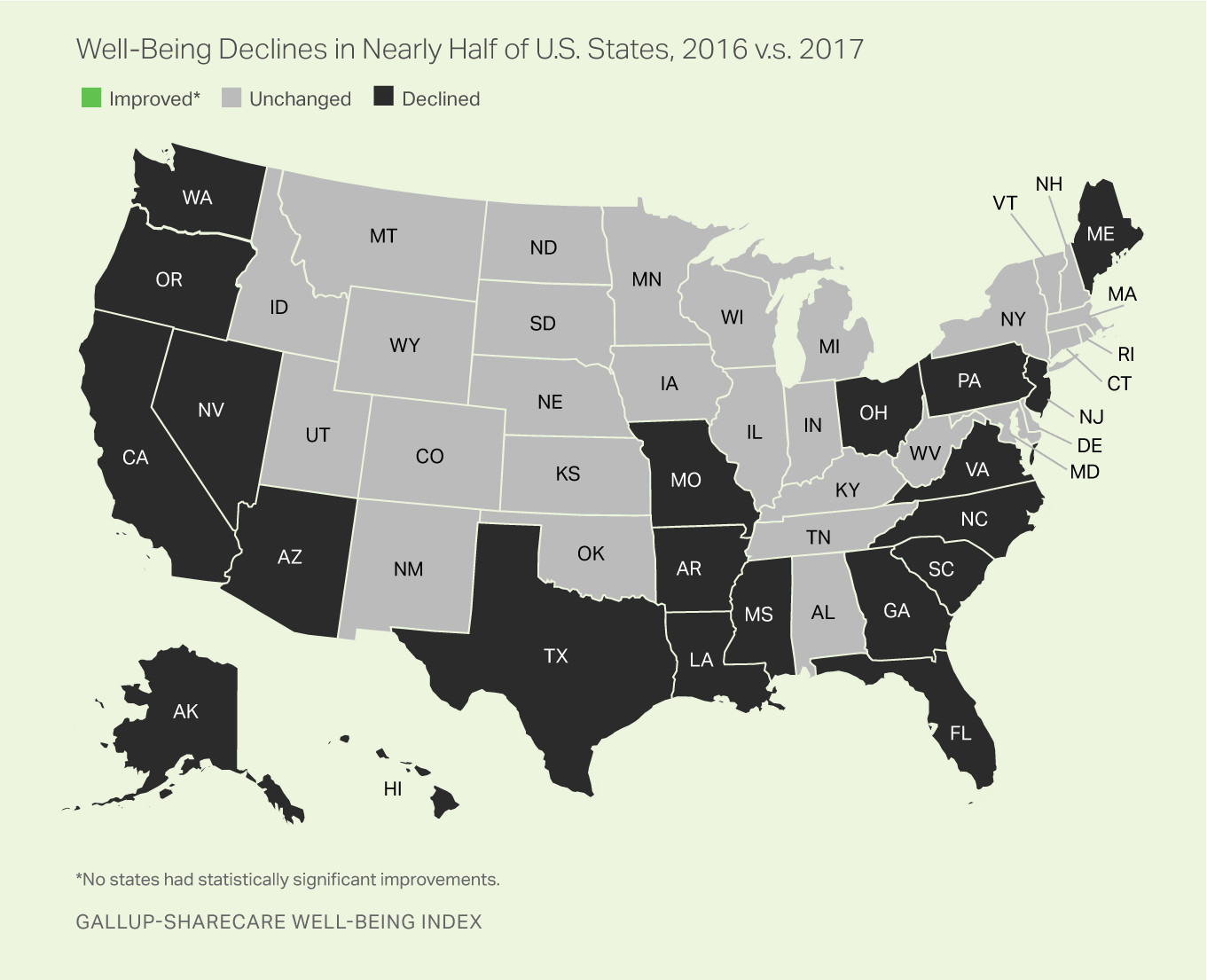
WASHINGTON, D.C. -- Nearly half of U.S. states saw their well-being scores decline by a statistically significant margin in 2017, according to the Gallup-Sharecare Well-Being Index. And, for the first time in nine years of tracking changes in state well-being, no state saw statistically significant improvement from the year before.
The 21 U.S. states that saw their well-being drop in 2017 shattered the previous record set in 2009 amidst the Great Recession, when 15 states had lower well-being than the year before. The large number of states with declines in well-being in 2017 is particularly notable given thatAmericans' confidence in the economyand perceptions of thejob marketare substantially better in 2017 than they were in 2009.
Statistically Significant Change in Well-Being Index Score Among States
Compared to Prior Year
Year
WBI Statistically Improved
WBI Statistically Declined
Net
2017
0
21
-21
2016
8
1
+7
2015
3
1
+2
2013
7
9
-2
2012
6
4
+2
2011
11
2
+9
2010
15
2
+13
2009
4
15
-11
Note: 2014 not available due to change in WBI instrument and scoring between 2013 and 2014
GALLUP-SHARECARE WELL-BEING INDEX
These data are based on more than 160,000 interviews with U.S. adults across all 50 states, from January 2 through December 30, 2017. The Well-Being Index is a mean score comprised of many metrics and is calculated on a scale of 0 to 100, where 0 represents the lowest possible well-being and 100 represents the highest possible well-being. The Gallup-Sharecare Well-Being Index score for the nation and for each state is based on metrics that make up five essential elements of well-being:
Purpose: liking what you do each day and being motivated to achieve your goals Social: having supportive relationships and love in your life Financial: managing your economic life to reduce stress and increase security Community: liking where you live, feeling safe and having pride in your community Physical: having good health and enough energy to get things done daily
For the nation as a whole, the Well-Being Index score for the U.S. in 2017 was 61.5, a decline from 62.1 in 2016 and the largest year-over-year decline since the index began in 2008.
High and Low Well-Being States Equally Vulnerable to Decline in 2017
The states that suffered declines in 2017 are primarily located in the South and West, and include states that have been both historically high in well-being (such as Hawaii and Alaska) and low in well-being (such as Mississippi, Louisiana and Ohio). By region, the declining states were:
South: Arkansas, Florida, Georgia, Louisiana, Mississippi, North Carolina, South Carolina, Texas
West: Alaska, Arizona, California, Hawaii, Nevada, Oregon, Washington
East: Maine, New Jersey, Pennsylvania, Virginia
Midwest: Missouri, Ohio
Many of the states showing declines in their well-being scores worsened on the same set of well-being metrics. These include:
An increase in experiencing significant worry on any given day
A sharp uptick in reporting "little interest or pleasure in doing things"
An increase in clinical diagnoses of depression
Elevated reports of daily physical pain
A decline in reports of receiving "positive energy" from friends and family members
A decline in having "someone who encourages you to be healthy"
A drop in reports of liking "what you do each day"
A decrease in those who have a leader in their life who makes them "enthusiastic about the future"
A decline in the percentage who report that they are reaching their goals
A reduction in satisfaction with standard of living (compared to peers)
The declines in well-being were mostly driven by drops in metrics comprising purpose and social well-being, as well as the mental health aspects of physical well-being rather than community well-being or traditional facets of physical health such as obesity, exercise or smoking.
South Dakota and Vermont Share Top Spot for First Time
Against the backdrop of deteriorating well-being nationally, South Dakota and Vermont led the nation in well-being for the first time in 2017, with Well-Being Index scores of 64.1. These scores were statistically unchanged from 2016, providing them an advantage in the rankings given broad declines elsewhere. Hawaii, which has had the highest well-being six of the previous nine years, finished 2017 with the third-highest-score.
States with Highest and Lowest Well-Being in 2017
Highest 15
Well-Being Index
Lowest 15
Well-Being Index
South Dakota
64.1
West Virginia
58.8
Vermont
64.1
Louisiana
58.9
Hawaii
63.4
Arkansas
59.4
Minnesota
63.1
Mississippi
59.6
North Dakota
63.1
Oklahoma
59.7
Colorado
62.9
Kentucky
59.8
New Hampshire
62.8
Ohio
60.0
Idaho
62.8
Nevada
60.2
Utah
62.8
Indiana
60.4
Montana
62.6
Rhode Island
60.5
Massachusetts
62.5
Delaware
60.7
Florida
62.4
Missouri
60.7
Texas
62.3
Alabama
60.8
California
62.3
South Carolina
61.0
Arizona
62.2
Illinois
61.1
GALLUP-SHARECARE WELL-BEING INDEX
South Dakota is no stranger to high well-being. It had the second highest Well-Being Index score in the U.S. in 2013 and has been among the six highest well-being states every year since. Vermont, which had the sixth highest well-being score in 2016, rose to its highest rank over the ten-year history of the Well-Being Index.
Hawaii and Colorado are the only two states that have made the list of the 10 highest well-being states each year since 2008. Montana and Minnesota have been among the highest 10 each year except for 2010 and 2014, respectively. Florida, Texas and California have in recent years consistently placed just outside of the highest 10.
Most of the lowest well-being states have frequented this list in the past. West Virginia, in particular, has had the lowest well-being in the nation for nine consecutive years while Louisiana -- typically on the high end of the lowest quintile -- finished in its lowest position ever.
In most cases, a difference of 0.5 to 1.0 points in the Well-Being Index score between any two states represents a statistically significant gap, and is characterized by meaningfully large differences in at least some of the individual metrics that make up the overall Gallup-Sharecare Well-Being Index.
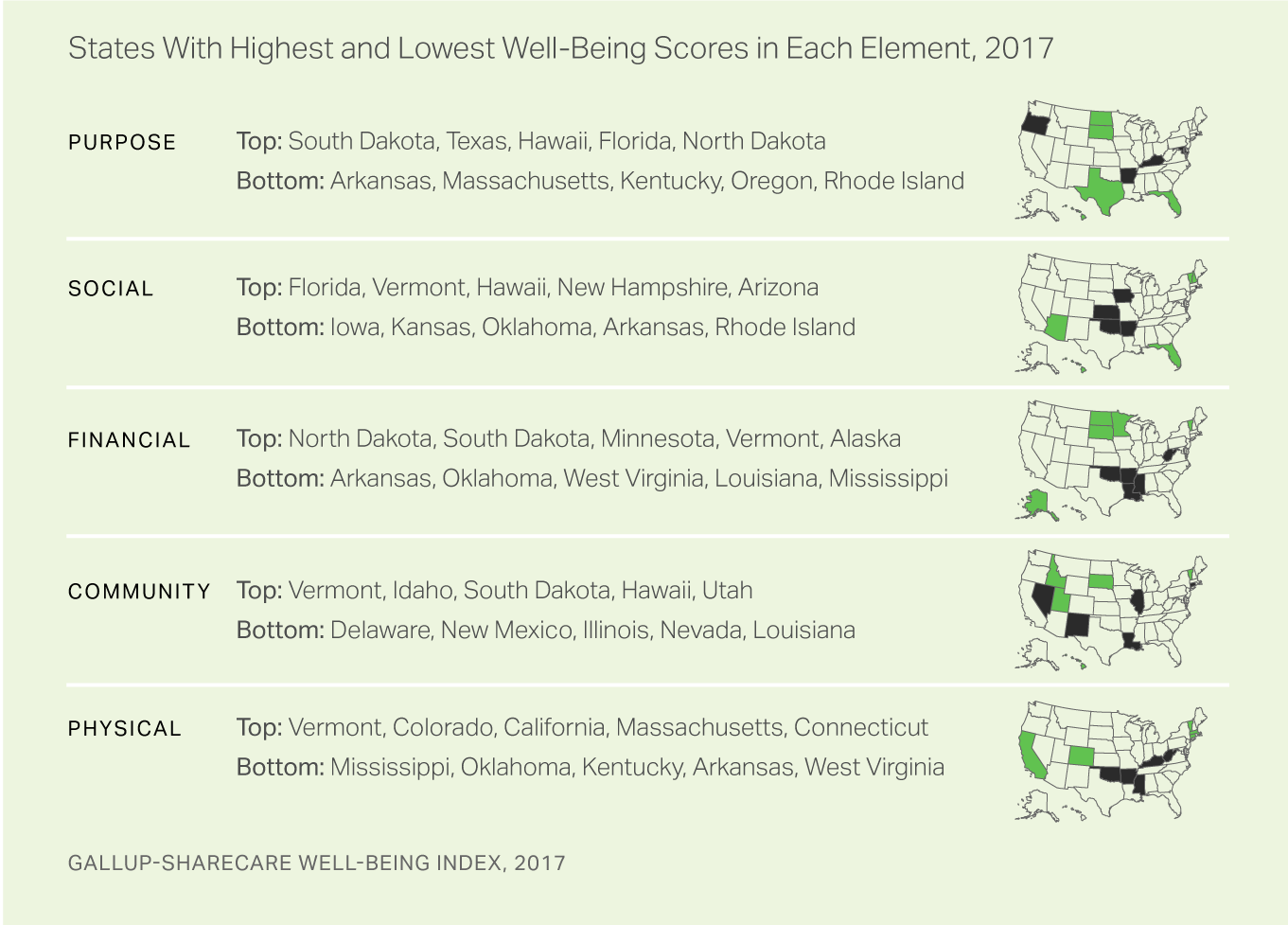
Vermont Has Best Community and Physical Well-Being, South Dakota Best Purpose
Vermont and South Dakota's strong performance in individual elements of well-being drove their first place finishes. Vermont ranked among the top four states in community, physical, social and financial well-being. South Dakota had the best purpose well-being in 2017 and also ranked among the top three in financial and community well-being. Hawaii was among the top four states in purpose, social and community well-being.
Florida led the pack on social well-being, while North Dakota finished first on financial well-being.
Implications
Thesteep declinein well-being nationally in 2017 is reflected at the state level. This is a trend state and business leaders should monitor because Gallup and Sharecare research has shown that workers withhigher well-beingare significantly less likely to experience unplanned absenteeism, perform better while at work and have lower healthcare utilization than their counterparts.
Havinghigh well-being across all five elements, in turn, results in individuals who are less likely to change employers voluntarily, file fewer worker compensation claims and are more resilient in the face of challenges such as layoffs or natural catastrophes than are those who are physically fit alone. People with higher well-being across the elements are better able to take care of their own basic needs, adapt readily to change and feel better able to contribute to and support the success of their organizations and communities.
Drops in well-being, therefore, increase the liability in each of these areas for the states that suffer them and should command the attention of their leaders, as weakening well-being can result in slowing the pace of an otherwise improving economy.
State leaders should monitor their well-being score and develop specific strategies to improve it. State and community leaders can study and adopt best practices from states with consistently high well-being scores such as Hawaii, South Dakota and Vermont in order to maximize the chances that their own constituents are best able to lead a life well lived.
Results are based on telephone interviews conducted Jan. 2-Dec. 30, 2017, as a part of the Gallup-Sharecare Well-Being Index, with a random sample of 160,498 adults, aged 18 and older, living in all 50 U.S. states and the District of Columbia. For results based on the total sample of national adults, the margin of sampling error for the Well-Being Index score is ±0.15 points at the 95% confidence level. The margin of sampling error for most states is about ±0.6 points, although this increases to about ±1.6 points for the smallest population states such as North Dakota, Wyoming, Hawaii and Delaware. All reported margins of sampling error include computed design effects due to weighting.
Statistical change testing is based at the 90% (p<.10) confidence level and includes design effect for more conservative results that incorporate the imperfectness of the randomness of the state samples.
Each sample of national adults includes a minimum quota of 70% cellphone respondents and 30% landline respondents, with additional minimum quotas by time zone within region. Landline and cellular telephone numbers are selected using random-digit-dial methods.
Blog: Enlighten Radio Post: The Moose Turd Cafe: Teachers Score Chinese Victory -- Dr. Lechter MOVES to IHOP Link: http://www.enlightenradio.org/2018/02/the-moose-turd-cafe-teachers-score.html
Today, the U.S. Supreme Court will hear argument inJanus v. AFSCME Council 31. The case will likely have the most significant impact on workers' freedom to organize and bargain collectively since our nation's basic labor law was radically amended by the Taft-Hartley Act in 1947. Unlike the political battle surrounding the passage of that legislation, this fight is taking place largely out of the public eye and with little opportunity for public debate. Instead,a small group of foundations with ties to the most powerful corporate lobbies have financed litigation attacking public-sector unions. These organizations operate with little public scrutiny, enabling wealthy interests to exert unprecedented private influence over matters of public policy, advancing an agenda that weakens the bargaining power of working people and shifts an ever-greater share of economic gains to corporate players and the wealthy elite.
Collective bargaining helps to create a fairer economy, ensuring that gains are shared broadly across the populace. Nearly half of the workers covered by a collective-bargaining agreement are public-sector workers. The plaintiffs inJanusare challenging public-sector unions' ability to collect fair share fees, which cover the costs the union incurs representing all workers covered by a collective-bargaining agreement—whether or not a worker chooses to join the union. If the wealthy interest groups behindJanushave their way, unions representing public-sector workers could be prohibited from collecting these fees, forcing them to operate with fewer resources.
The erosion of collective bargaining is at the core of America's wage stagnation and rising inequality.As union membership has fallen over the last few decades,the share of income going to the top 10 percent has steadily increased. When union membership was at its peak (33.4 percent in 1945) the share of income going to the top 10 percent was only 32.6 percent. In 2015, union membership was 11.1 percent, while the share of income going to the top 10 percent was 47.8 percent—the largest share going to the top 10 percent since 1917.
Janusis only the most recent challenge to public-sector unions' ability to collect fees for the services they provide. In the last five years, the Supreme Court has heard two other cases on this issue—but neither case produced the plaintiffs' desired result. Litigating a case all the way to the United States Supreme Court is expensive: attorneys' fees, court costs, and trial expenses add up. It is only with the financial backing of a dedicated group of foundations with deep ties to corporate lobbies that these cases have repeatedly made it to the Supreme Court.
Organizations litigating fair share fees and their donor foundations
The list below describes the main legal foundations involved in the Supreme Court litigation challenging fair share fees. In some instances, these foundations have participated in more than one case.
National Right to Work Legal Defense Foundation (NRTWLDF) | Represented the plaintiffs in Harris v. Quinn, which was argued before the U.S. Supreme Court in January 2014
Plaintiffs backed by the National Right to Work Legal Defense Foundation argued that fair share fee arrangements violated the Constitution. The NRTWLDF is the 501(c)(3) arm of the National Right to Work Committee (NRTWC), a 501(c)(4) organization. The National Right to Work Committee is financed by business and conservative interests that seek to undercut private-sector unions by lobbying states to pass laws that ban any requirements that workers pay fair share fees. NRTWLDF has received funding from many foundations including Donors Trust and Donors Capital Fund, the Lynde and Harry Bradley Foundation, the Ed Uihlein Family Foundation, Dunn's Foundation for the Advancement of Right Thinking, and the Walton Family Foundation.
Center for Individual Rights (CIR) | Represented the plaintiffs in Friedrichs v. California Teachers Association, which was argued before the U.S. Supreme Court in January 2016
The CIR-backed plaintiffs argued that a public-sector union's ability to collect fair share fees should be unconstitutional. This case yielded a 4-to-4 stalemated decision because of Justice Antonin Scalia's death halfway through the 2016 Supreme Court term. In the past, CIR was engaged primarily in litigation to limit environmental and health and safety regulations. As the organization's budget has grown, it has become involved in litigation aimed at limiting workers' rights. CIR has received funding from Dunn's Foundation for the Advancement of Right Thinking, the Sarah Scaife Foundation, and the John M. Olin Foundation. Most notably, CIR has received financial support from Donors Trust and Donors Capital Fund, which are donor-advised funds backed by Charles and David Koch (the Koch brothers), and from the Lynde and Harry Bradley Foundation.
Liberty Justice Center and NRTWLDF | Represented the plaintiffs in Janus v. AFSCME, which will be argued before the U.S. Supreme Court on February 26, 2018
In this case, the plaintiffs are making the same anti-union argument that was put on hold by Scalia's death in Friedrichs: that public-sector unions should not be able to cover the cost of representing and negotiating on behalf of nonmembers who benefit from the union's representation. The Liberty Justice Center (LJC) is the legal arm of an Illinois-based conservative think tank called the Illinois Policy Institute (IPI). A review of LJC and IPI's 990s provides a limited view of their financial profile, but it is clear that they survive off of the same core group of corporate-backed organizations that contribute to many political and legal fights against unions. Donors Trust, the Lynde and Harry Bradley Foundation, the Ed Uihlein Family Foundation, Dunn's Foundation for the Advancement of Right Thinking, and the Charles Koch Institute have supported the Illinois Policy Institute and Liberty Justice Center.
A closer look at the donor organizations supporting the anti-union litigants in fair-share-fee cases
The National Right to Work Legal Defense Foundation, Center for Individual Rights, and Liberty Justice Center are separate nonprofit organizations, but they share many of the same donors. Below is a profile of a few of these organizations' major donors, based on data found in their 990 filings.
Donors Trust/Donors Capital Fund | Donors Trust, headquartered in Virginia, is a tax-exempt charity founded in 1999 and is connected to Donors Capital Fund. Donors Trust is a donor-advised fund, which means that contributors to the fund can recommend how the money is allocated, but do not have final say. In return, contributors receive a bigger tax write-off than they would by donating money to a family foundation, and they preserve their anonymity. While most of the contributors to Donors Trust are unknown, Charles G. Koch, the Richard and Helen DeVos Foundation based in Grand Rapids, Michigan, and the Lynde and Harry Bradley Foundation based in Milwaukee have reported contributions. Donors Trust contributes tens of millions of dollars annually to conservative think tanks and advocacy groups. These include the Heritage Foundation, the Federalist Society, and the National Rifle Association's Freedom Action Fund, all in Washington, D.C.
Sarah Scaife Foundation | The Sarah Scaife Foundation is the largest of three foundations that make up the Pittsburgh-based Scaife family foundations. Under the direction of the late Richard Mellon Scaife, heir to the fortune of Andrew Mellon, the Scaife foundations in the late 1960s started to direct the majority of their assets toward conservative causes. Scaife helped fund early operations of the Heritage Foundation and the Stanford, California-based and Washington, D.C.-based Hoover Institution. The Sarah Scaife Foundation continues to support the major conservative think tanks. Other grantees of the Sarah Scaife Foundation include FreedomWorks, the tea party group backed by the circle of like-minded mega-donors that make up the Koch network, the Competitive Enterprise Institute in Washington, D.C., and the Commonwealth Foundation for Public Policy Alternatives, a Pennsylvania-based think tank associated with the American Legislative Exchange Council (ALEC) and the State Policy Network.
Lynde and Harry Bradley Foundation | The Lynde and Harry Bradley Foundation was founded in 1942, and became a major organization with a national impact following the 1985 acquisition of the Allen-Bradley company by Rockwell International, a Fortune 500 manufacturing company. This inflow of cash, along with the hiring of Michael Joyce of the conservative John M. Olin Foundation, turned Bradley from a locally focused philanthropic organization in Milwaukee to the nationally focused foundation it is today, granting around $40 million annually. Since 2011, the majority of grants from the Bradley Foundation have gone to conservative groups, conservative think tanks such as the American Enterprise Institute and The Heritage Foundation, and religious freedom groups.
Ed Uihlein Family Foundation | The Ed Uihlein Family Foundation is run by businessman Richard Uihlein, the son of Ed (Edgar) Uihlien. Richard Uihlein is an influential player in Illinois and Wisconsin state politics. He donated $2.6 million to Illinois Governor Bruce Rauner's 2014 campaign, and another $2.5 million to the Unintimidated super PAC that backed Wisconsin Governor Scott Walker's presidential campaign. The foundation also has given significant sums of money to the Illinois Policy Institute, whose legal arm, the Liberty Justice Center, is the main representative of the plaintiffs in Janus. The Uihlein family is also well connected to the Bradley family and the Bradley Foundation. David Uihlein Jr. served as vice chairman of the Lynde and Harry Bradley Foundation, and his father served on the board of the Allen-Bradley company.
Dunn's Foundation for the Advancement of Right Thinking | The foundation was founded by William A. Dunn in 1994 to advocate for and fund libertarian causes. William A. Dunn is the founder of Dunn Capital Management in Florida, which has over $1 billion in assets under management, and seems to be the main source of the foundation's assets. The Dunns have given millions to the Institute for Justice, the Pacific Legal Foundation, and the Landmark Legal Foundation. Since 2000, the foundation has also given well over $60 million to conservative groups such as the Competitive Enterprise Institute, the Cato Institute, the Mackinac Center for Public Policy, and the Reason Foundation.
The Court's ruling inJanuswill have far-reaching implications. It will determine how effective unions can be in the future, but the case is about more than that. This case is about whether a small group of wealthy donors and corporations is able to rewrite some of the nation's most fundamental rules to serve their own interests at the expense of the public good. Public-sector workers provide critical services on which every community depends. These workers care for our children and aging parents, keep us safe, and keep our streets clean. Attacking their wages and benefits will not only hurt them but the local communities where these services matter most. If the Supreme Court is persuaded by these powerful corporate interests to prohibit unions from collecting fees from the workers they are required by law to represent, working people and the communities they serve will suffer the consequences.