Friday, February 16, 2018

Paul Krugman: Budgets, Bad Faith and ‘Balance’ [feedly]

Paul Krugman: Budgets, Bad Faith and 'Balance'
http://economistsview.typepad.com/economistsview/2018/02/paul-krugman-budgets-bad-faith-and-balance.html

"our job, whether we're policy analysts or journalists, isn't to be "balanced"; it's to tell the truth":

Budgets, Bad Faith and 'Balance', by Paul Krugman, NY Times: Over the past couple of months Republicans have passed or proposed three big budget initiatives. First, they enacted a springtime-for-plutocrats tax cut that will shower huge benefits on the wealthy while offering a few crumbs for ordinary families — crumbs that will be snatched away after a few years, so that it ends up becoming a middle-class tax hike. Then they signed on to a what-me-worry budget deal that will blow up the budget deficit to levels never before seen except during wars or severe recessions. Finally, the Trump administration released a surpassingly vicious budget proposal that would punish not just the vulnerable but also most working families.
Looking at all of this should make you very angry... But my anger isn't mostly directed at Republicans; it's directed at their enablers, the professional centrists, both-sides pundits, and news organizations that spent years refusing to acknowledge that the modern G.O.P. is what it so clearly is.
Which is not to say that Republicans should be let off the hook. ...I can't think of a previous example of a party that so consistently acted in bad faith — pretending to care about things it didn't, pretending to serve goals that were the opposite of its actual intentions. ... The ... party's true agenda, dictated by the interests of a handful of super-wealthy donors, would be very unpopular if the public understood it. So the party must consistently lie...
Meanwhile, many news organizations ... treat recent G.O.P. actions as if they are some kind of ... departure from previous principles. They aren't. Republicans are what they always were: They never cared about deficits; they always wanted to dismantle Medicare, not defend it. They just happen not to be who they pretended to be.
Now, there's no mystery about why many people won't face up to the reality of Republican bad faith. Washington is full of professional centrists, whose public personas are built around a carefully cultivated image of standing above the partisan fray, which means that they can't admit that while there are dishonest politicians everywhere, one party basically lies about everything. News organizations are intimidated by accusations of liberal bias, which means that they try desperately to show "balance" by blaming both parties equally for all problems.
But our job, whether we're policy analysts or journalists, isn't to be "balanced"; it's to tell the truth. And while Democrats are hardly angels, at this point in American history, the truth has a well-known liberal bias.


 -- via my feedly newsfeed

IRS Must Now Be a Top Funding Priority [feedly]

IRS Must Now Be a Top Funding Priority
https://www.cbpp.org/blog/irs-must-now-be-a-top-funding-priority

Now that President Trump and congressional leaders have raised annual spending caps for defense and non-defense discretionary programs for 2018 and 2019, policymakers should make additional Internal Revenue Service (IRS) funding a top priority. The recent tax bill poses a once-in-a-generation, multi-dimensional challenge for the IRS, and the President and Congress must give the IRS the funds to implement it successfully.

Fortunately, congressional leaders who negotiated the agreement to raise the caps recognized the need for additional IRS funding, per their summary of the agreement: "Adequate Funding for Taxpayer and Social Security Administrative Services – Congressional leaders agree to adequate funding for the Internal Revenue Service and the Social Security Administration to satisfy the demand for constituent services and tax administration."

After all, the new tax law will affect virtually every taxpayer and business in America. It's certain to spark questions that individuals and businesses will look to the IRS to answer. Of particular concern, given some of the law's features and the hasty way it was put together, it is likely to fuel an aggressive effort by some businesses and wealthy individuals to push against the law's outer limits — and possibly beyond — to minimize their taxes.

As a result, the IRS will need to provide extensive guidance to taxpayers, update its systems and forms, provide significant public education, expand customer service, and strengthen enforcement in the years to come. The IRS's shrunken budget and depleted workforce magnify the challenge. Policymakers cut its budget by $2.4 billion, or 18 percent, between 2010 and 2017, after adjusting for inflation (see chart). It has lost 18,000 employees (nearly one-fifth of its workforce), with enforcement personnel accounting for more than three-quarters of that reduction.

IRS Funding Has Fallen Sharply


Congress' appropriators, who will write the bills to fund the IRS for 2018 and 2019, must now follow through on the recognized need for more dollars. Specifically, "adequate funding" should mean a robust increase across IRS functions compared to last year. Overall, the agreement raises overall non-defense discretionary (NDD) funding by roughly 12 percent in 2018 compared to last year. While the President has proposed a $581 million increase for the IRS to implement the new tax law and support technology and taxpayer services, he proposes to add that to his original request for 2018 — which was a 2 percent cut — rather than to the 2017 level. As a result, the President's 2018 proposal amounts to just under a 3 percent increase for the IRS, roughly one-quarter of the overall percentage increase for NDD and far short of what the IRS needs.

The President's request for 2019 shows further that he's not taking the IRS' challenge seriously enough. His budget inexplicably proposes to cut taxpayer services and set a target for it to answer less than half of taxpayer calls during fiscal year 2019, when people will file their first returns under the new law. As the Senate Finance Committee's Republican chairman, Orrin Hatch, said, "the Administration, in its budget, has proposed additional cuts to funding for the IRS. I think that is a mistake."

Policymakers should heed the example of how the Reagan Administration and Congress responded to major tax reform legislation in 1986. After enacting it, policymakers provided the IRS with more funds to meet its additional demands. In response, the IRS significantly expanded taxpayer service efforts, hiring 1,300 more staff. At the same time, the agency was in the midst of a major effort to recover unpaid taxes, and so was actively strengthening its enforcement capabilities. Moreover, these staff increases occurred at a time when the IRS had about one-fifth more staff than it does today.

In the face of deep budget cuts and personnel reductions, the IRS has struggled to perform its core functions of helping taxpayers comply with the tax code, enforcing the code fairly and credibly, and collecting nearly all of the revenue that funds federal programs. Policymakers must give the IRS sufficient resources over the coming years — a substantial increase above last year's depleted level, not simply a reversal of a proposed further cut — to meet the additional customer service and enforcement challenges that the new tax law will create.


 -- via my feedly newsfeed

Global Cities on the Bubblicious Scale [feedly]

Global Cities on the Bubblicious Scale
http://ritholtz.com/2018/02/8-global-cities-risk/

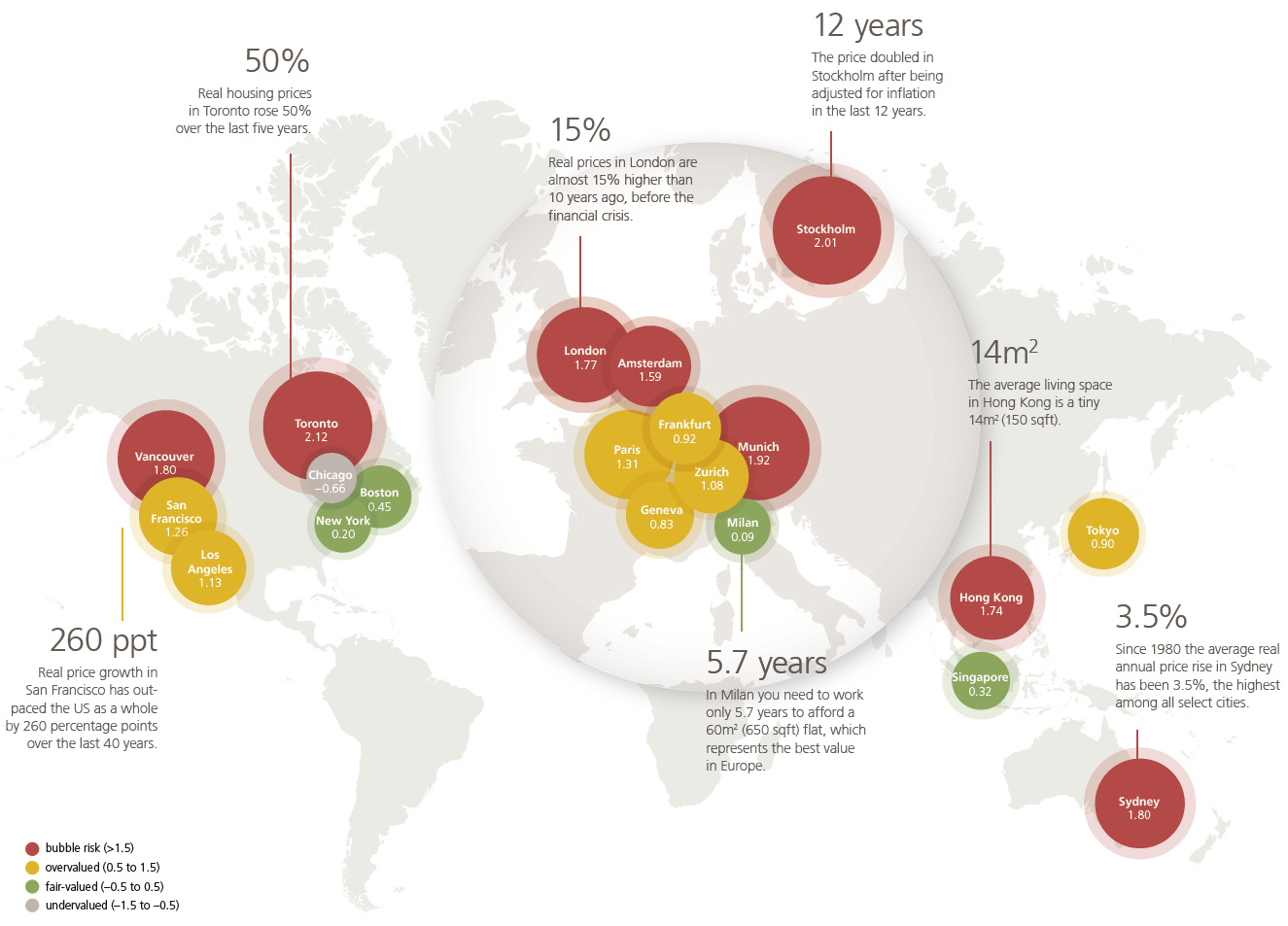
Real Estate Bubbles: The 8 Global Cities at Risk

Courtesy: UBS

Real Estate Bubbles: The 8 Global Cities at Risk

If you had $1 billion to spend on safe real estate assets, where would you look to buy?

For many funds, financial institutions, and wealthy individuals, the perception is that the world's financial centers are the places to be. After all, world-class cities like New York, London, and Hong Kong will never go out of style, and their extremely robust and high-density city centers limit the supply of quality assets to buy.

But what happens when too many people pile into a "safe" asset?

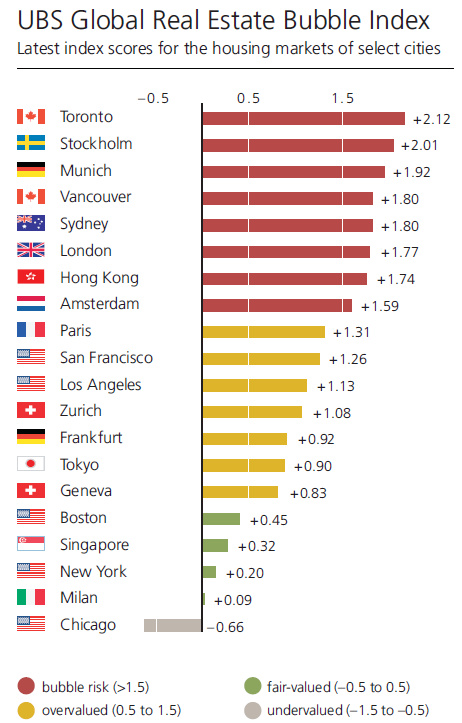
According to UBS, certain cities have seen prices rise at rates that are potentially not sustainable – and eight of these financial centers are at risk of having real estate bubbles that could eventually deflate.

GLOBAL REAL ESTATE BUBBLE INDEX

Every year, UBS publishes the Global Real Estate Bubble Index, and the most recent edition shows several key markets in bubble territory.

Global Real Estate Bubble Index

The bank highlights Toronto as the biggest potential bubble risk, noting that real prices have doubled over 13 years, while real rents and real income have only increased 5% and 10% respectively.

However, the largest city in Canada was certainly not the only global financial center with real estate appreciating at rapid rates in the last year.

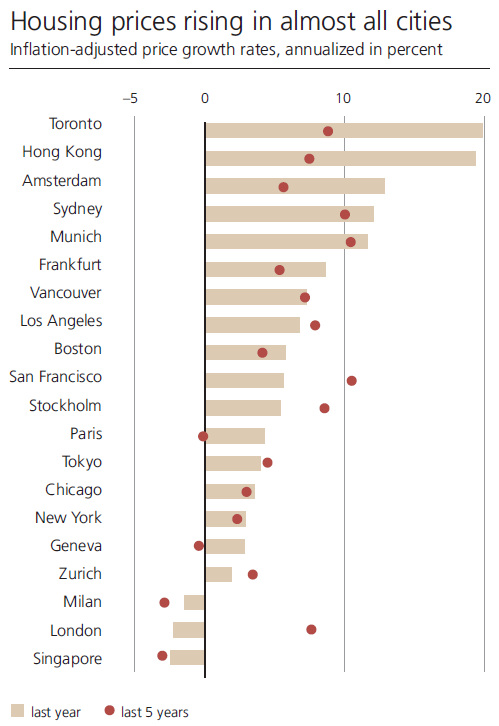
In Munich, Toronto, Amsterdam, Sydney and Hong Kong, prices rose more than 10% in the last year alone.

Annual increases at a 10% clip would lead to the doubling of prices every seven years, something the bank says is unsustainable.

Price Changes in select Real Estate Markets

In the last year, there were three key markets where prices did not rise: London, Milan, and Singapore.

London is particularly notable, since it holds more millionaires than any other city in the world and is rated as the #1 financial center globally.


 -- via my feedly newsfeed

sachs: Ending America’s Disastrous Role in Syria [feedly]

Ending America's Disastrous Role in Syria
https://www.project-syndicate.org/commentary/ending-disastrous-american-role-in-syria-by-jeffrey-d-sachs-2018-02

America's official narrative has sought to conceal the scale and calamitous consequences of US efforts to overthrow Syrian President Bashar al-Assad. That is understandable, because US efforts are in blatant violation of international law, which bars UN member states from supporting military action to overthrow other members' governments.

NEW YORK – Much of the carnage that has ravaged Syria during the past seven years is due to the actions of the United States and its allies in the Middle East. Now, faced with an alarming risk of a renewed escalation of fighting, it's time for the United Nations Security Council to step in to end the bloodshed, based on a new framework agreed by the Council's permanent members.


Here are the basics. In 2011, in the context of the Arab Spring, the US government, in conjunction with the governments of Saudi Arabia, Qatar, Turkey, and Israel, decided to bring down Syrian President Bashar al-Assad's regime, even though overthrowing another country's government amounts to a blatant violation of international law. We know that in 2012, if not earlier, President Barack Obama authorized the CIA to work with America's allies in providing support to rebel forces composed of disaffected Syrians as well as non-Syrian fighters. US policymakers evidently expected Assad to fall quickly, as had occurred with the governments of Tunisia and Egypt in the early months of the Arab Spring.

The Assad regime is led by the minority Alawi Shia sect in a country where Alawites account for just 10% of the population, Sunni Muslims account for 75%, Christians make up 10%, and 5% are others, including Druze. The regional powers behind Assad's regime include Iran and Russia, which has a naval base on Syria's Mediterranean coastline.

Whereas America's goal in seeking to topple Assad was mainly to undercut Iranian and Russian influence, Turkey's motive was to expand its influence in former Ottoman lands and, more recently, to counter Kurdish ambitions for territorial autonomy, if not statehood, in Syria and Iraq. Saudi Arabia wanted to undermine Iran's influence in Syria while expanding its own, while Israel, too, aimed to counter Iran, which threatens Israel through Hezbollah in Lebanon, Syria near the Golan Heights, and Hamas in Gaza. Qatar, meanwhile, wanted to bring a Sunni Islamist regime to power.

The armed groups supported by the US and allies since 2011 were assembled under the banner of the Free Syrian Army. In fact, there was no single army, but rather competing armed groups with distinct backers, ideologies, and goals. The fighters ranged from dissident Syrians and autonomy-seeking Kurds to Sunni jihadists backed by Saudi Arabia and Qatar.

While vast resources were devoted to overthrowing Assad, the effort ultimately failed, but not before causing massive bloodshed and displacing millions of Syrians. Many fled to Europe, fomenting Europe's refugee crisis and a surge in political support for Europe's anti-immigrant extreme right.


There were four main reasons for the failure to overthrow Assad. First, Assad's regime had backing among not only Alawites, but also Syrian Christians and other minorities who feared a repressive Sunni Islamist regime. Second, the US-led coalition was countered by Iran and Russia. Third, when a splinter group of jihadists split away to form the Islamic State (ISIS), the US diverted significant resources to defeating it, rather than to toppling Assad. Finally, the anti-Assad forces have been deeply and chronically divided; for example, Turkey is in open conflict with the Kurdish fighters backed by the US.

All of these reasons for failure remain valid today. The war is at a stalemate. Only the bloodshed continues.

America's official narrative has sought to conceal the scale and calamitous consequences of US efforts – in defiance of international law and the UN Charter – to overthrow Assad. While the US vehemently complains about Russian and Iranian influence in Syria, America and its allies have repeatedly violated Syrian sovereignty. The US government mischaracterizes the war as a civil war among Syrians, rather than a proxy war involving the US, Israel, Russia, Saudi Arabia, Iran, and Qatar.

In July 2017, US President Donald Trump announced the end of CIA support for the Syrian rebels. In practice, though, US engagement continues, though now it is apparently aimed more at weakening Assad than overthrowing him. As part of America's continued war-making, the Pentagon announced in December that US forces would remain indefinitely in Syria, ostensibly to support anti-Assad rebel forces in areas captured from ISIS, and of course without the assent of the Syrian government.

The war is in fact at risk of a new round of escalation. When Assad's regime recently attacked anti-Assad rebels, the US coalition launched airstrikes that killed around 100 Syrian troops and an unknown number of Russian fighters. Following this show of force, US Secretary of Defense Jim Mattis disingenuously stated that, "Obviously, we are not getting engaged in the Syrian civil war." In addition, Israel recently attacked Iranian positions in Syria.

The US and its allies should face reality and accept the persistence of Assad's regime, despicable as it may be. The UN Security Council, backed by the US, Russia, and the other major powers, should step in with peacekeepers to restore Syrian sovereignty and urgent public services, while blocking attempts at vengeance by the Assad regime against former rebels or their civilian supporters.

Yes, the Assad regime would remain in power, and Iran and Russia would maintain their influence in Syria. But the US official delusion that America can call the shots in Syria by choosing who rules, and with which allies, would end. It's long past time for a far more realistic approach, in which the Security Council pushes Saudi Arabia, Turkey, Iran, and Israel into a pragmatic peace that ends the bloodshed and allows the Syrian people to resume their lives and livelihoods.


Should-Read : Martin Wolf : Brexit has replaced the UK’s stiff upper lip with quivering rage : "In part, the UK is vict... [feedly]

Should-Read : Martin Wolf : Brexit has replaced the UK's stiff upper lip with quivering rage : "In part, the UK is vict...
http://www.bradford-delong.com/2018/02/should-read-martin-wolf-brexit-has-replaced-the-uks-stiff-upper-lip-with-quivering-ragehttpswwwftcomcon.html

Should-Read: Martin Wolf: Brexit has replaced the UK's stiff upper lip with quivering rage: "In part, the UK is victim of its past successes...

...A small offshore island became, temporarily, a superpower... defined... against Europe and... any power wishing to dominate Europe.... Now, Europe is uniting while the UK is very much not a superpower. So what does it choose? Is it to be an irrelevant offshore island or a part of a united Europe? The choice has to be divisive. When divisions are so deep, nobody is considered neutral....

How will this end? The answer is that anything is possible. Could there still be a "no-deal Brexit"? Yes. Could there be another referendum? Yes. But the likelihood is that the UK will exit on terms laid down, in detail, by the EU. When a country is this divided and its political processes are in such disarray, someone else has to sort things out. The EU will do so, because that is in its interests. The EU will not let the UK have its cake and eat it. It is led by people who also have a historical goal: not to return to the past. Their history was not British history and their aims are not British aims. They will determine the terms of the separation. We will then see whether the UK's civil war is resolved, or renewed in other, yet more bitter, ways.

VISIT WEBSITE

 -- via my feedly newsfeed

Kansas Should Reject Call for Constitutional Convention [feedly]

Kansas Should Reject Call for Constitutional Convention
https://www.cbpp.org/state-budget-and-tax/kansas-should-reject-call-for-constitutional-convention-0

Chair Estes and Members of the Committee:

Thank you for the opportunity to submit written testimony on Senate Concurrent Resolution 1611.

My name is Michael Leachman. I am the research director for the State Fiscal Project at the Center on Budget and Policy Priorities in Washington, D.C. We are a research institute that helps states make prudent fiscal policy decisions that build broad prosperity.

The resolution before the committee seeks to call, for the first time in the nation's history, a convention under Article V of the Constitution, at which amendments to the Constitution would be considered. Taking this unprecedented step would put the nation's Constitution up for grabs, putting at risk the cherished rights and freedoms the Constitution enshrines and widening the already great political divisions we see in this country today.

Members of the committee should not accept that claims made by groups promoting this resolution that states can control the actions or outcomes of a constitutional convention. Prominent legal scholars and jurists warn that a convention would open up the Constitution to radical and harmful changes.

The Constitution provides for no powers above that of a convention, and provides no guidance on the operating rules for a convention. Further, because a convention has never been called under Article V, there is no precedent upon which to base a shared understanding of the operating rules.  And yet so much is at stake. As constitutional scholar and Harvard Law School Professor Laurence Tribe has said, "what you're doing is putting the whole Constitution up for grabs." 

Further, the only constitutional convention in U.S. history, in 1787, went far beyond its mandate.  Charged with amending the Articles of Confederation, the convention instead wrote an entirely new governing document. The convention could even change the very rules of ratification as it did in 1787 when it created a new process, lowering the number of states needed to approve the new constitution.

There are no guarantees that the interests of Kansas would be upheld in a convention. A convention held today could also set its own agenda operating under the influence of powerful interest groups. As former Chief Justice Burger wrote, a "Constitutional Convention today would be a free-for-all for special interest groups."  Further, the broad language contained in many of the resolutions that states have passed recently might increase the likelihood of a convention enacting changes that are far more sweeping than many legislators supporting these resolutions envision.

Our Constitution was expertly crafted and has served us well for over 200 years. Americans across the political spectrum hold it dear. In the current environment, any constitutional amendments would be hard-fought and highly controversial — adding to the divisions of this country rather than creating the unity that's so desperately needed today. A convention that undermines the constitution's legitimacy with a large share of our citizens would be very harmful indeed.

For these reasons, I respectfully ask that you oppose this dangerous, misguided call for an unprecedented convention that would put our nation's founding and unifying document at risk.


 -- via my feedly newsfeed

Thursday, February 15, 2018

Rapid Job Growth, More Education Fail to Translate into Higher Wages for Health Care Workers [feedly]

Rapid Job Growth, More Education Fail to Translate into Higher Wages for Health Care Workers
http://cepr.net/publications/op-eds-columns/rapid-job-growth-more-education-fail-to-translate-into-higher-wages-for-health-care-workers

Eileen Appelbaum
Spotlight on Poverty & Opportunity, February 14, 2018

See article on original site

Health care, an important source of jobs in the US economy, accounts for nearly 13 percent of private sector employment. Unfortunately, despite rapid job growth in the sector, we've also seen wages of many healthcare workers in this critical area of our economy stagnate. Understanding this phenomenon and the factors that may have caused it, including decreased union participation and a shift in bargaining power from workers to employers is important for boosting health sector wages and potentially understanding some of the sources of growing inequality in our broader economy.

Since 2005, employment in health care grew by 20 percent. Hospitals provide the lion's share of jobs but grew by just 10 percent. The much smaller outpatient care segment grew six times faster, with employment increasing by nearly 60 percent. In 2015, the 5 million health care professionals were outnumbered by 5.5 million workers in two non-professional occupational groups — 2.1 million medical technicians and 3.4 million health aides and assistants.

Although robust job growth persisted through the financial crisis and beyond, wages of non-professional health care workers have stagnated. Median real wages of medical technicians working full-time in hospitals fell from $22.00 in 2005 to $21.60 in 2015; in outpatient facilities, their pay fell from $17.84 to $17.67.

Education is often seen as something of a panacea for higher wages but here it does not seem to be the culprit. Improvements in educational attainment for health aides and assistants over the 2005–2015 decade were dramatic. Many of these workers were poorly educated in 2005 — 41.4 percent in hospitals and 32.5 percent in outpatient facilities had a high school degree or less. By 2015, these shares had fallen to 29.4 percent in hospitals and 22.9 in outpatient care.

The share of these workers with some college education rose from 48.4 to 56.5 percent in hospitals and from 55.2 to 59.4 percent in outpatient facilities. By 2015, 62.5 percent of health aides and assistants in hospitals had some college or a four-year degree; more than three-quarters (77.1 percent) in outpatient care had this level of educational achievement.

Nevertheless, median real wages of full-time, full-year workers fell from $14.87 to $14.72 in hospitals and rose by a penny from $14.27 to $14.28 in outpatient facilities over the decade. Despite rapid advances in education, these workers were still earning less than $15-per-hour in 2015.

Rapid job growth and rising levels of education are often presented by policymakers as the cure for low wages. But the experiences of health care workers challenge this conventional wisdom. What, then, can explain the failure of wages to increase despite rising employment and educational levels?

The change in union density in these occupations may be one factor. The Bureau of Labor Statistics reports that union density for support occupations, which includes medical technicians and health aides and assistants, fell slightly from 13.0 percent to 12.6 percent in hospitals over the 2005–2015 decade. In outpatient care facilities, however, union density fell sharply, from 10.0 to 4.5 percent during the same period. Unions maintained membership in outpatient facilities, but the rapid growth in employment in this health care segment meant a steep decline in density. This fall in union density is a likely contributor to the stagnant wages of non-professional workers, and for the lower wages paid in outpatient care facilities compared to hospitals.

Another factor holding down workers' wages may be an increase in the bargaining power of employers. In consolidated health care markets characterized by one or a few health care systems, employers may have monopoly power in the market for their services and the ability to raise prices. They may also have monopsony power in the labor market and the ability to pay lower wages. The increase in hospital mergers over the 2005–2015 decade may partly explain stagnant or falling real wages in non-professional health care occupations.

Policies that increase competition in health care markets are good for consumers; providers will have to lower prices and increase the quality of care to compete for patients. They are also good for workers; in labor markets in which health care workers have a greater choice of employers, health care organizations will have to pay higher wages to attract and keep workers.

Policies that make it easier for workers to join unions can increase the bargaining power of workers. In the absence of increases in unionization rates, public policy can set a floor under workers' pay and living standards. Reforms such as a $15-dollar-per-hour minimum wage, universal access to health care, free higher education, and affordable quality child care will provide health care workers with greater economic security.


Eileen Appelbaum is Co-Director of the Center for Economic and Policy Research and Coauthor of the CEPR report, Organizational Restructuring in U.S. Healthcare Systems: Implications for Jobs, Wages, and Inequality, that examines the experiences of health care workers over a decade of change from 2005 to 2015.


 -- via my feedly newsfeed

West Virginia GDP -- a Streamlit Version

  A survey of West Virginia GDP by industrial sectors for 2022, with commentary This is content on the main page.