Friday, January 26, 2018

IRS Budget Needs to Be Restored and Supplemented to Implement and Enforce the New Tax Law [feedly]

IRS Budget Needs to Be Restored and Supplemented to Implement and Enforce the New Tax Law
https://www.cbpp.org/research/federal-tax/irs-budget-needs-to-be-restored-and-supplemented-to-implement-and-enforce-the

The implementation and enforcement of the recently enacted federal tax legislation pose a once-in-a-generation, multi-dimensional challenge for the Internal Revenue Service (IRS). The new law will affect virtually every taxpayer and business in the country.  It eliminates ingrained features of the income tax, such as the personal exemption and many deductions, introduces a new tax treatment of certain types of income, and adopts a completely new international corporate tax regime.  It is certain to spark questions from the public and businesses, who will look to the IRS for answers.  Of particular concern, given some of the law's features and the hasty way in which it was put together, it will also likely lead to an aggressive effort by some businesses and wealthy individuals to push against the law's outer boundaries — and possibly over them — to minimize their taxes.

THIS CHALLENGE IS MAGNIFIED BY THE IRS'S SHRUNKEN BUDGET AND DEPLETED WORKFORCE.

As a result, the IRS will need to provide extensive guidance to taxpayers, update its systems and forms, undertake significant public education, expand customer service, and, importantly, strengthen enforcement in the years to come.  This challenge is magnified by the IRS's shrunken budget and depleted workforce.  Its budget was cut by $2.4 billion, or 18 percent, between 2010 and 2017, after adjusting for inflation, and the agency has lost 18,000 employees (nearly one-fifth of its workforce), with enforcement personnel accounting for roughly four-fifths of this reduction.

In the weeks and months ahead, the Trump Administration and Congress should take two essential actions:

  1. Provide a substantial funding boost for the IRS in 2018.  The IRS was allocated $12 billion in 2017.  It will need a substantial boost across the organization for the current fiscal year in order both to address ongoing funding shortfalls and to gear up for the regulatory (with Treasury), customer service, and enforcement challenges the new law poses.  Providing additional funding for the IRS should be a top priority for the Administration and Congress as they negotiate 2018 funding levels.
  2. Make the necessary multi-year commitment to the IRS in the 2019 budget.  The Trump Administration's 2019 budget, expected to be released in early February, needs to include a robust commitment to the IRS, laying out a multi-year funding path sufficient to implement and enforce the new law's fundamental changes to the tax code.  Funding for 2019 will cover the crucial first filing season under the new law, and the IRS's customer service budget needs to reflect the increased workload that will entail.  Moreover, because the IRS enforcement budget has been disproportionately cut and the risk of new forms of tax gaming is high, the Trump 2019 budget should make a multi-year commitment to rebuild and bolster the IRS's enforcement capabilities.

After years of targeting the IRS's budget for deep cuts, some GOP taxwriters have indicated in recent weeks that more IRS funding is needed.[1]  Reportedly, the IRS estimates that it will need roughly $500 million in 2018 and 2019 for implementation of the new law.[2]  Any funding increase should start from last year's levels, not from the lower levels in the House and Senate appropriations bills.  Those bills were drafted before the tax law's enactment and merely continued the same misguided policy of undermining the IRS's ability to perform its core functions of collecting taxes, providing service to taxpayers, and enforcing the nation's tax laws.

Policymakers should heed the example of how Congress and the IRS responded to major tax reform legislation in 1986.  After that reform was enacted, the IRS significantly expanded taxpayer service efforts, hiring an additional 1,300 staff.[3]  At the same time, the agency was in the midst of a major effort to recover unpaid taxes, and so was actively strengthening its enforcement capabilities.  And these staff increases occurred at a time when the IRS already had about one-fifth more staff that it does today.

The IRS plays a fundamental role in our system of government by helping taxpayers comply with the tax code and ensuring that the nation's tax laws are enforced fairly and credibly, as well as by collecting nearly all of the revenue that funds federal programs from national defense and health care to investments in highways, science research, and education.  In the face of deep budget cuts and personnel reductions, the IRS has struggled to keep up with its basic core functions.  Implementation of the new tax law will add substantially to the strain.  It is incumbent on Congress and the Trump Administration to provide the resources the IRS will need over the coming years to meet the customer service and enforcement challenges the new tax law creates.

IRS Funding Has Fallen Sharply Since 2010

The IRS has been targeted for sharp funding cuts since 2010.  Its 2017 appropriation was $2.4 billion below the 2010 level after adjusting for inflation, amounting to an 18 percent cut.  (See Figure 1.)  As most IRS funding goes to staffing, the cuts have forced the IRS to reduce its workforce dramatically; the agency lost roughly 18,000 employees — around 19 percent of its workforce — between 2010 and 2017.[4]

These damaging cuts have weakened the agency's ability to perform its core functions of collecting taxes and enforcing the nation's tax laws.  As seven former IRS commissioners from both Republican and Democratic administrations have written: "Over the last fifty years, none of us has ever witnessed anything like what has happened to the IRS appropriations over the last five years and the impact these appropriations reductions are having on our tax system."[5]

FIGURE 1
IRS Funding Has Fallen Sharply


Even as congressional Republican leaders and the Trump Administration announced their intention to overhaul the tax code last year, they continued to propose still deeper cuts to the IRS budget for 2018.  The House and Senate appropriations bills would cut the IRS budget by $149 million and $124 million below its 2017 level, respectively.  Both bills would shrink the IRS budget to fully 20 percent below its 2010 level, adjusted for inflation.

As the tax bill moved closer to its eventual enactment, however, some key GOP lawmakers acknowledged that the IRS would need additional funding to implement it.  House Ways and Means Oversight Subcommittee Chairman Rep. Vern Buchanan said he "envisioned $500 million in funding. . . to design new tax forms, write new guidance publications and train customer service staff to implement a rewritten tax code," Government Executive reported.[6]  And Senate Finance Committee Chairman Orrin Hatch, according to his spokesperson, "will work closely with the IRS to make sure they can implement [the new law]."[7]

According to the National Taxpayer Advocate, the IRS has estimated that it will need $495 million in 2018 and 2019 to implement the new tax law.  Any funding increase should start from last year's levels, not from the lower levels in the House and Senate appropriations bills.  The additional funds would be used for bolstering customer service, producing new tax forms and publications, revising regulations, and issuing guidance as well as training IRS employees on the new law's provisions.  The IRS will also need to update its systems to reflect the new law's changes.  For instance, it has identified 131 filing season systems that will need updates to address changes to individual and business tax rates, inflation indexing, various tax threshold levels, and the like, as well as to align fraud detection filters with the new provisions.[8]

Customer Service, Shortchanged Since 2010, Likely to See Rise in Demand

The tax legislation received significant media and paid-advertising attention as it moved rapidly through Congress.  As a result, many Americans are likely aware there has been a major tax change, but may be unclear on many of the details of the changes, such as the end of the personal exemption, the elimination or modification of a number of longstanding deductions, and the complex new definitions of who is eligible for certain favorable tax treatments, particularly the new tax break for "pass-though" business income (that is, income from businesses such as partnerships, S corporations, and sole proprietorships that is passed through to the firms' owners and claimed on their individual tax returns).  While it's hard to predict how many taxpayers will seek to contact the IRS with questions, these combined factors could well lead to a substantial increase in customer-service demand.

The 1986 tax reform sparked a 14 percent increase in call volume.  More recent tax policy changes also have generated a significant increase in questions from taxpayers.  Following the enactment of the Affordable Care Act in 2010, calls and correspondence rose 8 percent the next year and 18 percent the year after that.  Call volume more than doubled after the stimulus tax cuts of 2008, even though the changes were relatively straightforward.[9]

The IRS is currently ill-prepared for a surge in taxpayer inquiries.  The budget cuts since 2010 have significantly weakened taxpayer services, making it more difficult for taxpayers to reach IRS representatives for assistance filing their returns and paying their tax bills.

The tax filing season in 2015 was particularly "abysmal," according to then-IRS Commissioner John Koskinen.  During that filing season, nearly two-thirds of calls were not answered at all, and callers that did get through waited an average of 23 minutes.[10]  The dismal state of taxpayer services helped convince Congress to boost IRS funding modestly for 2016 and 2017, which was used to hire seasonal employees to provide phone and correspondence service.[11]  This increase led to an improvement: for the 2017 filing season, 21 percent of calls to the IRS's main taxpayer services line went unanswered, and taxpayers waited an average of 7 minutes to speak to an IRS representative.[12] But with other new demands on the IRS as a result of the tax law, such improvements can't be maintained for the 2018 filing season absent a funding increase.

Outside of tax season, customer service is even weaker.  For instance, the IRS no longer answers any tax law questions outside of tax season.  The National Taxpayer Advocate has criticized that policy, stating "the IRS's continued unwillingness to help taxpayers by answering such a broad range of tax law questions represents a breathtaking abdication of a core function of tax administration."[13] While this practice is objectionable even in the absence of large tax policy changes, it seems especially untenable for the years ahead, as taxpayers focus on how their taxes will change as they head into filing their first returns under the new law in 2019.

The IRS will need more people to answer phone inquiries, and they will need to be trained on the provisions of the new tax law so they can provide correct answers.  Even with the modest funding boost for the IRS in 2017, staffing for taxpayer services in 2017 was still 10 percent (roughly 3,000 employees) below its 2010 level.[14]  (See Figure 2.)  Further, employee training resources have been cut to the bone.  To live within shrunken appropriations, the IRS has had to reduce its employee training budget by two-thirds since 2009, and it spent less than $500 per employee on training in 2017.[15]

FIGURE 2
Budget Cuts Have Reduced Taxpayer Services Staff by 10 Percent Since 2010


In response to the 1986 tax reform, the IRS added 1,300 staff and increased phone capacity by 30 percent.[16]  (And in the year before the 1986 tax reform bill was passed, the IRS had roughly 15,000 more employees than it does today.)  Following a full review in late 1988, the General Accounting Office concluded that the:

IRS did a good job implementing the Tax Reform Act and preparing for the increased work load it expected during the 1988 filing season.  IRS mounted an extensive media campaign to inform taxpayers about tax law changes and to encourage them to file early.  It hired and trained additional staff to answer taxpayer questions and process tax returns, extensively tested tax forms before distributing them to the public, and tested service center readiness before the filing season began.[17]

The President, Congress, and IRS should strive for a similar result for the 2019 filing season, though the job will not end in a single year, as discussed below.

Implementation Should Include Restoring and Significantly Bolstering Enforcement

Given the expected spike in taxpayer questions and the risk of backlash if inquiries are not answered, it is understandable that the initial attention of policymakers and the media seems to be on customer service.  And successful customer service is critical.

But IRS enforcement must be strengthened, as well, which will pose a dual challenge.  First, budget cuts have disproportionately targeted funding for enforcement, and the IRS's capability to perform this function adequately must be restored.  Second, the new tax law's design will invite taxpayers, particularly affluent ones and corporations with means to hire high-priced accountants and lawyers, to re-characterize their financial affairs strictly for tax purposes, aggressively pushing against the boundaries of the new law.  IRS enforcement must be able to identify those who step over the boundaries.

The new tax law will tax various types of income — labor, pass-through, domestic corporate, and international corporate income — at different tax rates.  It will also tax pass-through income from some sectors at a different rate than pass-through income from other sectors.  Certain deductions can be taken against certain types of income but not others (e.g., pass-throughs generally will be able to deduct more interest expenses than corporations will).  Meanwhile, the lines the new law draws within and around various types of "professional services" income are seemingly arbitrary (e.g., taxing a doctor or lawyer differently than an architect or an engineer) — and potentially porous.[18]

As a group of the nation's top tax experts observed, for example, "the new pass-through deduction will likely result in a massive restructuring of employment and service management across many industries."[19] As Tax Policy Center fellow and former Treasury Deputy Assistant Secretary of Tax Analysis Gene Steuerle has warned, "perhaps millions will change their form of ownership.  Some taxpayers will also find it desirable to create multiple layers of corporations, partnerships, and other pass-through businesses."[20]

Similarly, the new law adopts a new international corporate tax regime that will no longer subject foreign profits to U.S. tax, except for a minimum tax on certain extraordinary profits.  This will create a greater incentive for large corporations to turn domestic profits into foreign profits.

This drive to game the new law poses daunting challenges for the IRS to police and retain the integrity of the tax system.  Yet as noted, IRS enforcement funding has been hit hard by funding and staffing reductions since 2010.  In 2017, enforcement funding was 21 percent below its 2010 level in inflation-adjusted terms.  The agency has lost roughly 14,000 enforcement employees — more than a quarter of its enforcement staff — since 2010.[21]  (See Figure 3.)

FIGURE 3
Budget Cuts Have Reduced Enforcement Staff by 28 Percent Since 2010


The decline in enforcement has reduced the IRS's ability to go after tax evaders.  The IRS audited just 1 of every 140 individual returns in 2016, down from 1 of 90 returns in 2010.[22]  (See Figure 4.)  Audit rates have fallen particularly sharplyamong high-income taxpayers.  For instance, the audit rate for returns with incomes of over $1 million fell from its recent peak of 12.5 percent in 2011 to 5.8 percent in 2016.[23]

The IRS has designated high-income taxpayers as an enforcement priority due to their more complex finances and greater risk of noncompliance.  Moreover, the return per audit hour is substantial.  Among the highest-income returns, those with income above $1 million, the IRS identified over $2,000 in additional liability per audit hour, and for those with income above $5 million, it identified additional liability per audit hour of more than $4,500.[24]

Likewise, the audit rate for large corporations (defined by the IRS as those with assets greater than $10 million) fell from its recent peak of 17.8 percent in 2012 to just 9.5 percent in 2016.  As a result, the IRS identified $12 billion less in additional tax liability through audits of large corporations in 2016 than it did in 2010, a decline of nearly 50 percent.[25]

Wealthy people trying to take advantage of the pass-through tax break, and multinationals trying to minimize tax under the new international regime, will not be one-year enforcement challenges.  These challenges will last as long as these provisions remain in law.

Conclusion

FIGURE 4
Audit Rate Has Dropped Steeply Since 2010

The new tax law poses an immense challenge that the IRS is ill-prepared to handle, due to a dramatic reduction in its funding and workforce since 2010.  Policymakers need to recognize the depth of the IRS's budget and workforce depletion, as well as the multi-year and multi-dimensional nature of the response that will be urgently needed to implement and enforce the recently enacted tax changes.  The Trump Administration and Congress should make the IRS a top priority in the negotiations of how to allocate funding for 2018, and should commit to sufficient multi-year funding for the IRS to implement and enforce the new tax law.

End Notes

[1] Angie Petty, "Will IRS Have The Resources to Implement Tax Reform?," Deltek, January 2, 2018, https://www.deltek.com/en/learn/blogs/b2g-essentials/2018/01/will-irs-have-the-resources-to-implement-tax-reform.

[2] National Taxpayer Advocate, "2017 Annual Report to Congress: Executive Summary," December 31, 2017, p. 5, https://taxpayeradvocate.irs.gov/Media/Default/Documents/2017-ARC/ARC17_ExecSummary.pdf.

[3]Ibid.

[4] Staffing level for 2017 is an estimate based on the annualized continuing resolution funding level.  Government Accountability Office, "Internal Revenue Service: Observations on IRS's Operations, Planning, and Resources," February 27, 2015, p. 35, http://www.gao.gov/assets/670/668769.pdf; Internal Revenue Service, "Congressional Justification for Appropriations and Annual Performance Report and Plan," 2017, https://www.treasury.gov/about/budget-performance/CJ18/05.%20%20IRS%20-%20FY%202018%20CJ.pdf.

[5] Former IRS Commissioners Mortimer M. Caplan, Sheldon S. Cohen, Lawrence B. Gibbs, Fred T. Goldberg, Jr., Shirley D. Peterson, Margaret M. Richardson, and Charles O. Rossotti, "Letter to the Honorable Thad Cochran, the Honorable Barbara A. Mikulski, the Honorable Harold Rogers, and the Honorable Nita M. Lowey: IRS Appropriations for Fiscal Year 2016," November 9, 2015, http://taxprof.typepad.com/files/former-irs-commissioners-letter-on-agency-budget.pdf.

[6] Charles S. Clark, "House Subcommittee Mulls IRS Funding to Implement Tax Reform," Government Executive, December 13, 2017, http://www.govexec.com/management/2017/12/house-subcommittee-mulls-irs-funding-implement-tax-reform/144540/.

[7] Charles S. Clark, "Could a Resource-Strapped IRS Handle Tax Reform?," Government Executive, November 30, 2017, http://www.govexec.com/management/2017/11/could-resource-strapped-irs-handle-tax-reform/144193/.

[8] National Taxpayer Advocate, "2017 Annual Report to Congress: Executive Summary," December 31, 2017, p. 5, https://taxpayeradvocate.irs.gov/Media/Default/Documents/2017-ARC/ARC17_ExecSummary.pdf.

[9]Ibid, p. 5.

[10] National Taxpayer Advocate, "FY 2016 Objectives Report to Congress: Review of the 2015 Filing Season," June 30, 2017, p. 9, http://www.taxpayeradvocate.irs.gov/Media/Default/Documents/2016-JRC/2015_Filing_season_review.pdf.

[11] IRS, 2018 Congressional Justification.

[12] National Taxpayer Advocate, "FY 2018 Objectives Report to Congress: Review of the 2017 Filing Season," June 28, 2017, p. 6, https://taxpayeradvocate.irs.gov/Media/Default/Documents/2018-JRC/JRC18_Volume1_2017Review.pdf.

[13]Ibid, p. 7.

[14] Staffing level for 2017 is an estimate based on the annualized continuing resolution funding level.  Government Accountability Office, 2015 and IRS 2018 Congressional Justification.

[15] National Taxpayer Advocate, "Annual Report to Congress 2017: Executive Summary," p. 4, https://taxpayeradvocate.irs.gov/Media/Default/Documents/2017-ARC/ARC17_ExecSummary.pdf.

[16]Ibid, p.5.

[17] General Accounting Office, "Internal Revenue Service: Effective Implementation of the Tax Reform Act Led to Uneventful 1988 Filing Season," November 1988, p. 2, https://www.gao.gov/assets/150/147107.pdf.

[18] For more information on pass-throughs, see Reuven Avi-Yonah et al., "The Games They Will Play: An Update on the Conference Committee Tax Bill," revised December 22, 2017, https://ssrn.com/abstract=3089423.

[19]Ibid.

[20] C. Eugene Steuerle, "The TCJA Will Create More Complexity For Taxpayers Than It Claims," Tax Policy Center, January 5, 2018, http://www.taxpolicycenter.org/taxvox/tcja-will-create-more-complexity-taxpayers-it-claims.

[21] Staffing level for 2017 is an estimate based on the annualized continuing resolution funding level.  Government Accountability Office, 2015 and IRS 2018 Congressional Justification.

[22] Internal Revenue Service, "2016 Data Book," https://www.irs.gov/pub/irs-soi/16databk.pdf and Internal Revenue Service, "2010 Data Book," https://www.irs.gov/pub/irs-soi/10databk.pdf.

[23] IRS data books, 2011-2016.

[24] IRS defines high-income returns as those with total positive income over $200,000.  Treasury Inspector General for Tax Administration, "Improvements Are Needed in Resource Allocation and Management Controls for Audits of High-Income Taxpayers," September 18, 2015, https://www.treasury.gov/tigta/auditreports/2015reports/201530078fr.pdf.

[25] IRS data books, 2010-2016.


 -- via my feedly newsfeed

The Housing Market Crash and Wealth Inequality in the U.S. [feedly]

The Housing Market Crash and Wealth Inequality in the U.S.
http://economistsview.typepad.com/economistsview/2018/01/the-housing-market-crash-and-wealth-inequality-in-the-us.html

From the NBER Digest:

The Housing Market Crash and Wealth Inequality in the U.S., by Jen Deaderick, NBER Digest: Middle-class households tend to be heavily leveraged, with their homes as primary assets, while the rich tend to have more diverse investments. This made the middle class particularly vulnerable to the housing market crash.
Wealth inequality in the U.S. rose steeply between 2007 to 2010, largely as a result of the sharp decline in house prices during that period, Edward N. Wolff reports in Household Wealth Trends in the United States, 1962 to 2016: Has Middle Class Wealth Recovered? (NBER Working Paper No. 24085). Households with a greater concentration of wealth in their homes — including younger households, African Americans, and Hispanics — fared worse than other groups. The decline in home prices had a far greater percentage impact on the net worth of the middle class than the stock market plunge had on net worth of the top 1 percent.

The study draws on data from the Survey of Consumer Finances (SCF), which was conducted eleven times between the years 1983 and 2016. It defines wealth as net worth — the current value of all marketable assets minus any outstanding debts. This wealth measure excludes the future value of Social Security benefits and defined benefit pension payments. Median net worth declined from $118,600 in 2007 to $66,500 in 2010. Mean net worth, which is more sensitive to the holdings of high net worth households, declined from $620,500 to $521,000 — a drop of 16 percent. By 2016, median net worth had rebounded to $78,100, while mean net worth had reached $667,600, surpassing its 2007 value.
The rich tend to have a more diverse range of investments than the middle class, making them less vulnerable to declines in particular asset categories. The middle class tends to be heavily leveraged, with their homes as primary assets. As a result, they were disproportionately affected by the housing crash. Median wealth fell more than house prices from 2007 to 2010.
The study also reports the average return on all investments for households in different strata of the wealth distribution. For the period 1983-2016, "the average annual return on gross assets for the top 1 percent was 0.57 percentage points greater than that of the next 19 percent and 1.44 percentage points greater than that of the middle quintiles." This return differential, which contributes to greater wealth accumulation by those in higher wealth categories, is largely due to greater weight on owner-occupied housing in the asset holdings of the middle class, and a higher weight on corporate stocks — historically a high return asset class — in the portfolios of the wealthiest households.
The racial divide in wealth-holding widened with the housing crisis. In 2007, the ratio of debt to net worth in African-American households averaged 0.553, as opposed to 0.154 for white households. The ratio of mortgage debt to home value was also greater for African-American households: 0.49 compared with 0.32. The greater leverage made the relative loss in home equity after the housing crash far greater for African-American households. Hispanic households were even harder hit, as many bought homes at high prices between 2001 and 2007 in states that saw particularly steep drops in home prices. Both African-Americans and Hispanics recovered fairly well after the Great Recession, though not quite to their 2007 levels.
The study also notes a significant reduction in the relative wealth of the young versus the old during the Great Recession. "The average wealth of the youngest age group [households headed by someone under the age of 35] collapsed almost in half, from $105,500 in 2007 to $57,000 in 2010 (measured in 2016 USD), its second lowest point over the 30-year period ...while the relative wealth of age group 35-44 shrank from $357,400 to $217,600, its lowest point over the whole 1983 to 2010 period." This may be the result of younger households having bought homes at peak housing prices. The wealth of older age groups declined by less during this period.


 -- via my feedly newsfeed

Enlighten Radio Podcasts:Podcast: Moose Turd Cafe: Try a Davos Slice this morning

John Case has sent you a link to a blog:


Blog: Enlighten Radio Podcasts
Post: Podcast: Moose Turd Cafe: Try a Davos Slice this morning
Link: http://podcasts.enlightenradio.org/2018/01/podcast-moose-turd-cafe-try-davos-slice.html

--
Powered by Blogger
https://www.blogger.com/

Enlighten Radio Podcasts:Podcast: Moose Turd Cafe -- Mike Returns from the near Dead to do stand up.

John Case has sent you a link to a blog:


Blog: Enlighten Radio Podcasts
Post: Podcast: Moose Turd Cafe -- Mike Returns from the near Dead to do stand up.
Link: http://podcasts.enlightenradio.org/2018/01/podcast-moose-turd-cafe-mike-returns.html

--
Powered by Blogger
https://www.blogger.com/

Thursday, January 25, 2018

Bernstein:Populism, Globalization, Trump at Davos, Tariffs, the Dollar… [feedly]

Populism, Globalization, Trump at Davos, Tariffs, the Dollar…
http://jaredbernsteinblog.com/populism-globalization-trump-at-davos-tariffs-the-dollar/

As my title betrays, I'm trying to organize my thoughts around all of the above. There's a unifying theme to all this, and maybe if I noodle on about it here for a bit, I'll trip over it. But let me stipulate from the outset that I'm pretty sure the underlying theme of the moment will link up to the extremely important and deeply insightful recent work of the economist Dani Rodrik.

–Trump and a bunch of his staff are at the World Economic Forum in Davos, Switzerland. This feels like one of those teen movies where the good kids' parents are away and the kids have a party, which the bad kids show up to trash. The good kids act all scared and annoyed, but they're secretly titillated to have the bad kids at their party, hoping they'll set off some fireworks.

–Trump at Davos creates a collision of many strains of global political economics and Trumpian psychology, as Noah Bierman nicely covers here. Trump's populism is largely phony, so to the extent that he hits the Davos elites with America-first protectionism, it will be accompanied by an implicit wink, as if to signal: "Hey, fellow billionaires. This globalization stuff is working out great for us. But watch and learn, Davos. If you want to keep this deal going, you've got to shout a lot more about the 'forgotten man and women.' You might even need to slap a tariff on something here and there. But that's a small cost of doing business. You guys saw my tax cut, right?! You're welcome!"

–Well, Treasury Sec'y Mnuchin certainly let the cat out of the bag yesterday. He said "a weaker dollar is good for trade," which knocked already declining currency down even further, to its lowest level since late 2014 by the WSJ ICE index. The thing is, what he said is…um…true, and the nonsense that Treasury officials have had to spout about how the US is always and everywhere for a strong dollar is false and non-economic. Readers know I have no love at all for the Trump administration's economic policies, but I have to say that I appreciate this example of dumping a DC trope that never made sense in the first place.

–Which brings me to the tariffs. Between Mnuchin's dollar comment, the TPP-11 (the revival of the multi-lateral trade deal without the US), tariffs/quotas on solar panels and washers (but not dryers!), and possible forthcoming "section 232" tariffs on steel (the rationale for 232 tariffs is national security), the DC trade establishment has to be reaching for their vapors.

–These actions have generated lots of hand-wringing from the usual suspects, but what do they amount to? Presidents of all stripes have long invoked measures against countries that dump alleged under-priced goods on our shores, or unfairly hurt our own manufacturers (as the non-partisan ITC found in these cases; see this USTR fact sheet). Such measure make those goods more expensive, but at least in recent history, they've  never been large enough or long-lasting enough to change the underlying structure of the industry, domestic or foreign. At this point, 95 percent of our solar panels are imports! The tariff can have but a marginal impact on that share, and changes in the dollar and industrial policy have much greater long-run impacts on trade flows and balances. This then raises the good question as to why raise the tariffs? Typically, they've been used as a chess move, signalling to trading partners that we're unhappy with their pricing practices (which, to be clear, is not an endorsement). So, do yourself a favor and discount hyperventilating "trade war!" warnings by the usual critics. Forget the trade deals, the tariffs, and the noise they engender. Watch the trade and capital flows, which go up and down, but remain robust and will likely be boosted this year by synchronized global growth.

–Trump is apparently slated to argue the his "America first" nationalism must be a fine thing because, you know, the stock market's up and the unemployment rate is down. This makes absolutely zero sense. Other countries stock markets are up more than ours and growth is accelerating across the globe. Any trends Trump is enjoying were inherited. If he can claim credit for anything, it's not screwing up the economy Obama left him. Finally, there is no nationalist agenda, just a bunch of hot air accompanied by standard-issue, establishment Republican trickle-down tax cuts and industry deregulation.

–Still, even amidst all this posturing, what's most interesting about Trump in Davos is the collision of the cheerleaders of globalization with the president who ran against them, even while his legislative agenda is comforting and familiar to some of them. This collision invokes conflicts far more interesting than the Trump show, as masterfully covered in recent work by the economist Dani Rodrik. His survey of the history of globalization, clear-eyed look at the actual predictions (vs. the sugar-coated ones) of trade theory, documentation of the empirical outcomes of expanded trade, along with his fundamental understanding of the interactions between politics, institutions, and trade provide the deepest insights I've seen into this moment in global political economy. Read this for a somewhat technical, but still readable, version summarizing his sweeping take on these issues, and then read his highly accessible new book, which I'm working through and will have more to say about when I'm done. For me, and I suspect you'll feel similarly, this work perfectly crystallizes much of what got us to where we are today.


 -- via my feedly newsfeed

Is Economic Insecurity Behind the Specter of Populism?


Is Economic Insecurity Behind the Specter of Populism?

A new study examines the role of the 2007–9 global financial crisis and its metastasis in Europe on voting and political beliefs, showing that crisis-driven economic insecurity is a substantial driver of populism and political distrust. 


To paraphrase the opening line of the Communist Manifesto in 1848, a specter is haunting Europe and the Westthe specter of populism. Populist parties and politicians have been gaining momentum all around the world over the recent years.


Nationalistic parties with an explicit anti-globalizationas well as anti-elite and anti-immigration agendahave risen to power in Poland, Hungary, and Austria. AfD and Marine Le Pen's Front National did very well in the past German and French elections, respectively; and Beppe Grillo's Five Star Movement is leading the opinion polls in the forthcoming Italian elections. At the same time, radical left parties, opposing financial and trade globalization, have also been on the rise, especially in southern Europe with the electoral success of Syriza and Podemos. In 2016, Donald Trump's campaign was based on a typical populist anti-elite, anti-immigrant, and anti-trade agenda. Similarly, an anti-EU agenda was supported by the majority of British votes during the Brexit referendum. Populist parties and politicians are also on the rise in emerging and frontier economies. Furthermore, mainstream parties have taken note of the populists' successes and are now catering to people's growing demand for populist policies in many countries (Guiso et al. 2018).   


A lot of ink has been spilled on the drivers of populism, mostly in the US and UK (Becker et al. 2018). Researchers, policy makers, and journalists seem to broadly agree that medium-term developments related to automation (technological progress and outsourcing) and rising competition in manufacturing from low-cost countries have hurt the middle class in advanced countries (as shown in a series of influential studies by Autor et al. 2016), which in turn is becoming attracted by the simplistic populist messages.


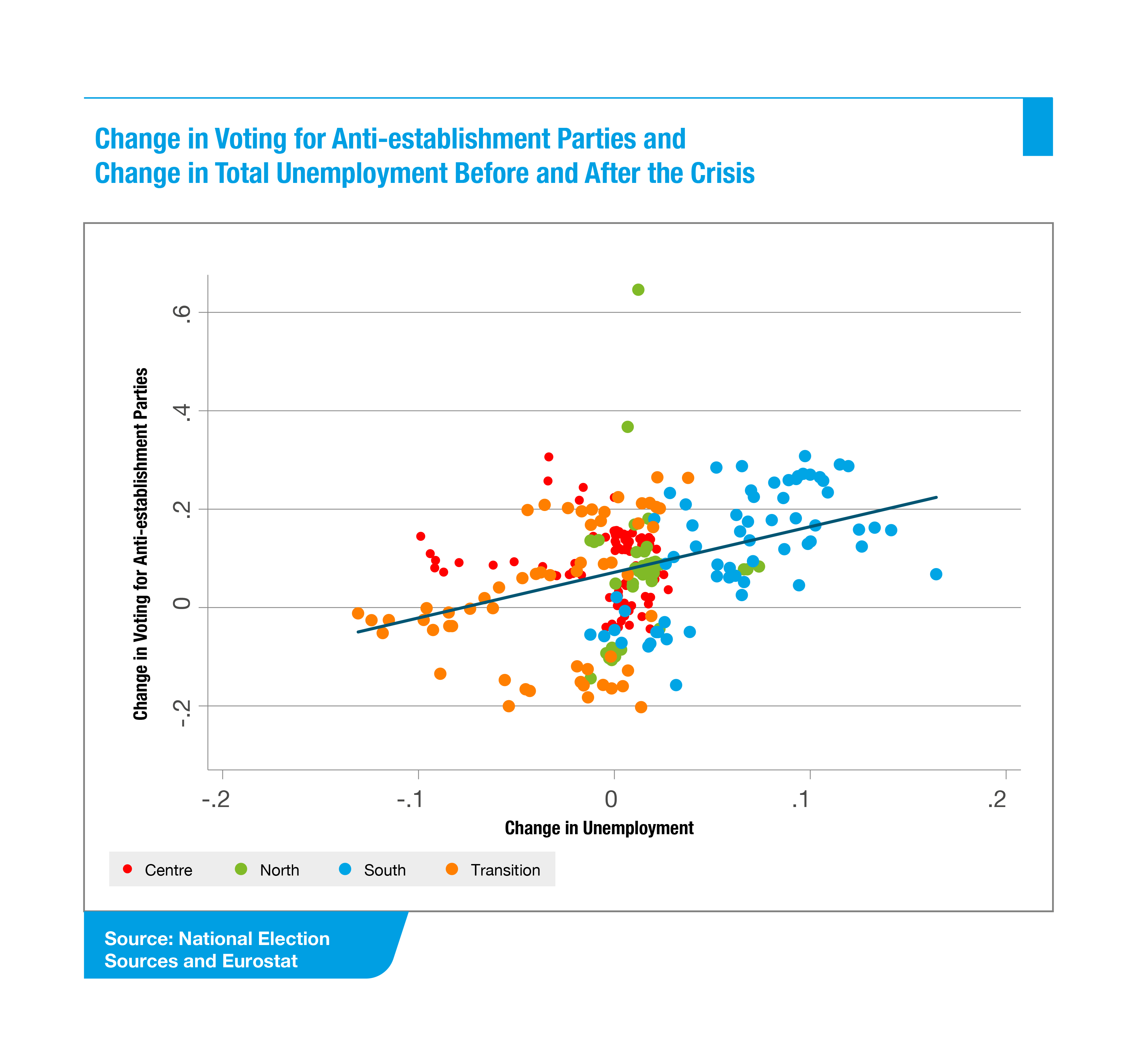
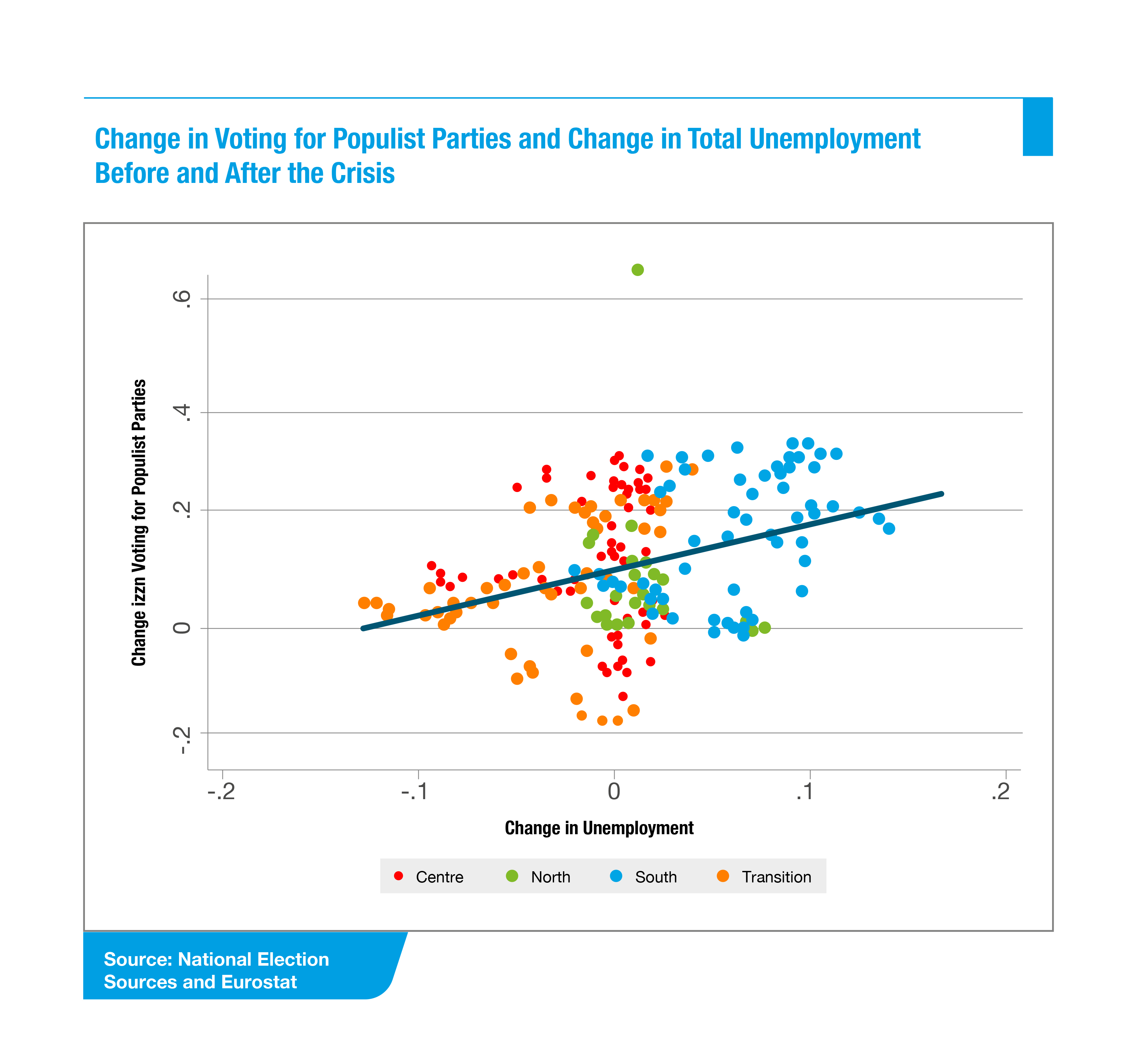
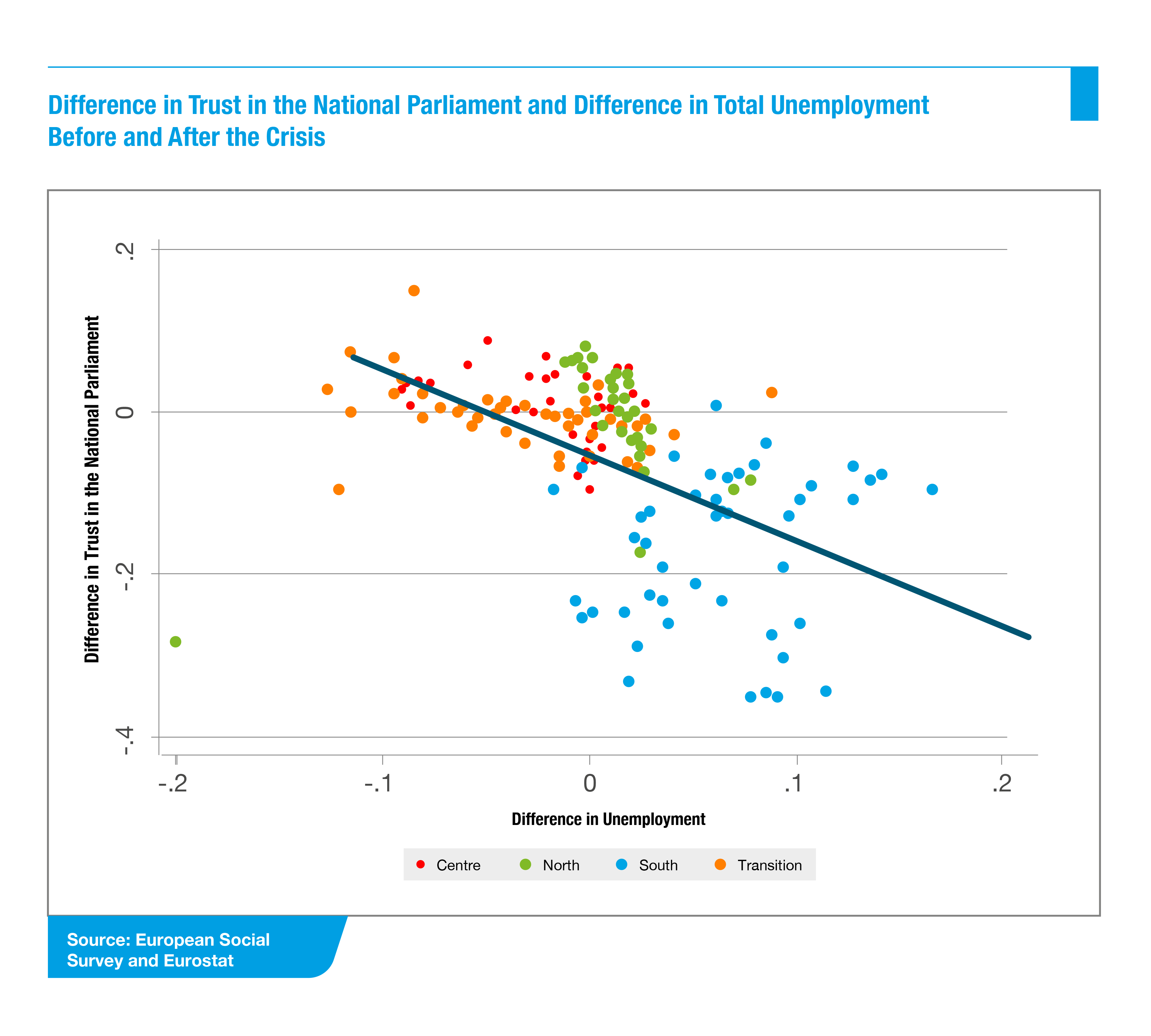
Rather than looking at medium-/long-run features, in recent work (Algan, Guriev, Papaioannou, and Passari 2017), we examine the role of the 2007–9 global financial crisis and its metastasis in Europe on voting and political beliefs in 220 subnational regions of 26 European countries. We show that crisis-driven economic insecurity is a substantial driver of populism and political distrust. We find a strong causal impact of the rises in unemployment on voting for non-mainstream, especially populist parties. Increases in unemployment go in tandem with a decline in trust in national and European political institutions.


Unemployment and Voting


We assign non-mainstream parties into four (not mutually exclusive) categories using earlier works in political science and a reading of parties' manifestos: far-right nationalistic parties like the Golden Dawn in Greece or True Finns, extreme-radical left parties like Syriza in Greece and Podemos in Spain, populist parties like UKIP in the UK and the Five Star Movement in Italy, and Euro-sceptic like Jobbik in Hungary and Poland's Law and Justice party. As shown in Figures 1a and 1b there is a strong correlation between rising regional unemployment and voting for non-mainstream and especially populist parties. A one percentage point increase in unemployment is associated with a one percentage point increase in the populist vote. The association is especially strong in the south, where voters turn mostly to radical-left parties. In the north increases in regional unemployment are correlated with a rise in far-right party vote. This pattern is also present in eastern Europe, where people are moving towards xenophobic, anti-European parties.


These associations do not necessarily imply causality. To advance on causality we associate voting patterns to the component of changes in unemployment stemming from the pre-crisis share of construction (which is strongly related to falling unemployment pre-2007 and rising unemployment post-2008). This approach also yields a strong correlation between the recent rise of the populist vote and industrial specialization–driven unemployment.


Figure 1a
Figure 1b

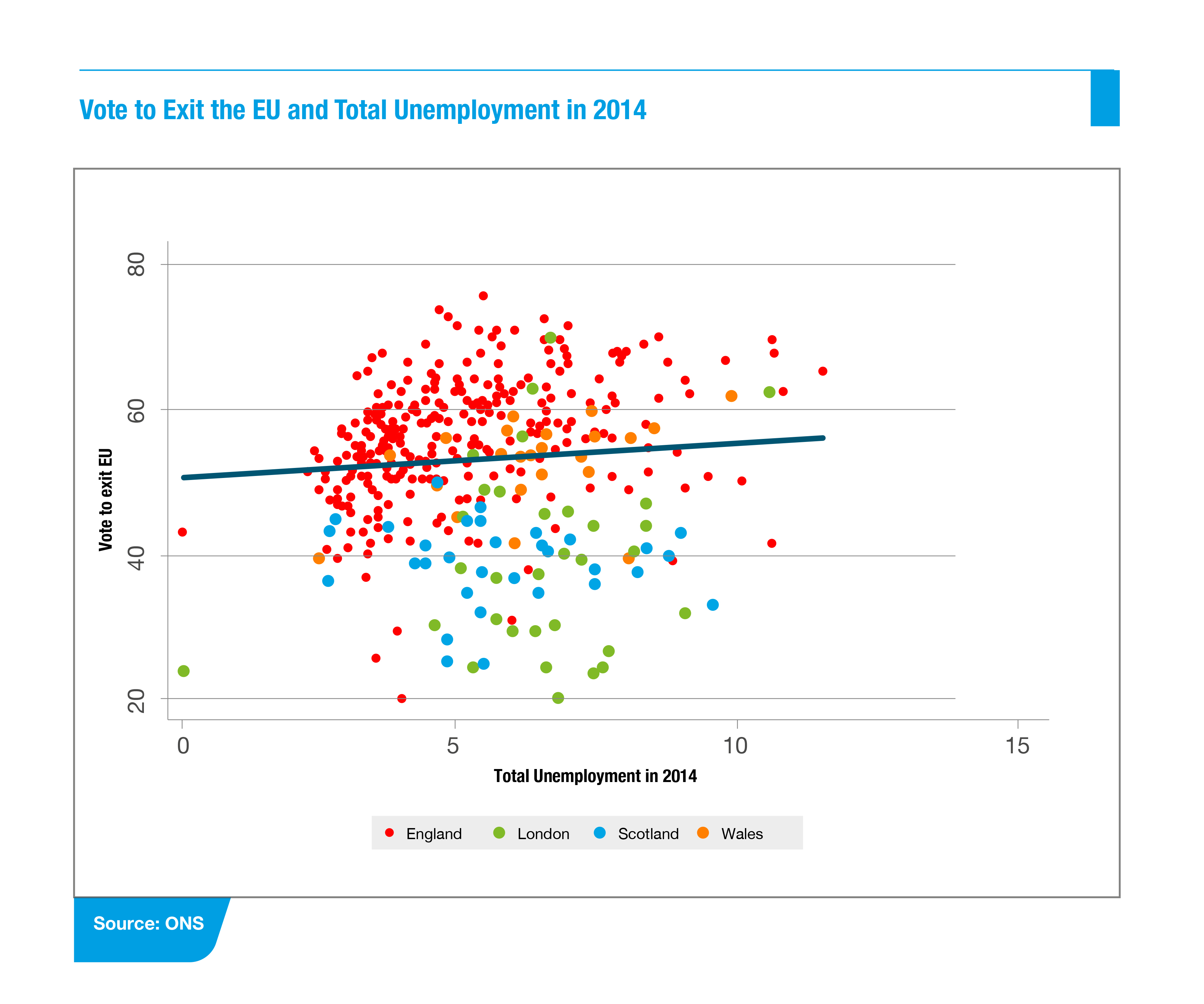
We then examine the role of the crisis on the Brexit vote across the UK's 379 electoral districts. In line with the European-wide results, Figures 2a and 2b show that the increases in regional unemployment before the referendum (2007–15) are strong predictors of the Brexit vote, while the level of unemployment is not much related to Brexit.


Figure 2a
Figure 2b

Unemployment and Political Beliefs


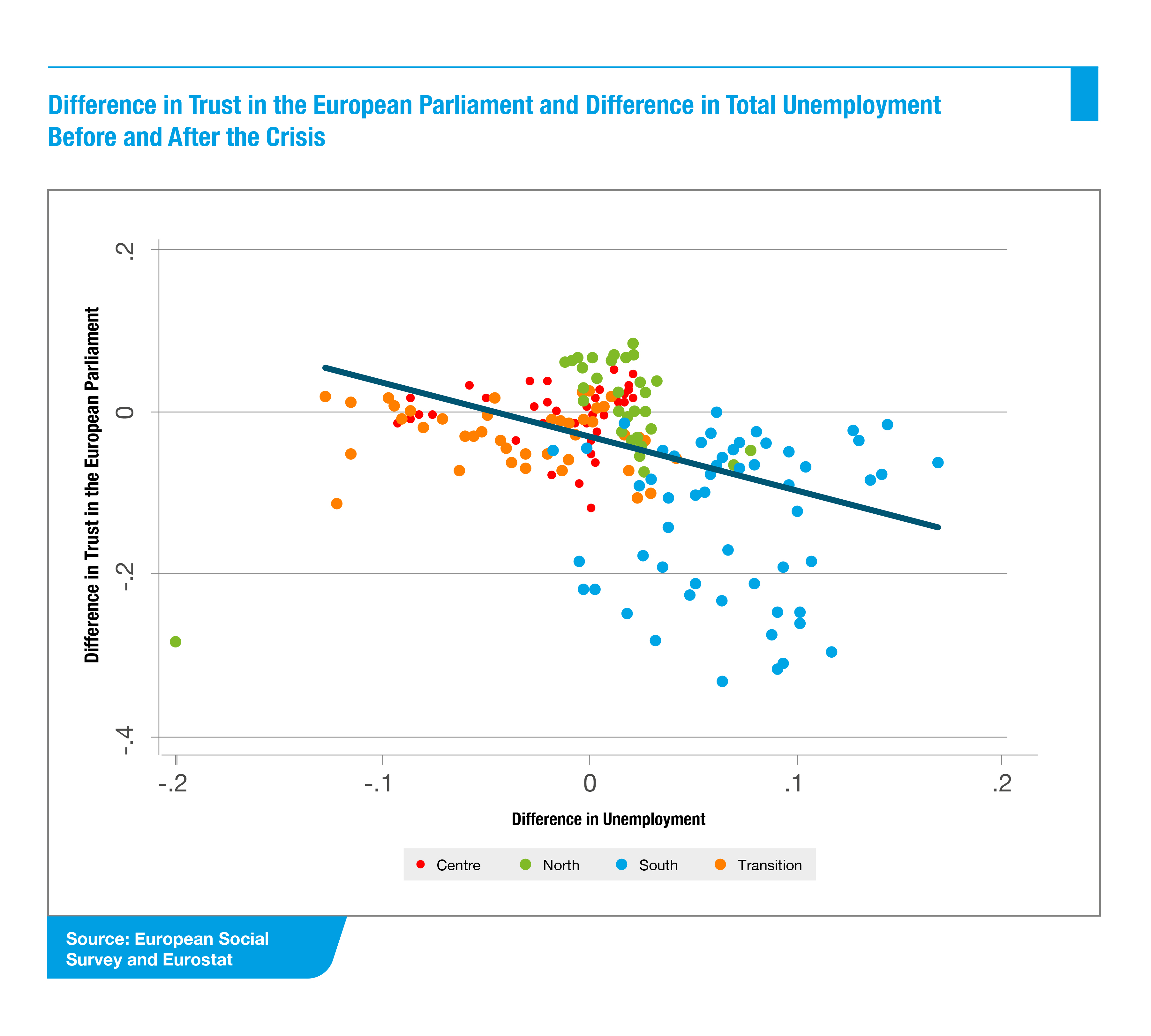
We then study the evolution of trust, political beliefs and attitudes before and after the 2007–10 crisis and examine whether swings in unemployment are related to changing ideology. We use individual-level data on Europeans' beliefs and attitudes from the European Social Survey that covers the period 2000–2014. Figures 3a and 3b show that increases in regional unemployment have resulted in a deterioration of trust towards national and European political institutions.


Figure 3a
Figure 3b

Unemployment is also related to declining trust in national courts, an alarming result as the rule of law is an essential element of Western democracies. Unemployment is not systematically linked to respondents' self-reported political orientation on the traditional left-right axis. This finding is thus in line with rising populism from both ends of the political spectrum. Although many new parties have emerged in Europe, respondents in crisis-hit areas are more likely to report that no party is close to their views. Finally, we uncover an interesting heterogeneity when examining the impact of unemployment on beliefs about the future of Europe. In the south (Greece, Portugal, Spain, Italy, Cyprus) increases in unemployment are mapped with aspirations for deeper European integration. In contrast, in central and northern European countries (Germany, Netherlands, Austria), respondents in crisis-hit regions argue that the European Union project has gone too far.


These patterns apply to men and women, younger and older cohorts. The relationship between unemployment and distrust in national and European institutions is stronger for non-college graduates, a pattern that echoes the findings of Autor et al. (2016, 2017), Che et al. (2016), and Colantone and Stanig (2016), who relate populist voting and political polarization to depressed wages among unskilled workers fueled by rising competition from low-/middle-income countries.


Unemployment and Beliefs on Immigrants


Given the widespread anti-immigration rhetoric of Donald Trump, Nigel Farage, Viktor Orban, and other populist politicians, we also examined the association between regional unemployment and self-reported beliefs on the role of immigrants in the society and the economy. Individuals in more crisis-hit regions are not more likely to express negative feelings about immigrants and their role in country's cultural and social life. There is some evidence that in regions that experienced the highest increase in unemployment respondents argue that immigrants' economic impact has been on average negative. Yet this associationthough statistically significantis not particularly strong.


However, when we examine heterogeneity we find that for non-college educated respondents the link between unemployment and negative feelings on immigrants' economic impact is sizable, most likely because unskilled workers have been affected the most from the crisis, technical progress, and globalization. Although unemployment is especially high among the youth and although the European social safety net is less strong for younger cohorts, attitudes towards immigrants among them have not moved much, most likely because of rising cosmopolitanism and open mindedness.


Implications


Our results give a rationale for countercyclical macroeconomic policies, preventing rising unemployment and attenuating its impact. Even a temporary increase in unemployment may result in political fallout, which in turn would give rise to anti-market policies undermining long-term growth. Indeed, a cyclical downturn may bring about populist policies which in turn can give rise to sustained negative economic implications.


The impact of rising unemployment on political trust is also important for the success of structural reforms that many European countries are currently implementing. Political trust is key for the reforms that are painful in the short run but deliver socioeconomic benefits later (such as labor market reforms, reforms of public administration, opening up protected occupations, deepening the fiscal and banking union). In order to support such reforms, the public needs to trust that politicians have the public interest at heart. If this is not the case, reforms are not implementedor get reversed by populists. This in turn means that unemployment remains high, further reinforcing the vicious circle of political distrust and lack of reforms.


References


Algan, Yann; Sergei Guriev; Elias Papaioannou, and Evgenia Passari. (2017). "The European Trust Crisis and the Rise of Populism." Brookings Papers on Economic Activity, Fall 2018


Autor, David H., David Dorn, Gordon H. Hanson, and Kaveh Majlesi. (2016). "Importing Political Polarization? The Electoral Consequences of Rising Trade Exposure." Working paper. MIT Department of Economics.


Autor, David H., David Dorn, Gordon H. Hanson, and Kaveh Majlesi. (2017). "A Note on the Effect of Rising Trade Exposure on the 2016 Presidential Elections" Working paper. MIT Department of Economics.


Becker, Sascha O., Thiemo Fetzer and Dennis Novy, (2017). "Who Voted for Brexit? A Comprehensive District-Level Analysis", Economic Policy, 32(1).


Che, Yi, Yi Lu, Justin R. Pierce, Peter K. Schott, and Zhigang Tao. (2016). "Does Trade Liberalization with China Influence US Elections?". No. w22178. National Bureau of Economic Research.


Colantone, Italo and Pierro Stanig (2016), "Global Competition and Brexit", BAFFI CAREFIN Centre Research Paper No. 2016-44. Forthcoming American Political Science Review


Colantone, Italo, and Piero Stanig. (2017). "The Trade Origins of Economic Nationalism: Import Competition and Voting Behavior in Western Europe". Forthcoming American Journal of Political Science.


De Vries, Catherine E.  (2017). "The Cosmopolitian-Parochial Divide: What the 2017 Dutch Election Result Tells Us About Political Change in the Netherlands and Beyond". Journal of European Public Policy, forthcoming.


Dustmann, Christian, Barry Eichengreen, Sebastian Otten, Andre Sapir, Guido Tabellini and Gylfi Zoega (2017), "Europe's Trust Deficit: Causes and Remedies", Monitoring International Integration 1, CEPR Press.


Guiso, Luigi, Helios Herrera, and Massimo Morelli. (2017). "Populism. Demand and Supply of Populism". Working Paper n°1703, Einaudi Institute for Economics and Finance (EIEF).


Disclaimer: The ProMarket blog is dedicated to discussing how competition tends to be subverted by special interests. The posts represent the opinions of their writers, not those of the University of Chicago, the Booth School of Business, or its faculty. For more information, please visit ProMarket Blog Policy.  


--
John Case
Harpers Ferry, WV

The Winners and Losers Radio Show
7-9 AM Weekdays, The Enlighten Radio Player Stream, 
Sign UP HERE to get the Weekly Program Notes.

Wednesday, January 24, 2018

Brazil’s Democracy Pushed Into the Abyss [feedly]

Brazil's Democracy Pushed Into the Abyss
http://cepr.net/publications/op-eds-columns/brazil-s-democracy-pushed-into-the-abyss

Brazil's Democracy Pushed Into the Abyss

Mark Weisbrot
The New York Times, January 23, 2018

New York Times en Español, January 23, 2018

See article on original site

Em Portuguese

En español

The rule of law and the independence of the judiciary are fragile achievements in many countries — and susceptible to sharp reversals.

Brazil, the last country in the Western world to abolish slavery, is a fairly young democracy, having emerged from dictatorship just three decades ago. In the past two years, what could have been a historic advancement ― the Workers' Party government granted autonomy to the judiciary to investigate and prosecute official corruption ― has turned into its opposite. As a result, Brazil's democracy is now weaker than it has been since military rule ended.

This week, that democracy may be further eroded as a three-judge appellate court decides whether the most popular political figure in the country, former President Luiz Inácio Lula da Silva of the Workers' Party, will be barred from competing in the 2018 presidential election, or even jailed.

There is not much pretense that the court will be impartial. The presiding judge of the appellate panel has already praised the trial judge's decision to convict Mr. da Silva for corruption as "technically irreproachable," and the judge's chief of staff posted on her Facebook page a petition calling for Mr. da Silva's imprisonment.

The trial judge, Sérgio Moro, has demonstrated his own partisanship on numerous occasions. He had to apologize to the Supreme Court in 2016 for releasing wiretapped conversations between Mr. da Silva and President Dilma Rousseff, his lawyer, and his wife and children. Judge Moro arranged a spectacle for the press in which the police showed up at Mr. da Silva's home and took him away for questioning — even though Mr. da Silva had said he would report voluntarily for questioning.

The evidence against Mr. da Silva is far below the standards that would be taken seriously in, for example, the United States' judicial system.

He is accused of having accepted a bribe from a big construction company, called OAS, which was prosecuted in Brazil's "Carwash" corruption scheme. That multibillion-dollar scandal involved companies paying large bribes to officials of the state-owned oil company, Petrobras, to obtain contracts at grossly inflated prices.

The bribe alleged to have been received by Mr. da Silva is an apartment owned by OAS. But there is no documentary evidence that either Mr. da Silva or his wife ever received title to, rented or even stayed in the apartment, nor that they tried to accept this gift.

The evidence against Mr. da Silva is based on the testimony of one convicted OAS executive, José Aldemário Pinheiro Filho, who had his prison sentence reduced in exchange for turning state's evidence. According to reporting by the prominent Brazilian newspaper Folha de São Paulo, Mr. Pinheiro was blocked from plea bargaining when he originally told the same story as Mr. da Silva about the apartment. He also spent about six months in pretrial detention. (This evidence is discussed in the 238-page sentencing document.)

But this scanty evidence was enough for Judge Moro. In something that Americans might consider to be a kangaroo court proceeding, he sentenced Mr. da Silva to nine and a half years in prison.

The rule of law in Brazil had already been dealt a devastating blow in 2016 when Mr. da Silva's successor, Ms. Rousseff, who was elected in 2010 and re-elected in 2014, was impeached and removed from office. Most of the world (and possibly most of Brazil) may believe that she was impeached for corruption. In fact, she was accused of an accounting maneuver that temporarily made the federal budget deficit look smaller than it otherwise would appear. It was something that other presidents and governors had done without consequences. And the government's own federal prosecutor concluded that it was not a crime.

While there were officials involved in corruption from parties across the political spectrum, including the Workers' Party, there were no charges of corruption against Ms. Rousseff in the impeachment proceedings.

Mr. da Silva remains the front-runner in the October election because of his and the party's success in reversing a long economic decline. From 1980 to 2003, the Brazilian economy barely grew at all, about 0.2 percent annually per capita. Mr. da Silva took office in 2003, and Ms. Rousseff in 2011. By 2014, poverty had been reduced by 55 percent and extreme poverty by 65 percent. The real minimum wage increased by 76 percent, real wages overall had risen 35 percent, unemployment hit record lows, and Brazil's infamous inequality had finally fallen.

But in 2014, a deep recession began, and the Brazilian right was able to take advantage of the downturn to stage what many Brazilians consider a parliamentary coup.

If Mr. da Silva is barred from the presidential election, the result could have very little legitimacy, as in the Honduran election in November that was widely seen as stolen. A poll last year found that 42.7 percent of Brazilians believed that Mr. da Silva was being persecuted by the news media and the judiciary. A noncredible election could be politically destabilizing.

Perhaps most important, Brazil will have reconstituted itself as a much more limited form of electoral democracy, in which a politicized judiciary can exclude a popular political leader from running for office. That would be a calamity for Brazilians, the region and the world.


Mark Weisbrot is Co-Director of the Center for Economic and Policy Research in Washington, D.C., and the president of Just Foreign Policy. He is also the author of "Failed: What the 'Experts' Got Wrong About the Global Economy" (2015, Oxford University Press). You can subscribe to his columns here.


 -- via my feedly newsfeed

West Virginia GDP -- a Streamlit Version

  A survey of West Virginia GDP by industrial sectors for 2022, with commentary This is content on the main page.