Thursday, January 25, 2018

Is Economic Insecurity Behind the Specter of Populism?


Is Economic Insecurity Behind the Specter of Populism?

A new study examines the role of the 2007–9 global financial crisis and its metastasis in Europe on voting and political beliefs, showing that crisis-driven economic insecurity is a substantial driver of populism and political distrust. 


To paraphrase the opening line of the Communist Manifesto in 1848, a specter is haunting Europe and the Westthe specter of populism. Populist parties and politicians have been gaining momentum all around the world over the recent years.


Nationalistic parties with an explicit anti-globalizationas well as anti-elite and anti-immigration agendahave risen to power in Poland, Hungary, and Austria. AfD and Marine Le Pen's Front National did very well in the past German and French elections, respectively; and Beppe Grillo's Five Star Movement is leading the opinion polls in the forthcoming Italian elections. At the same time, radical left parties, opposing financial and trade globalization, have also been on the rise, especially in southern Europe with the electoral success of Syriza and Podemos. In 2016, Donald Trump's campaign was based on a typical populist anti-elite, anti-immigrant, and anti-trade agenda. Similarly, an anti-EU agenda was supported by the majority of British votes during the Brexit referendum. Populist parties and politicians are also on the rise in emerging and frontier economies. Furthermore, mainstream parties have taken note of the populists' successes and are now catering to people's growing demand for populist policies in many countries (Guiso et al. 2018).   


A lot of ink has been spilled on the drivers of populism, mostly in the US and UK (Becker et al. 2018). Researchers, policy makers, and journalists seem to broadly agree that medium-term developments related to automation (technological progress and outsourcing) and rising competition in manufacturing from low-cost countries have hurt the middle class in advanced countries (as shown in a series of influential studies by Autor et al. 2016), which in turn is becoming attracted by the simplistic populist messages.


Rather than looking at medium-/long-run features, in recent work (Algan, Guriev, Papaioannou, and Passari 2017), we examine the role of the 2007–9 global financial crisis and its metastasis in Europe on voting and political beliefs in 220 subnational regions of 26 European countries. We show that crisis-driven economic insecurity is a substantial driver of populism and political distrust. We find a strong causal impact of the rises in unemployment on voting for non-mainstream, especially populist parties. Increases in unemployment go in tandem with a decline in trust in national and European political institutions.


Unemployment and Voting


We assign non-mainstream parties into four (not mutually exclusive) categories using earlier works in political science and a reading of parties' manifestos: far-right nationalistic parties like the Golden Dawn in Greece or True Finns, extreme-radical left parties like Syriza in Greece and Podemos in Spain, populist parties like UKIP in the UK and the Five Star Movement in Italy, and Euro-sceptic like Jobbik in Hungary and Poland's Law and Justice party. As shown in Figures 1a and 1b there is a strong correlation between rising regional unemployment and voting for non-mainstream and especially populist parties. A one percentage point increase in unemployment is associated with a one percentage point increase in the populist vote. The association is especially strong in the south, where voters turn mostly to radical-left parties. In the north increases in regional unemployment are correlated with a rise in far-right party vote. This pattern is also present in eastern Europe, where people are moving towards xenophobic, anti-European parties.


These associations do not necessarily imply causality. To advance on causality we associate voting patterns to the component of changes in unemployment stemming from the pre-crisis share of construction (which is strongly related to falling unemployment pre-2007 and rising unemployment post-2008). This approach also yields a strong correlation between the recent rise of the populist vote and industrial specialization–driven unemployment.
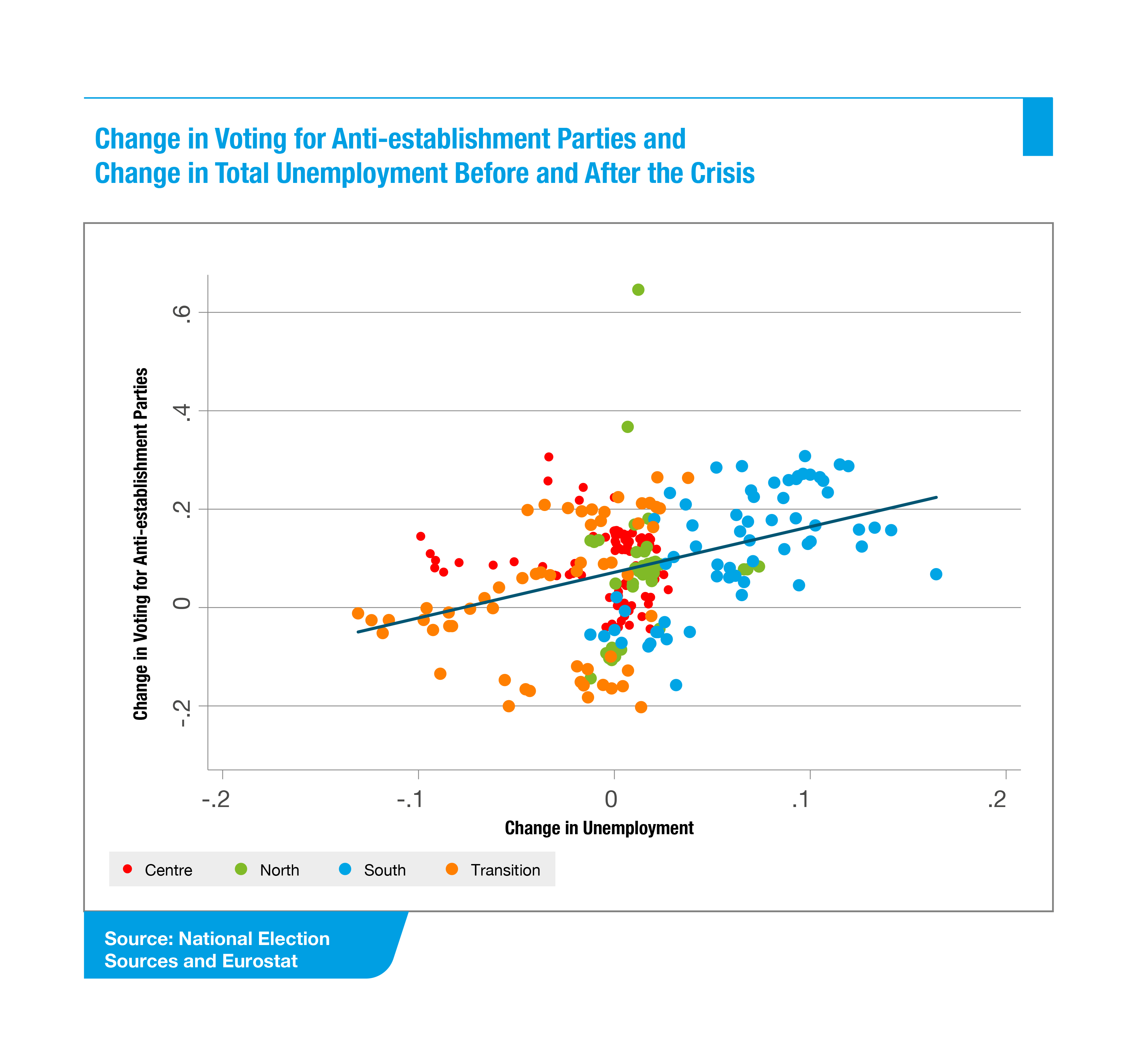
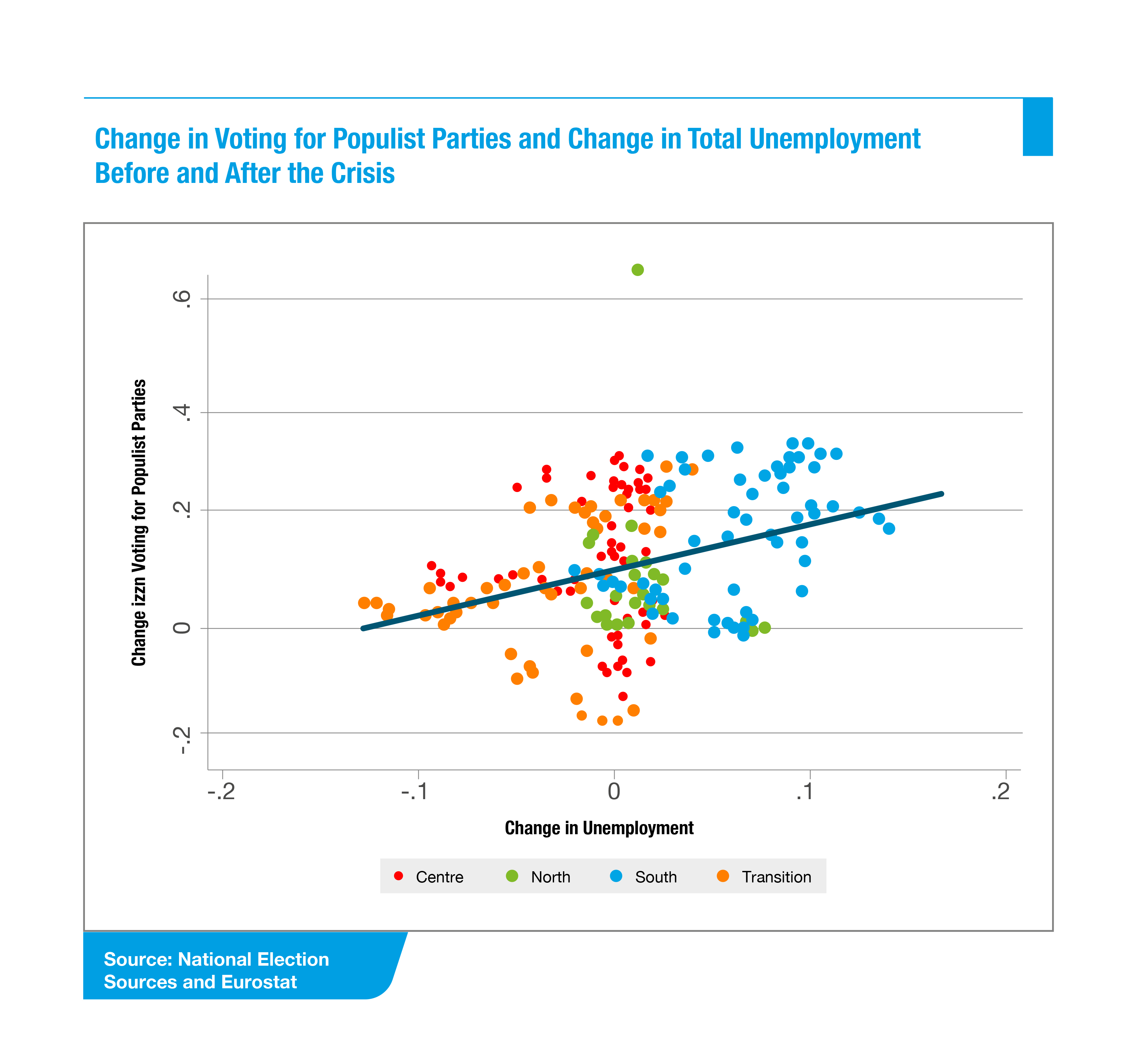
 

Figure 1a
Figure 1b

We then examine the role of the crisis on the Brexit vote across the UK's 379 electoral districts. In line with the European-wide results, Figures 2a and 2b show that the increases in regional unemployment before the referendum (2007–15) are strong predictors of the Brexit vote, while the level of unemployment is not much related to Brexit.
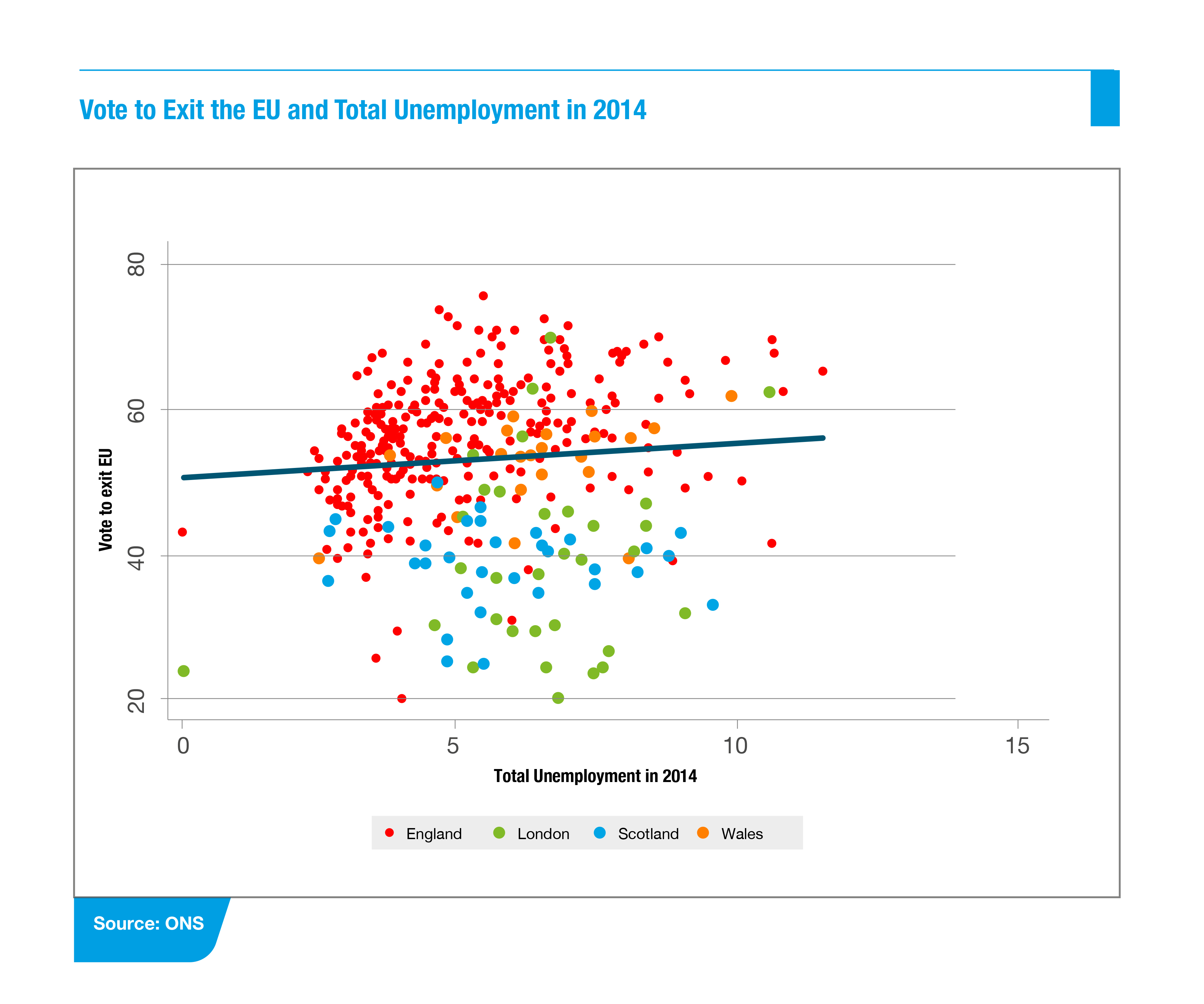
 

Figure 2a
Figure 2b

Unemployment and Political Beliefs


We then study the evolution of trust, political beliefs and attitudes before and after the 2007–10 crisis and examine whether swings in unemployment are related to changing ideology. We use individual-level data on Europeans' beliefs and attitudes from the European Social Survey that covers the period 2000–2014. Figures 3a and 3b show that increases in regional unemployment have resulted in a deterioration of trust towards national and European political institutions.
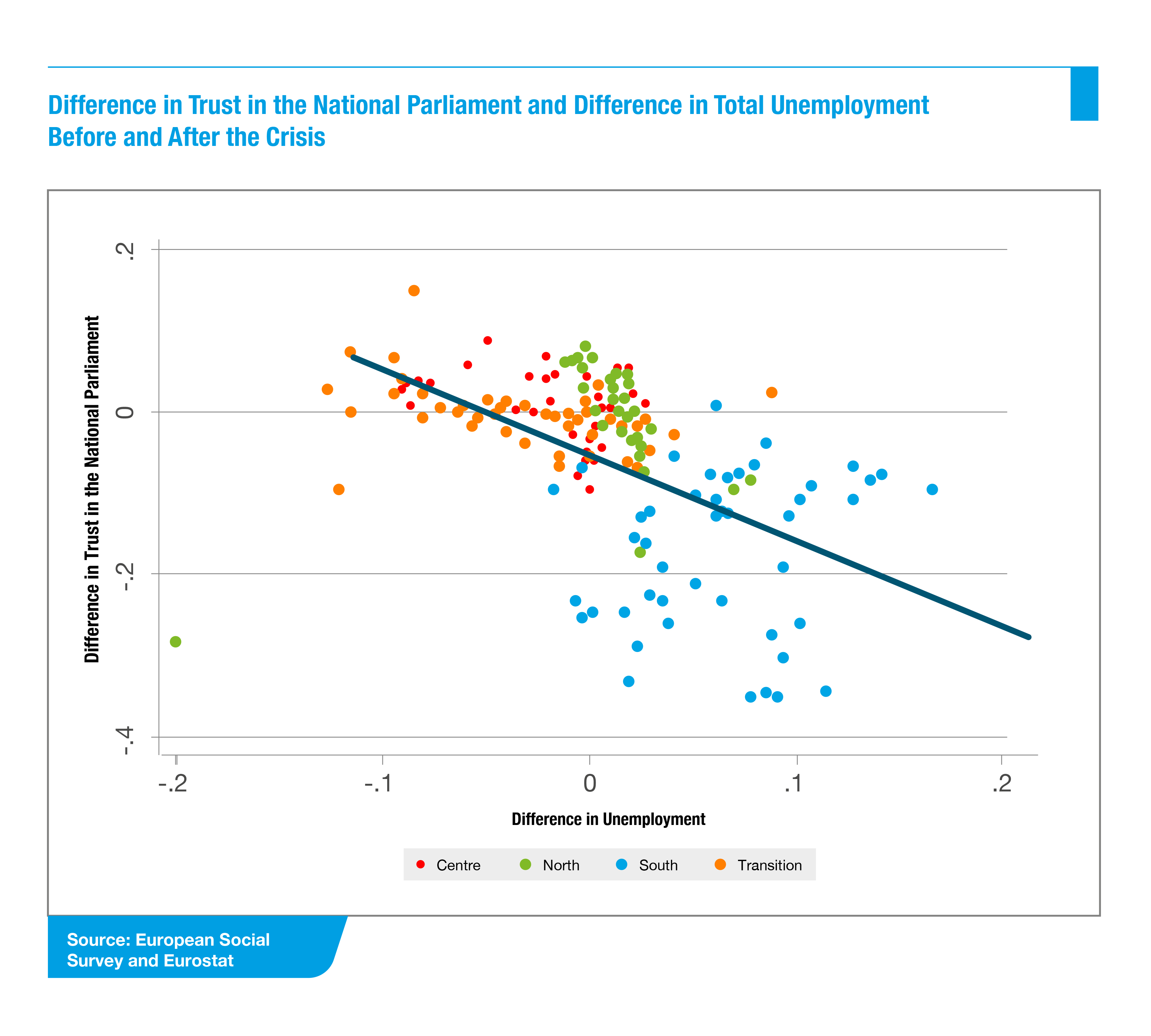
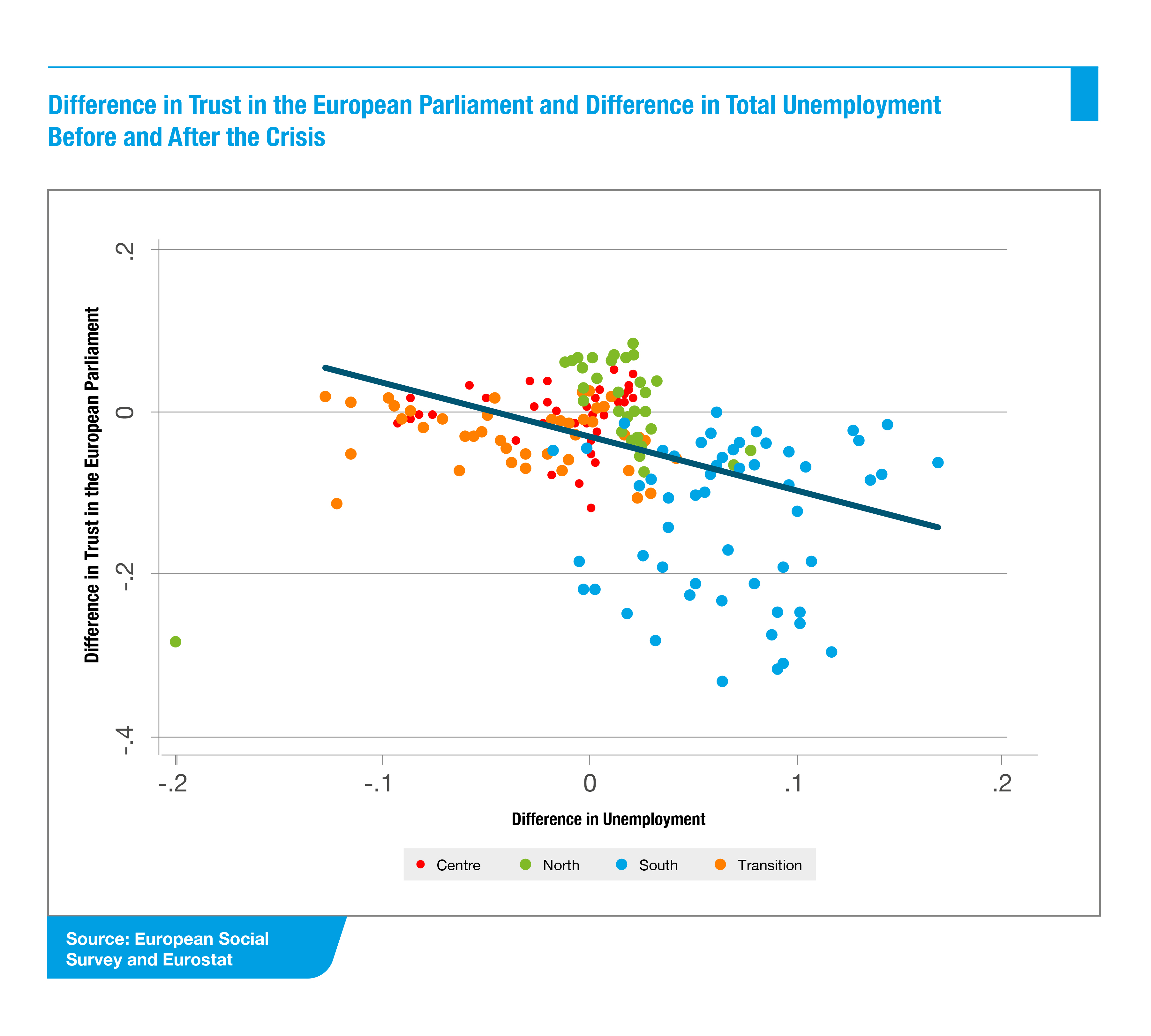
 

Figure 3a
Figure 3b

Unemployment is also related to declining trust in national courts, an alarming result as the rule of law is an essential element of Western democracies. Unemployment is not systematically linked to respondents' self-reported political orientation on the traditional left-right axis. This finding is thus in line with rising populism from both ends of the political spectrum. Although many new parties have emerged in Europe, respondents in crisis-hit areas are more likely to report that no party is close to their views. Finally, we uncover an interesting heterogeneity when examining the impact of unemployment on beliefs about the future of Europe. In the south (Greece, Portugal, Spain, Italy, Cyprus) increases in unemployment are mapped with aspirations for deeper European integration. In contrast, in central and northern European countries (Germany, Netherlands, Austria), respondents in crisis-hit regions argue that the European Union project has gone too far.


These patterns apply to men and women, younger and older cohorts. The relationship between unemployment and distrust in national and European institutions is stronger for non-college graduates, a pattern that echoes the findings of Autor et al. (2016, 2017), Che et al. (2016), and Colantone and Stanig (2016), who relate populist voting and political polarization to depressed wages among unskilled workers fueled by rising competition from low-/middle-income countries.


Unemployment and Beliefs on Immigrants


Given the widespread anti-immigration rhetoric of Donald Trump, Nigel Farage, Viktor Orban, and other populist politicians, we also examined the association between regional unemployment and self-reported beliefs on the role of immigrants in the society and the economy. Individuals in more crisis-hit regions are not more likely to express negative feelings about immigrants and their role in country's cultural and social life. There is some evidence that in regions that experienced the highest increase in unemployment respondents argue that immigrants' economic impact has been on average negative. Yet this associationthough statistically significantis not particularly strong.


However, when we examine heterogeneity we find that for non-college educated respondents the link between unemployment and negative feelings on immigrants' economic impact is sizable, most likely because unskilled workers have been affected the most from the crisis, technical progress, and globalization. Although unemployment is especially high among the youth and although the European social safety net is less strong for younger cohorts, attitudes towards immigrants among them have not moved much, most likely because of rising cosmopolitanism and open mindedness.


Implications


Our results give a rationale for countercyclical macroeconomic policies, preventing rising unemployment and attenuating its impact. Even a temporary increase in unemployment may result in political fallout, which in turn would give rise to anti-market policies undermining long-term growth. Indeed, a cyclical downturn may bring about populist policies which in turn can give rise to sustained negative economic implications.


The impact of rising unemployment on political trust is also important for the success of structural reforms that many European countries are currently implementing. Political trust is key for the reforms that are painful in the short run but deliver socioeconomic benefits later (such as labor market reforms, reforms of public administration, opening up protected occupations, deepening the fiscal and banking union). In order to support such reforms, the public needs to trust that politicians have the public interest at heart. If this is not the case, reforms are not implementedor get reversed by populists. This in turn means that unemployment remains high, further reinforcing the vicious circle of political distrust and lack of reforms.


References


Algan, Yann; Sergei Guriev; Elias Papaioannou, and Evgenia Passari. (2017). "The European Trust Crisis and the Rise of Populism." Brookings Papers on Economic Activity, Fall 2018


Autor, David H., David Dorn, Gordon H. Hanson, and Kaveh Majlesi. (2016). "Importing Political Polarization? The Electoral Consequences of Rising Trade Exposure." Working paper. MIT Department of Economics.


Autor, David H., David Dorn, Gordon H. Hanson, and Kaveh Majlesi. (2017). "A Note on the Effect of Rising Trade Exposure on the 2016 Presidential Elections" Working paper. MIT Department of Economics.


Becker, Sascha O., Thiemo Fetzer and Dennis Novy, (2017). "Who Voted for Brexit? A Comprehensive District-Level Analysis", Economic Policy, 32(1).


Che, Yi, Yi Lu, Justin R. Pierce, Peter K. Schott, and Zhigang Tao. (2016). "Does Trade Liberalization with China Influence US Elections?". No. w22178. National Bureau of Economic Research.


Colantone, Italo and Pierro Stanig (2016), "Global Competition and Brexit", BAFFI CAREFIN Centre Research Paper No. 2016-44. Forthcoming American Political Science Review


Colantone, Italo, and Piero Stanig. (2017). "The Trade Origins of Economic Nationalism: Import Competition and Voting Behavior in Western Europe". Forthcoming American Journal of Political Science.


De Vries, Catherine E.  (2017). "The Cosmopolitian-Parochial Divide: What the 2017 Dutch Election Result Tells Us About Political Change in the Netherlands and Beyond". Journal of European Public Policy, forthcoming.


Dustmann, Christian, Barry Eichengreen, Sebastian Otten, Andre Sapir, Guido Tabellini and Gylfi Zoega (2017), "Europe's Trust Deficit: Causes and Remedies", Monitoring International Integration 1, CEPR Press.


Guiso, Luigi, Helios Herrera, and Massimo Morelli. (2017). "Populism. Demand and Supply of Populism". Working Paper n°1703, Einaudi Institute for Economics and Finance (EIEF).


Disclaimer: The ProMarket blog is dedicated to discussing how competition tends to be subverted by special interests. The posts represent the opinions of their writers, not those of the University of Chicago, the Booth School of Business, or its faculty. For more information, please visit ProMarket Blog Policy.  


--
John Case
Harpers Ferry, WV

The Winners and Losers Radio Show
7-9 AM Weekdays, The Enlighten Radio Player Stream, 
Sign UP HERE to get the Weekly Program Notes.

Wednesday, January 24, 2018

Brazil’s Democracy Pushed Into the Abyss [feedly]

Brazil's Democracy Pushed Into the Abyss
http://cepr.net/publications/op-eds-columns/brazil-s-democracy-pushed-into-the-abyss

Brazil's Democracy Pushed Into the Abyss

Mark Weisbrot
The New York Times, January 23, 2018

New York Times en Español, January 23, 2018

See article on original site

Em Portuguese

En español

The rule of law and the independence of the judiciary are fragile achievements in many countries — and susceptible to sharp reversals.

Brazil, the last country in the Western world to abolish slavery, is a fairly young democracy, having emerged from dictatorship just three decades ago. In the past two years, what could have been a historic advancement ― the Workers' Party government granted autonomy to the judiciary to investigate and prosecute official corruption ― has turned into its opposite. As a result, Brazil's democracy is now weaker than it has been since military rule ended.

This week, that democracy may be further eroded as a three-judge appellate court decides whether the most popular political figure in the country, former President Luiz Inácio Lula da Silva of the Workers' Party, will be barred from competing in the 2018 presidential election, or even jailed.

There is not much pretense that the court will be impartial. The presiding judge of the appellate panel has already praised the trial judge's decision to convict Mr. da Silva for corruption as "technically irreproachable," and the judge's chief of staff posted on her Facebook page a petition calling for Mr. da Silva's imprisonment.

The trial judge, Sérgio Moro, has demonstrated his own partisanship on numerous occasions. He had to apologize to the Supreme Court in 2016 for releasing wiretapped conversations between Mr. da Silva and President Dilma Rousseff, his lawyer, and his wife and children. Judge Moro arranged a spectacle for the press in which the police showed up at Mr. da Silva's home and took him away for questioning — even though Mr. da Silva had said he would report voluntarily for questioning.

The evidence against Mr. da Silva is far below the standards that would be taken seriously in, for example, the United States' judicial system.

He is accused of having accepted a bribe from a big construction company, called OAS, which was prosecuted in Brazil's "Carwash" corruption scheme. That multibillion-dollar scandal involved companies paying large bribes to officials of the state-owned oil company, Petrobras, to obtain contracts at grossly inflated prices.

The bribe alleged to have been received by Mr. da Silva is an apartment owned by OAS. But there is no documentary evidence that either Mr. da Silva or his wife ever received title to, rented or even stayed in the apartment, nor that they tried to accept this gift.

The evidence against Mr. da Silva is based on the testimony of one convicted OAS executive, José Aldemário Pinheiro Filho, who had his prison sentence reduced in exchange for turning state's evidence. According to reporting by the prominent Brazilian newspaper Folha de São Paulo, Mr. Pinheiro was blocked from plea bargaining when he originally told the same story as Mr. da Silva about the apartment. He also spent about six months in pretrial detention. (This evidence is discussed in the 238-page sentencing document.)

But this scanty evidence was enough for Judge Moro. In something that Americans might consider to be a kangaroo court proceeding, he sentenced Mr. da Silva to nine and a half years in prison.

The rule of law in Brazil had already been dealt a devastating blow in 2016 when Mr. da Silva's successor, Ms. Rousseff, who was elected in 2010 and re-elected in 2014, was impeached and removed from office. Most of the world (and possibly most of Brazil) may believe that she was impeached for corruption. In fact, she was accused of an accounting maneuver that temporarily made the federal budget deficit look smaller than it otherwise would appear. It was something that other presidents and governors had done without consequences. And the government's own federal prosecutor concluded that it was not a crime.

While there were officials involved in corruption from parties across the political spectrum, including the Workers' Party, there were no charges of corruption against Ms. Rousseff in the impeachment proceedings.

Mr. da Silva remains the front-runner in the October election because of his and the party's success in reversing a long economic decline. From 1980 to 2003, the Brazilian economy barely grew at all, about 0.2 percent annually per capita. Mr. da Silva took office in 2003, and Ms. Rousseff in 2011. By 2014, poverty had been reduced by 55 percent and extreme poverty by 65 percent. The real minimum wage increased by 76 percent, real wages overall had risen 35 percent, unemployment hit record lows, and Brazil's infamous inequality had finally fallen.

But in 2014, a deep recession began, and the Brazilian right was able to take advantage of the downturn to stage what many Brazilians consider a parliamentary coup.

If Mr. da Silva is barred from the presidential election, the result could have very little legitimacy, as in the Honduran election in November that was widely seen as stolen. A poll last year found that 42.7 percent of Brazilians believed that Mr. da Silva was being persecuted by the news media and the judiciary. A noncredible election could be politically destabilizing.

Perhaps most important, Brazil will have reconstituted itself as a much more limited form of electoral democracy, in which a politicized judiciary can exclude a popular political leader from running for office. That would be a calamity for Brazilians, the region and the world.


Mark Weisbrot is Co-Director of the Center for Economic and Policy Research in Washington, D.C., and the president of Just Foreign Policy. He is also the author of "Failed: What the 'Experts' Got Wrong About the Global Economy" (2015, Oxford University Press). You can subscribe to his columns here.


 -- via my feedly newsfeed

Jared Bernstein What should states do about the new tax law? [feedly]

What should states do about the new tax law?
http://jaredbernsteinblog.com/what-should-states-do-about-the-new-tax-law/

While everybody's been trying to figure out what the Republican tax plan means for families, paychecks, and the federal budget, there's another important group of stakeholders that hasn't gotten enough attention: states. Yes, the capping of the state and local tax deduction (SALT)—one of the bill's more substantial payfors (it's expected to raise over $600 billion over the next decade)—got elevated during the debate. But now that the new code is in place, what does it mean for state finances, what are states planning to do about it, and what should they do?

The fact that every state interacts differently with the federal tax code means that there's no simple answer to this question, but here's why trying to figure this out is so critical. Those of us concerned about maintaining what we've achieved in terms of progressive social policies are focused on at least two things. First, not losing what we've got, and second, making further progress at the sub-national level.

The first goal requires fighting it out around the federal budget and in battles over national policies, like health care and taxes. But regarding the second goal, there's a trap embedded in their tax plan into which we must not fall: shifting the funding of progressive policies to the states, while making it harder for the states to support them.

Whether it's Medicaid, SNAP (food stamps), education, job training, infrastructure, or any other anti-poverty program or public good, the R's strategy is to shrink the federal role by making states responsible for the programs. They sell this under the rubric of "block grants," with the sales job that states can do a better job administering programs. In fact, states already administer such programs on the ground. The block grant is just a code word for a frozen budget. If you don't believe me, see the TANF block grant, which has been frozen in nominal terms since the mid-1990s.

OK, so I'm onto their plot. What does any of this have to do with the tax plan?

The answer comes from a new paper by two of my CBPP colleagues—Michael Leachman and Michael Mazerov (or, factoring: Michael(Leachman, Mazerov)). Because some states link to the federal code in a way that will raise state revenues, some state policy makers want to cut taxes because they think their state will get a revenue windfall.

Depending on the existing linkages (state to federal), some revenue raisers in the fed code will also raise state revenues. For example, some states have personal exemptions that mimic the federal ones, so the fact that the new fed code gets rid of these exemptions means more revenues to these states. That is, however, as LM point out, a highly regressive revenue raiser.

Other linkages have similar effects, including the reduction in the mortgage interest deduction and the SALT cap, which raises state revenues because state taxpayers that get fewer itemized deductions will have higher taxable incomes.

But just like the overall tax plan loses much more than it collects—i.e., it is deficit financed—LM point out that "roughly 29 states will lose revenue, see no impact, or see modest revenue gains totaling less than 1 percent of general fund revenue…And in many of those states that could see larger revenue boosts, the added revenue would come disproportionately from lower-income families (due to the elimination of the states' personal exemptions), which would partially reverse states' substantial progress in recent decades in eliminating income taxes for families in poverty."

In fact, as the figure reveals, the federal tax cuts for the richest 1 percent of households alone, whose average income is over $2 million, will amount to about $80 billion this year. "Even under generous assumptions, states will net [about] $7.5 billion to $10 billion in new personal income tax revenue this year…roughly one-tenth of the total windfall for the top 1 percent." [These estimates are by the invaluable tax analysts at ITEP.]

Further tax cuts at the state level would thus be a serious mistake, one that would both compound the dis-equalizing impacts of the federal change, while making it harder for states to support economically vulnerable populations. Instead, states should:

–Decouple from the federal code on personal exemptions, as any revenue gained through that route is too regressive. Similarly, states should consider decoupling on standard deductions (the new fed code doubles them, so this is a revenue loser for states that link to it), the estate tax, and expensing provisions.

–Build up their reserves to a) offset the R's attempts to shift anti-poverty funding responsibilities to the states, and b) be ready for the next downturn (LM point out that state budgets, while largely recovered, still have balances below where they need to be in this regard).

–Do not enact further tax cuts.

–Consider tax changes that would hold state taxpayers harmless from the SALT cap. A number of these ideas have surfaced in recent weeks, though they're complex and may invoke "technical and legal challenges."

–Improve their revenue outlooks by clawing back some of the windfalls the tax plan bestows on the wealthiest households.

Given the pace at which this benighted tax plan was jammed through, there's considerable uncertainty regarding its impacts. In my own writings, I've stressed the incentives for US multinationals to increase their offshore production, leading to revenue losses for both the state and federal coffers. Bevies of tax lawyers are finding new loopholes every day, underscoring my strongly held view that the revenue losses will go well beyond initial estimates.

All of which pushes toward states not doubling down on further tax cuts, nor allowing these changes to undermine their abilities to make up for the loss of federal support for progressive programs. The conservative playbook is to shift funding sources to the states, while cutting states' abilities to raise such funds off at the knees. It's an evil plan, and it must be resisted.


 -- via my feedly newsfeed

Tuesday, January 23, 2018

Sam Webb: the shutdown and the fallout

The shutdown and the fallout

1. "Cave In" would fit if Democrats had power to leverage to begin with. But that wasn't the case. The other party controls government in toto at least until November. On the positive side, CHIP is now funded, the Democrats and the rest of us can fight another day, and a rift among Senate Republicans might give Democrats some room to maneuve

2. Not persuaded at all that an extended shutdown of the government would play out in the favor of the Dreamers, the Democrats, or the larger movement. In fact, a prolonged closure could easily dissipate public support for the Dreamers and our side generally. In effect, we could end up losing ground in the immediate battle as well as the larger war in November. Sometimes tactical retreats are necessary, and I believe that is the case here.

3. Leveraging a government shutdown to secure political demands, no matter how just and righteous they are, is difficult in any conditions, but that is especially so when optics — if not reality — suggest that Democrats initiated the closure and when the other side not only holds a tight grip on the main branches of government, but is determined to give the Democrats and democratic movement no legislative achievements to tout in the fall elections unless the weight of public opinion gives them no other alternative. And it may well be the case with regard to the Dreamers now that the legislative fight is disconnected from a shutdown government.

4. From the shutdown debate, it is clear that the strategy of Trump and the right wing extremists is to cast, with a cascade of lies, demagogy, and disinformation, the Democrats as the "party of porous borders and Illegal immigration." In their cynical calculus, they believe that such fear mongering will play well in those states and congressional districts that they figure they must retain this fall when voters go to the polls.

Their tactic that rests on the murky, but time tested ground of racism and nativism should be resisted by Democrats and the rest of the resistance movement. But not by giving up even an inch in their defense of immigrants in general and Dreamers in particular; in fact, they should embrace with new vigor these civil rights issues of the 21st century.

At the same time, they shouldn't allow themselves to boxed in by the Trump/Republican sound bite-tweet machine, as the elections draw close. Indeed, they should speak — and I'm sure they will — to the whole range of issues that are weighing heavily on the entire electorate, while articulating an overarching narrative or story of a country that is generous of spirit, welcoming, inclusive, and rises when all rise, beginning with people who dally encounter discrimination, oppression, and violence.

5. And not least, nearly 100 years ago, someone named Lenin wrote:"In Russia, however, lengthy, painful and sanguinary experience has taught us the truth that revolutionary tactics cannot be built on a revolutionary mood alone. Tactics must be based on a sober and strictly objective appraisal of all the class forces in a particular state (and of the states that surround it, and of all states the world over) as well as of the experience of revolutionary movements. It is very easy to show one's "revolutionary" temper merely by hurling abuse at parliamentary opportunism, or merely by repudiating participation in parliaments; its very ease, however, cannot turn this into a solution of a difficult, a very difficult, problem."

Not sure we have fully metabolized his advice.


--
John Case
Harpers Ferry, WV

The Winners and Losers Radio Show
7-9 AM Weekdays, The Enlighten Radio Player Stream, 
Sign UP HERE to get the Weekly Program Notes.

West Virginia GDP -- a Streamlit Version

  A survey of West Virginia GDP by industrial sectors for 2022, with commentary This is content on the main page.