Monday, February 17, 2020

Piketty: Social-federalism vs national-liberalism [feedly]

The rotten  fruits of austerity 'liberalism'

Social-federalism vs national-liberalism

Thomas Piketty

https://www.lemonde.fr/blog/piketty/2020/02/11/social-federalism-vs-national-liberalism/
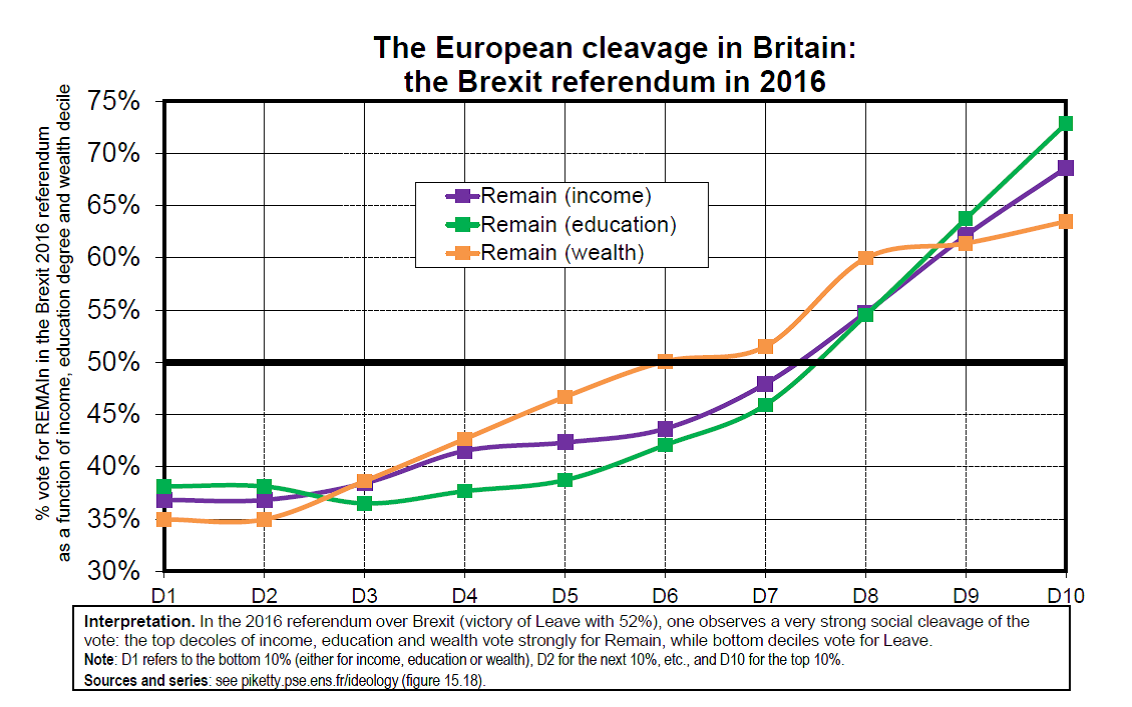
The United Kingdom officially left the European Union a few days ago. So now, make no mistake; along with the election of Trump in the United States in 2016 this is a major upheaval in the history of globalisation. The two countries which had the choice of ultra-liberalism with Reagan and Thatcher in the 1980s and which, since then, have witnessed the highest rise in inequalities, have decided three decades later to opt for nationalism and a form of return to frontiers and national identity.

This change in direction can be viewed from different angles. In its way, it expresses the failure of Reaganism and Thatcherism. The British and American middle and working classes have not experienced the affluence promised by absolute liberalism, laissez-faire policies and economic deregulation. Over time they have felt themselves increasingly under pressure from international competition and the world economic system. Culprits had to be found. For Trump it was the workers from Mexico, China, and all those cunning people in the rest of the world who are reputed to have stolen the hard work of white America. For the Brexiters it was the Polish workers, the European Union and all those who attack the grandeur of Great Britain. In the long run, withdrawing into nationalism and identity-based politics will in no way resolve any of the major challenges of our times which are associated with inequality and global warming. This is all the more true as the Trumpists and the Brexiters have added a new layer of fiscal and social dumping in favour of the wealthiest and the most mobile which will only increase the inequalities and frustrations. But in the immediate future, the nationalist-liberal discourse often appears to those voters who do still vote as being the only new and credible answer to their sense of unease, for lack of any convincing alternative discourse.

De facto, this risk of ideological drift extends far beyond the English-speaking world. The temptation of nationalism and xenophobia exists in many places, in Italy and in Eastern Europe, in Brazil or in India. In Germany, in Thuringe the "right-wing centre" party has just elected a regional government with support from the extreme right for the first time since World War Two. In France, the Arabophobic hysteria has grown to epic proportions. An increasing share of the press seems to imagine that the "left" is responsible for the rise in Islamism at world level as a result of its permissiveness, its support for the Third World and its electoral politics. In reality, if voters of North African or sub-Saharan origin vote for the left-wing parties, it is primarily due to the violent hostility expressed toward them by right wing and extreme-right parties; the same applies to black voters in the United States or Muslims in India.
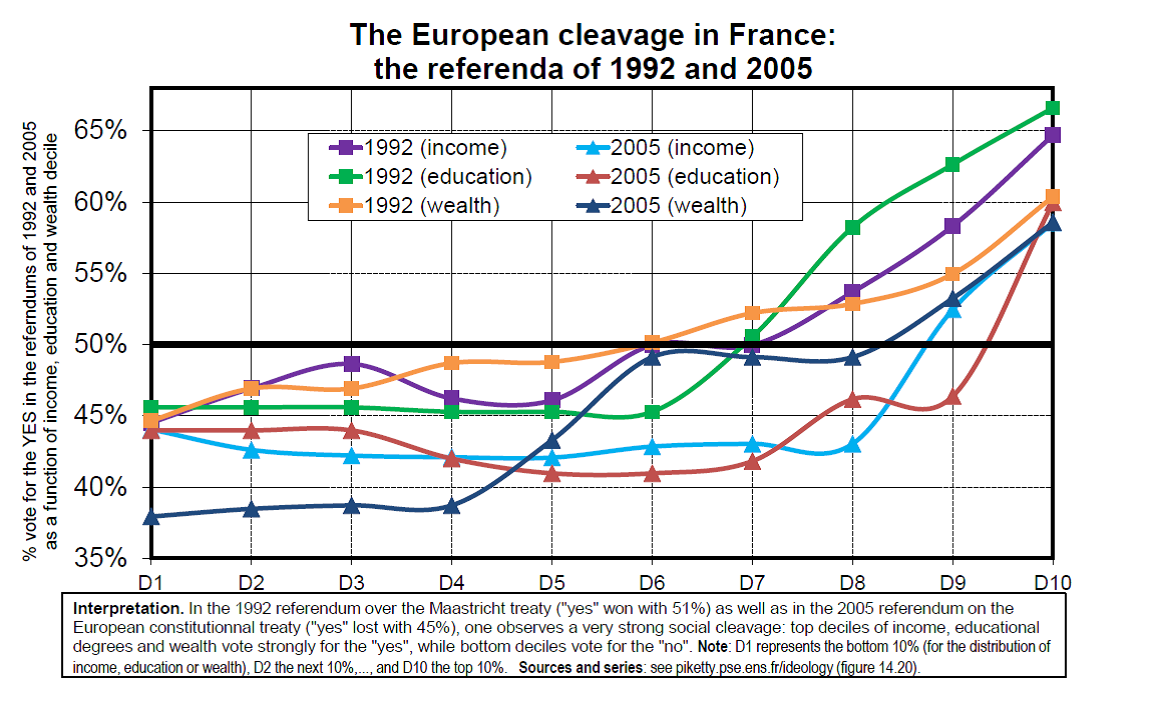
Over and above national specificities, Brexit must be analysed in the first instance for what it is: the consequence of a collective failure in the way in which economic globalisation has been organised since the 1980s, particularly within the European Union. All the European leaders in turn, in particular the French and the Germans bear their share of responsibility. The free circulation of capital, goods and services with no collective regulation or joint fiscal or social policy functions primarily to the benefit of the richest and the most mobile, and undermines the most disadvantaged and the most vulnerable. It is not possible to define a political project and a model for development by relying simply on free trade, everyone competing with everyone else and market discipline.

True, the European Union has added two elements to this general scheme of organisation of the world economy: free circulation of persons and a small joint budget (1% of European GDP) maintained by contributions from States and financed by small transfers from the richest countries (approximately 0.5% of their GDP) to the poorest ones. Along with the shared currency (which we also find in West Africa) this is what distinguishes the E U from other free trade areas in the world, like for example North America (Mexico, the United States and Canada), where there is neither free circulation of persons nor a joint budget or joint regional structural funds.

The problem is that these two elements are not enough to bond these countries together. The Brexiters gamble is simple: the present rate of globalisation enables access to free trade in goods, services and capital, while at the same time, maintaining control over the flow of people and does not involve contributing to a joint budget.

This trap which spells death to the European Union can only be avoided by radically redefining the rules of globalisation with a "social-federalist" type of approach. In other words, free trade must be conditional on the adoption of binding social aims enabling the wealthiest and most mobile economic actors to be obliged to contribute to a model for sustainable and equitable development. To sum up: the nationalists attack the free circulation of people; social federalism must deal with the circulation of capital and the fiscal impunity of the wealthiest. Karl Polanyi and Hannah Arendt in 1944 and 1951 denounced the naiveté of the social democrats in the face of capital flows and their federal timidity – a lesson that still applies today. To go in this direction, a revision of the European and international treaties is required, beginning with a few countries. In the meantime, we can and must all take new unilateral and incentive measures, for example by taxing imports from countries and firms which practice fiscal dumping. If we do not oppose national-liberalism with a resolute alternative, it will sweep everything aside in its path.


 -- via my Feedly newsfeed

Saturday, February 15, 2020

to reach the Host of this site

send email to host@enlightenradio.org

Economic Update - Socialism and Left Unity in the US [feedly]

Economic Update - Socialism and Left Unity in the US
https://economicupdate.podbean.com

Updates on Trump's 2019 $ 1 trillion plus deficit, burden of poor countries' debt, Amsterdam forgives young peoples' debts, "strong man" governments' fund-raising strategy, and gross failures of Trump/GOP's 2017 tax cut. Interview Karen Ranucci (Center for Critical Thought) and Rob Robinson (Left Forum) on their programs and their collaboration to serve the rising US interests in socialism and building a movement for transition.  

 -- via my feedly newsfeed

Is this your jcase4218.lightanddark@blogger.com still active ??

I have tried to reach you on this jcase4218.lightanddark@blogger.com mail account severally but I have gotten no response from you, Please get back to me at your earliest convenience if you have received my email this time.

Sincerely,
Nelson C.

Telephone Switchboard Operators: Rise and Fall [feedly]

Tim Taylor dives into details of a technological transition affecting thousands of workers and the structure of a regulated monopoly


Telephone Switchboard Operators: Rise and Fall

http://conversableeconomist.blogspot.com/2020/02/telephone-switchboard-operators-rise.html

n  1950, there were 342,000 telephone switchboard operators working for the Bell Telephone System and some independent operators, as well as another 1 million or so telephone switchboard operators who worked at private locations like office buildings, factories, hotels, and apartment buildings. Almost all of these switchboard operators were female. To put it another way, about one out of every 13 working women in 1950 were telephone operators.  But by 1984, national employment as an operator in the telecommunications industry was down to 40,000, and now it's less than 2,000 (according to the Bureau of Labor Statistics). 

 David A. Price sketches the  history of this rise and fall in "Goodbye, Operator," appearing in Econ Focus (Federal Reserve Bank of Richmond, Fourth Quarter 2019, pp. 18-20). The story provokes some thoughts about the interaction of workers with new and evolving technologies. 

For more than a half-century from the late 19th century up to 1950, technology was creating jobs as telephone operators. From the phone company point of view, customers needed personal assistance and support if they were to incorporate this new technology into their lives. The workers with what we would now call the "soft skills" to provide this interface between technology and customers were reasonably well-rewarded. Price writes:
In the early decades of the industry, telephone companies regarded their business less as a utility and more as a personal service. The telephone operator was central to this idea, acting as an early version of an intelligent assistant with voice recognition capabilities. She got to know her 50 to 100 assigned customers by name and knew their needs. If a party didn't answer, she would try to find him or her around town. If that didn't succeed, she took a message and called the party again later to pass the message along. She made wake-up calls and gave the time, weather, and sports scores. During crimes in progress or medical emergencies, a subscriber needed only to pick up the handset and the operator would summon the police or doctors. ...

While operators were not highly paid, the need to attract and retain capable women from the middle classes led telephone companies to be benevolent employers by the standards of the day — and in some respects, of any day. Around the turn of the century, the companies catered to their operators with libraries, athletic clubs, free lunches, and disability plans. Operators took their breaks in tastefully appointed, parlor-like break rooms, some with armchairs, couches, magazines, and newspapers. At some exchanges, the companies provided the operators with a community garden in which they could grow flowers or vegetables. In large cities, company-owned dormitories were offered to night-shift operators.
But even as the number of telephone operator jobs was growing rapidly, the job of being a telephone operator evolved dramatically. By 1950, the hyper-personal touch seems to have greatly diminished, and the telephone operator skills involved being able to handle "the board," which involved plugging and unplugging several hundred connections per hour.

Looking back, the slow diffusion of automatic telephone switching technology seems a little puzzling. One reason is that digital technology differs in some fundamental ways from the earlier methods of automation. It's a standard story that the switchboard operators were replaced by automation. But why weren't they replaced by automation much earlier? Part of the answer seems to be that the automated telephone-switching systems in the first half of the 20th century did not actually display economies of scale. Price writes: 
With the electromechanical systems of the day, each additional customer was more, not less, expensive. Economies of scale weren't in the picture. To oversimplify somewhat, a network with eight customers needed eight times eight, or 64, interconnections; a network with nine needed 81. "You were actually getting increasing unit costs as the scope of the network increased," says Mueller. "You didn't get entirely out of the telephone scaling problem until digital switching in the 1960s."
This pattern of technology led to a situation where small-scale independent phone companies were more likely to use automated switching in the early part of the 20th century, while the giant Bell company continued to rely heavily on combinations of automatic switching with oversight from human switchboard operators--especially for long-distance calls.
More broadly, diffusion of technology is important in many contexts. Some well-known historical examples of important technologies that diffused slowly, over decades, include tractors and electricity. In the modern economy, a prominent pattern across many industries is that a few leading "superstar" firms are jumping farther ahead in terms of productivity, and their example of how to achieve such productivity gains is apparently not diffusing as quickly to other firms. There's an old economic lesson here, which is that for purposes of economic growth, just inventing a new technology is not enough: instead, many participants in the economy need to find ways to change their behavior in both simple and more fundamental ways to take full advantage of that technology. 

Back in 1964, even knowledgeable industry observers thought that the decline in telephone operators from about 1950 to 1960 was a one-time and temporary shift. Elizabeth Faulkner Baker wrote in  her 1964 book, Technology and Women's Work:
In sum, it is possible that the decline in the relative importance of telephone operators may be nearing an end. It seems that in the foreseeable future no machines will be devised that can completely handle person-to-person calls, credit-card calls, emergency calls, information calls, transient calls, messenger calls, marine and mobile calls, civilian defense calls, conference calls, and coin-box long-distance calls. Indeed, although an executive vice-president of the American Telephone and Telegraph Company has said that the number of dial telephones will reach almost 100 percent in the next few years and that there will be an increasing amount of customer dialing of long-distance calls: "Yet we will still need about the same number of operators we need now, perhaps more."
Again the underlying notion was that the job of being a telephone operator would evolve, but not the need for people who could play a role of facilitating use of telecommunications technology easier for customers. When it comes to the specific job of telephone operator, this prediction was clearly off-base. (Although as a college student in the late 1970s and early 1980s, I remember the days when if you really needed to call home, you could just grab a public phone, dial zero for "operator," and be answered by a person, from whom you would recite your home phone number and request a collect call.) But when thinking more broadly about the interaction between workers and technology, the central question remains as to what areas now and in the future will continue to benefit from human support at the interface between new technologies and ultimate users. 

 -- via my feedly newsfeed

Top five Valentine’s Day gifts ideas for U.S. workers: Nothing spells ‘romance’ like a fair wage and quality jobs [feedly]

Top five Valentine's Day gifts ideas for U.S. workers: Nothing spells 'romance' like a fair wage and quality jobs
https://www.epi.org/blog/top-five-valentines-day-gifts-ideas-for-u-s-workers-nothing-spells-romance-like-a-fair-wage-and-quality-jobs/

That's why we decided to sum up what we think are the top five Valentine's Day gifts ideas for working people across the country.

Power through collective action!

Our economy is out of balance. Corporations and CEOs hold too much power and wealth, and working people know it. Workers are mobilizing, organizing, protesting, and striking at a level not seen in decades, and they are winning pay raises and other real change by using their collective voices.

But, the fact is, it is still too difficult for working people to form a union at their workplace when they want to. The law gives employers too much power and puts too many roadblocks in the way of workers trying to organize a union. The Protecting the Right to Organize (PRO) Act will go a long way toward restoring workers' right to join together to bargain for better wages and working conditions by streamlining the process when workers form a union, ensuring that they are successful in negotiating a first agreement, and holding employers accountable when they violate labor law. The U.S. Senate should join the House of Representatives and pass the PRO Act in order to restore power to working people.

Affording bread…and roses

The real (inflation-adjusted) minimum wage is now roughly 30 percent lower than it was in 1968, and it has been more than 10 years since congress raised the minimum wage—the longest stretch in history. To end this shameful streak, it is incumbent upon the Senate to take up and pass the Raise the Wage Act immediately. Raising the federal minimum wage to $15 by 2025 would lift wages for 33.5 million workers across the country—more than one-fifth of the wage-earning workforce. The increase would boost total annual wages for these low-wage workers by $92.5 billion, lifting annual earnings for the average affected year-round worker by $2,800. Recent survey data have shown that 74% of U.S. workers live paycheck to paycheck. Policymakers should give working people the ability to make ends meet—but also the ability to treat themselves occasionally.

Figure A

Pay workers for their hours worked, or give them their time back

The U.S. Department of Labor announced in September its final overtime rule, which will set the salary threshold under which salaried workers are automatically entitled to overtime pay to $35,568 a year. The rule leaves behind millions of workers who would have received overtime protections under the much stronger rule, published in 2016, that Trump administration chose to abandon. A stronger overtime protection would pay more workers for working more than 40 hours a week, or allow them extra time with their families.

Seven states have already taken steps to raise the overtime threshold, but without further action, it's estimated that 8.2 million workers who would have benefited from the 2016 rule will be left behind by the Trump administration's rule, including 3.2 million workers who would have gotten new overtime protections under the 2016 rule and 5.0 million who would have gotten strengthened overtime protections under the 2016 rule. States should follow suit and extend the overtime protections so workers don't continue to lose out on their hard-earned wages.

Let your workers move on

At least 36 million workers—27.8% of the private-sector workforce—are required to enter noncompete agreements. Noncompete agreements are employment provisions that ban workers at one company from going to work for, or starting, a competing business within a certain period of time after leaving a job. Establishments with high pay or high levels of education among workers are more likely to use noncompetes, but noncompetes agreements are also common in workplaces with low pay and low levels of education. More than a quarter (29.0%) of private-sector workers with an average hourly wage below $13.00 require noncompetes for all their workers. Noncompetes are part of a disturbing trend of employers requiring workers to sign away their rights. Noncompetes may be contributing to weak wage growth, given that changing jobs is how workers often get a raise. And given that noncompetes limit the ability of individuals to start businesses or take other jobs, it also is not difficult to see that noncompetes may be contributing to the declines in dynamism in the U.S. labor market. Congress should pass the bipartisan legislationthe Workforce Mobility Act of 2019to prohibit noncompete agreements.

Labor protections for Uber drivers shuttling around Valentine's couples

The General Counsel of the National Labor Relations Board recently released a memo claiming that Uber drivers are independent contractors, not employees of Uber. The reality is that these drivers have very little entrepreneurial freedom: Drivers can't raise revenues because they can't control prices or expand their customer base through marketing. Unlike a typical enterprise, Uber drivers do not build earnings as they get more experience. Uber drivers are not able to choose their customers—drivers are penalized for rejecting or not accepting trips. And after accounting for Uber's commissions and fees and vehicle expenses, and taking into account the cost of a modest package of health insurance and other benefits equivalent to those earned by W-2 workers, Uber drivers earn the equivalent of $9.21 in hourly wages—less than what is earned by 90% of all other wage and salary earners, and below the minimum wage in 13 of the 20 major urban markets where Uber operates.

Recently, AB5 went into effect in California, a set of protections aimed at combatting the misclassification of workers as independent contractors, helping ensure that California's employees have access to basic labor and employment protections denied to independent contractors including: minimum wage and overtime protections, paid sick days and family leave, workers' compensation benefits, and unemployment insurance benefits. Policymakers across the country should take notice and provide similar protections to workers in their states.


 -- via my feedly newsfeed

Friday, February 14, 2020

Medicare in the 2021 Trump Budget [feedly]

Medicare in the 2021 Trump Budget
https://www.cbpp.org/blog/medicare-in-the-2021-trump-budget

President Trump's 2021 budget proposes about $500 billion in net Medicare spending reductions over ten years (see table), most of which would come from reducing payments to health care providers and not affect beneficiaries directly.

For the most part, the budget does not reflect the President's efforts to end the Affordable Care Act (ACA) or his executive order calling for various Medicare changes. These policies, which a budget would typically include, would weaken Medicare in several ways.

The budget would establish a new payment system for post-acute care, reduce Medicare coverage of bad debts (deductible and coinsurance amounts that are uncollectible from Medicare beneficiaries and that Medicare now pays to reimburse hospitals and other institutional providers), limit medical malpractice awards, extend through 2030 the 2 percent Medicare sequestration cut under the 2011 Budget Control Act, and pay for all doctor and other outpatient services at the same rate regardless of where they're provided. Most of these proposals also appeared in last year's budget.

In two cases — payments to hospitals for graduate medical education (GME) and for uncompensated care — the budget proposes to move spending from Medicare's trust funds to new, smaller grant programs funded by general revenues. While the budget would cut Medicare spending by $756 billion over ten years, the cuts amount to $501 billion after accounting for the general revenue payments for GME and uncompensated care.

In addition to its specific Medicare proposals, the budget assumes $135 billion in savings over ten years from unspecified comprehensive drug pricing reform. Most savings from such legislation would likely accrue to Medicare.

Several of the major budget proposals, such as site-neutral payments to equalize Medicare's payments to different kinds of facilities (as explained in the table below), are similar to recommendations from the Medicare Payment Advisory Commission to address overpayments to certain providers. These proposals would strengthen Medicare's finances. Medicare's trustees project that its Hospital Insurance (HI) trust fund will be depleted in 2026 under current law, though incoming payroll taxes and other revenue could still pay 89 percent of HI costs that year. Under the President's budget proposals, HI would remain solvent for at least 25 years, according to the Department of Health and Human Services.

Unfortunately, other Administration proposals would weaken Medicare's finances and harm beneficiaries.

President Trump's October executive order on Medicare could weaken the program in several ways. Although many of its proposed changes are vague, and most would require changes in law or regulation, the order would promote private Medicare Advantage plans over traditional Medicare and could raise costs for some or all beneficiaries by increasing payment rates to providers, moving toward transforming Medicare into a program that provides premium support for beneficiaries, removing limits on private contracts between patients and providers, and making it easier for seniors to opt out of Medicare. The budget includes the latter two proposals, but with no costs or savings attached.

Most significant, the Administration has joined 18 Republican attorneys general in asking the courts to strike down the entire ACA. The President has also pledged to pursue ACA repeal legislation in 2021 if Republicans control Congress. If these efforts succeed, Medicare beneficiaries, providers, and plans could face serious harm.

Striking down the ACA would reopen the Medicare drug "donut hole" (under which beneficiaries paid all of their drug costs until they reached the yearly catastrophic spending threshold), reintroduce cost sharing for preventive services, and create confusion and uncertainty around payments to plans and providers. It would also greatly weaken Medicare financing by repealing the ACA's Medicare payroll tax increase on high earners and undoing significant payment reforms.

Medicare Proposals in the 2021 Budget
Savings, 2021-2030 (In billions of dollars)
ProposalBillions
Pay hospital outpatient departments and hospital-owned physician offices at physician office rates (move toward site neutrality)-164
Reduce post-acute care payments-101
Promote site neutrality in payments for long-term care hospitals-9
Reduce Medicare coverage of bad debts-34
Modify payments to hospitals for uncompensated care-88
Reform graduate medical education payments-47
Expand durable medical equipment competitive bidding-8
Expand prior authorization in traditional Medicare-14
Reform medical liability-27
Extend mandatory sequestration-12
Interactions between proposals and other3
Net Medicare savings-501
Less: General revenue payments for uncompensated care and graduate medical education255
Gross Medicare savings-756

Note: The general revenue payments for graduate medical education are allocated between Medicare and Medicaid in proportion to the gross savings in each program. The budget also assumes $135 billion in savings from unspecified drug pricing reform. Most of these savings would likely accrue to Medicare.

Source: Office of Management and Budget


 -- via my feedly newsfeed

West Virginia GDP -- a Streamlit Version

  A survey of West Virginia GDP by industrial sectors for 2022, with commentary This is content on the main page.